

Relief required
Urine, feces on downtown sidewalks spark calls for more public toilets

Advertisement
Read this article for free:
or
Already have an account? Log in here »
To continue reading, please subscribe:

Digital Subscription
One year of digital access for only $205*
- Enjoy unlimited reading on winnipegfreepress.com
- Read the E-Edition, our digital replica newspaper
- Access News Break, our award-winning app
- Play interactive puzzles
*First annual payment billed as $205.00 + GST for one year. This annual subscription will automatically renew at $233.00 + GST every 52 weeks (10% off the regular annual price of $259.35). Offer available to new and qualified returning subscribers only. Cancel any time.
To continue reading, please subscribe:
Add Free Press access to your Brandon Sun subscription for only an additional
$1 for the first 4 weeks*
- Enjoy unlimited reading on winnipegfreepress.com
- Read the E-Edition, our digital replica newspaper
- Access News Break, our award-winning app
- Play interactive puzzles
*Your next Brandon Sun subscription payment will increase by $1.00 and you will be charged $17.95 plus GST for four weeks. After four weeks, your payment will increase to $24.95 plus GST every four weeks.
Read unlimited articles for free today:
or
Already have an account? Log in here »
Hey there, time traveller!
This article was published 27/09/2023 (1078 days ago), so information in it may no longer be current.
It’s not unusual for pedestrians to get a whiff of urine or be forced to step over human excrement on the sidewalk near the intersection of Graham Avenue and Fort Street.
Lee Fehler, who works in that part of downtown, has walked past feces three times in a one-block radius in the last month.
“If people are doing this in doorways or in downtown, there is a need for accessible washrooms,” he said Wednesday. “I’m curious if there’s a plan to deal with this, or are we trying to literally sweep this away?”
Fehler said pedestrians accidentally walked through feces on a sidewalk near the corner of Portage Avenue and Fort Tuesday before it was cleaned up by Downtown Winnipeg BIZ staff.
RUTH BONNEVILLE / WINNIPEG FREE PRESS Lee Fehler has walked past feces three times in a one-block radius in the last month.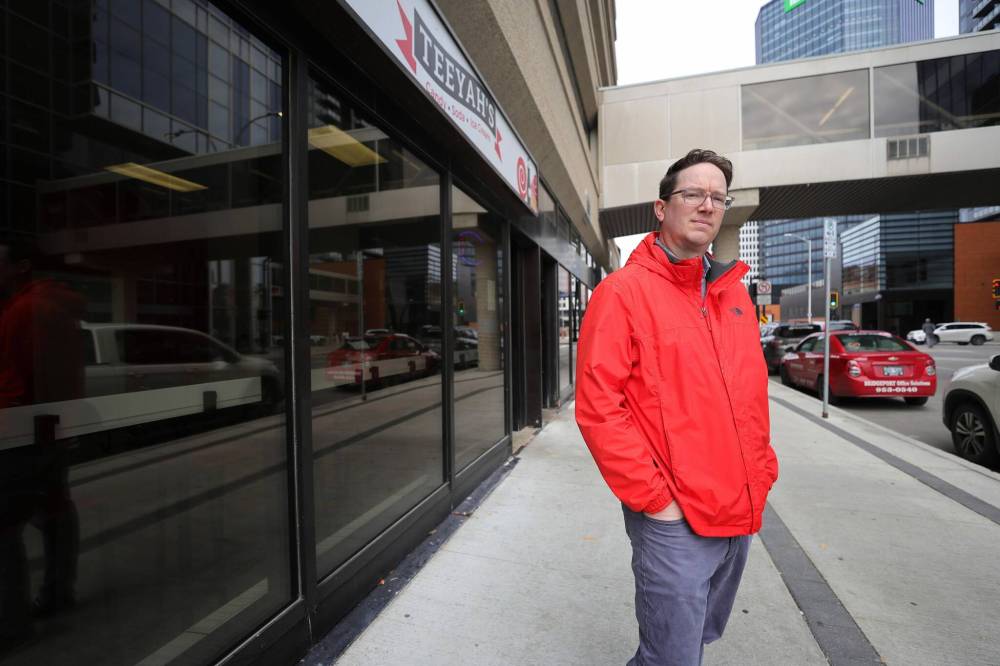
“It’s an unsightly mess, and there are some health risks around it, too,” he said.
At Teeyah’s, a candy, ice cream and soda shop at Graham and Fort, staff regularly find human waste in the doorway when they arrive for work.
Wearing gloves, manager Alexander Berens washed down and disinfected the entrance Wednesday morning, after someone urinated overnight.
“It would be really cool to have an accessible washroom because it would probably clean up a lot of the mess,” he said. “Everyone deserves an accessible washroom.”
Downtown Winnipeg BIZ’s “enviro team” is tasked with, among other things, cleaning up litter and biological waste.
Staff at Teeyah’s opt to clean up messes themselves rather than request help, in case a crew cannot respond before customers start arriving.
RUTH BONNEVILLE / WINNIPEG FREE PRESS Staff at Teeyah’s opt to clean up messes themselves rather than request help, in case a crew cannot respond before customers start arriving.
When people need to go, the Millennium Library or privately owned shopping centres are among their options.
Some businesses restrict access to their toilets because they are concerned about drug use, said Berens.
For homeless or other people who face barriers, their options become even more limited after 6 p.m. because most places are closed, he noted.
After witnessing Tuesday’s mess at Portage and Fort, Fehler emailed Sherri Rollins, the local city councillor, and the Downtown Winnipeg BIZ to note the lack of public facilities and ask if there are plans to open more.
Rollins (Fort Rouge-East Fort Garry) said she has campaigned for more public toilets in the city, especially in core areas.
She cited a lack of funds or political will to open sites. The councillor said funding from the provincial or federal governments is necessary.
“The city can’t be the only policy actor,” she said.
“The city can’t be the only policy actor.”–Sherri Rollins
Downtown BIZ has also advocated for more public washrooms, said spokeswoman Pamela Hardman.
The City of Winnipeg has three portable washrooms — at 685 Maryland St., 185 Young St. and 1 Granite Way —that are open 24-7, said spokesman Kalen Qually.
Amoowigamig, a public facility near Main Street and Higgins Avenue, is run by Ma Mawi Wi Chi Itata. It has received funding from the city and the Winnipeg Foundation.
Serving up to 3,500 people every month, the supervised site is open from 8 a.m. to 5:30 p.m. daily. It provides outreach to vulnerable people who lack alternatives. The goal is to eventually be open around the clock.
“That has been a tremendous success, in that the area is much cleaner than it ever was before,” said Amoowigamig advocate and architect Wins Bridgman, whose office is nearby. “We think it’s a model for Winnipeg and the rest of Canada.”
“The need for public toilets that are accessible and safe and clean is a definite requirement throughout downtown and, really, throughout the city.”
Using part of a $100,000 federal grant, the Spence Neighbourhood Association opened a temporary and portable accessible washroom at Cumberland Avenue and Sherbrook Street on Sept. 22.
“It’s an essential human need. It’s a service the city should provide.”–Kate Kehler
Interim executive director Michele Wikkerink said the staffed facility — inspired by Amoowigamig — is open daily from 9 a.m. to 5 p.m., likely until the snow flies.
The organization is seeking funding to reopen the washroom next spring.
There have been similar concerns about people urinating or defecating in the neighbourhood because they have no place to go.
Wikkerink said neighbours and passersby were excited to see the washroom when it opened.
“I had no idea it would be able to spark community the way it is,” she said.
Kate Kehler, executive director of the Social Planning Council of Winnipeg, said there has been a long-term need for public toilets throughout the city.
“It’s an essential human need. It’s a service the city should provide,” she said.
The lack of accessible washrooms creates additional expenses for businesses and puts an extra onus on facilities in public buildings and there aren’t enough of them, said Kehler.
She said there is a “strong demand” from the community to have 24-7, fully accessible washrooms in the redeveloped Portage Place site.
After the Oct. 3 provincial election, Rollins intends to lobby the Manitoba government to build a new public restroom near Memorial Boulevard and Broadway, where a previous facility was closed in 2006.
chris.kitching@freepress.mb.ca
Twitter: @chriskitching
Chris Kitching is a general assignment reporter at the Free Press. He began his newspaper career in 2001, with stops in Winnipeg, Toronto and London, England, along the way. After returning to Winnipeg, he joined the Free Press in 2021, and now covers a little bit of everything for the newspaper. Read more about Chris.
Every piece of reporting Chris produces is reviewed by an editing team before it is posted online or published in print — part of the Free Press‘s tradition, since 1872, of producing reliable independent journalism. Read more about Free Press’s history and mandate, and learn how our newsroom operates.
Our newsroom depends on a growing audience of readers to power our journalism. If you are not a paid reader, please consider becoming a subscriber.
Our newsroom depends on its audience of readers to power our journalism. Thank you for your support.
Chris Kitching is a general assignment reporter at the Free Press. He began his newspaper career in 2001, with stops in Winnipeg, Toronto and London, England, along the way. After returning to Winnipeg, he joined the Free Press in 2021, and now covers a little bit of everything for the newspaper. Read more about Chris.
Every piece of reporting Chris produces is reviewed by an editing team before it is posted online or published in print — part of the Free Press‘s tradition, since 1872, of producing reliable independent journalism. Read more about Free Press’s history and mandate, and learn how our newsroom operates.
Our newsroom depends on a growing audience of readers to power our journalism. If you are not a paid reader, please consider becoming a subscriber.
Our newsroom depends on its audience of readers to power our journalism. Thank you for your support.
Related Articles
When it’s potty time in the neighbourhood



Advertisement Advertise With Us
Advertisement Advertise With Us