Use of uncertified teachers soars amid pandemic fallout

Manitoba schools have become increasingly reliant on adults with limited teaching permits, which can be earned with a Grade 12 diploma and satisfactory criminal record checks, to staff classrooms and deliver lessons.

Read this article for free:


or

Already have an account? Log in here »

To continue reading, please subscribe:

Subscribe and receive a limited-edition Free Press branded hat or tote.

Digital Subscription

One year of digital access for only $205*

  • Enjoy unlimited reading on winnipegfreepress.com
  • Read the E-Edition, our digital replica newspaper
  • Access News Break, our award-winning app
  • Play interactive puzzles

*First annual payment billed as $205.00 + GST for one year. This annual subscription will automatically renew at $233.00 + GST every 52 weeks (10% off the regular annual price of $259.35). Offer available to new and qualified returning subscribers only. Cancel any time.

To continue reading, please subscribe:

Add Free Press access to your Brandon Sun subscription for only an additional

$1 for the first 4 weeks*

  • Enjoy unlimited reading on winnipegfreepress.com
  • Read the E-Edition, our digital replica newspaper
  • Access News Break, our award-winning app
  • Play interactive puzzles
Start now

*Your next Brandon Sun subscription payment will increase by $1.00 and you will be charged $17.95 plus GST for four weeks. After four weeks, your payment will increase to $24.95 plus GST every four weeks.

Hey there, time traveller!
This article was published 13/10/2023 (1038 days ago), so information in it may no longer be current.

Manitoba schools have become increasingly reliant on adults with limited teaching permits, which can be earned with a Grade 12 diploma and satisfactory criminal record checks, to staff classrooms and deliver lessons.

New data show the education department’s certification branch is approving hundreds more such permits than it did a decade ago — and there have been an excessive number issued since COVID-19 was detected in the province.

“Everybody would like to have a fully certified teacher in every classroom. When that’s not possible, school divisions work to find someone suitable to take that role, remembering that once a person becomes a staff member (they receive ongoing support),” said Barb Isaak, executive director the Manitoba Association of School Superintendents.

“They’re not left on their own to figure it all out.”

An average of 425 limited teaching permits were granted annually in the five school years leading up to the pandemic. Last year, almost 800 were approved.

That’s a jump of 177 from one year prior, and more than double the total recorded in 2013-14.
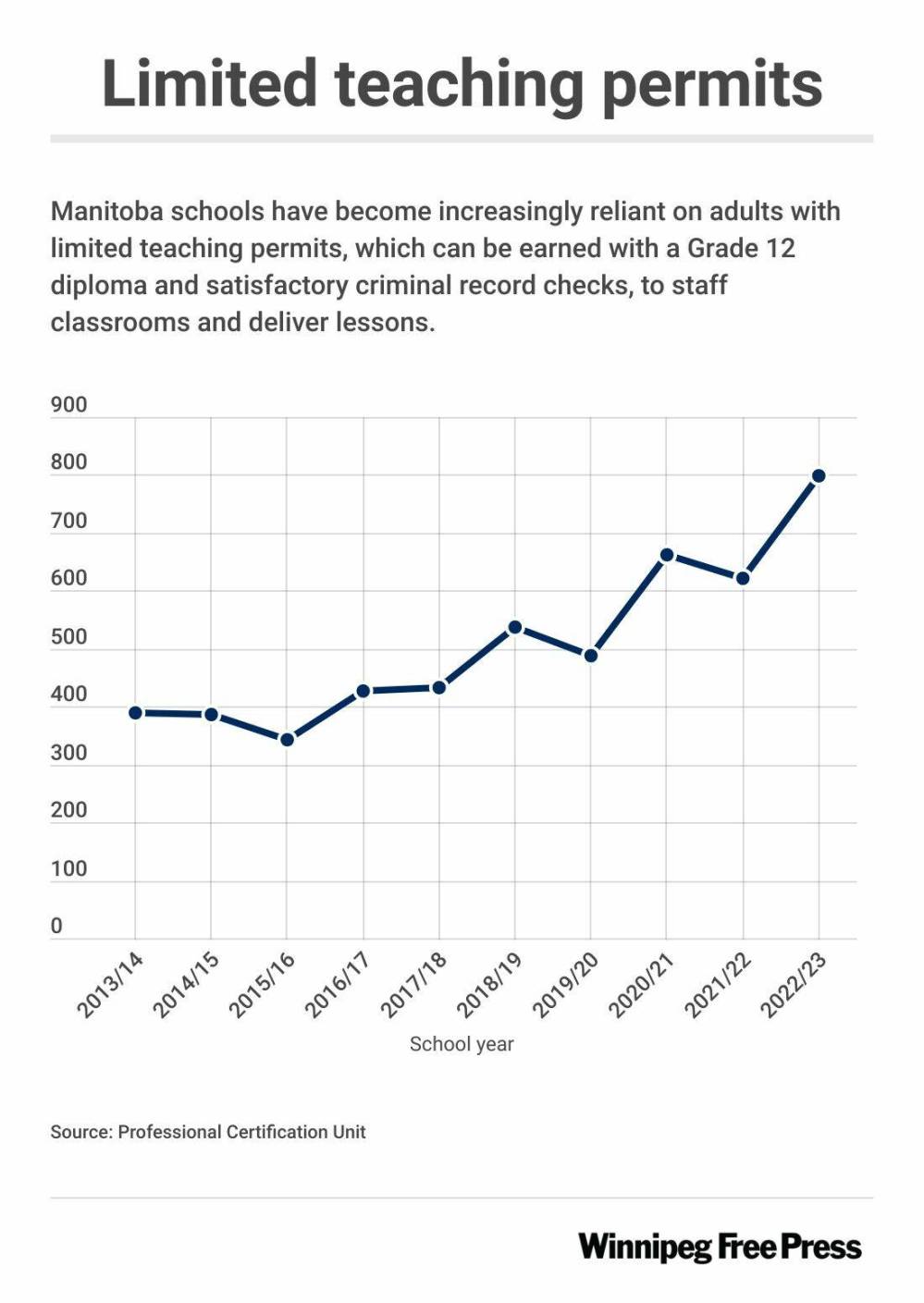
New data show the education department’s certification branch is approving hundreds more such permits than it did a decade ago.

Limited permits surged against the backdrop of a wave of teachers retiring during the pandemic and once public health orders were lifted. Substitute pools have also been depleted since 2020, due to retirees foregoing a return to work to limit their close contacts during respiratory illness season.

Isaak said those realities have proven more difficult for some divisions, especially those in rural and northern communities, than others.

Last year, Sunrise, Western and Brandon school divisions were actively advertising job postings to community members with few qualifications aside from a personal interest in working with children and successful background checks.

Uncertified educators can work without an limited teaching permit for 15 consecutive days or 20 days over the course of a school year. Employers are responsible for submitting applications on behalf of uncertified substitute and classroom teachers, if they surpass those working periods.

Administrators often use limited teaching permits, which expire at the end of every school year, to hire bachelor of education students, internationally trained teachers who fall short of meeting provincial standards and tradespeople, if they cannot find enough qualified vocational teachers.

JESSICA LEE / WINNIPEG FREE PRESS FILES
                                'They’re not left on their own to figure it all out,' says Barb Isaak, executive director of the Manitoba Association of School Superintendents.

JESSICA LEE / WINNIPEG FREE PRESS FILES

'They’re not left on their own to figure it all out,' says Barb Isaak, executive director of the Manitoba Association of School Superintendents.

Sunrise employed 96 uncertified substitute teachers, including 23 permit-holders, at the end of last year. One month into the new academic season, the Beausejour-based district’s numbers mirror those figures.

“We had a blip as we came out of the pandemic,” superintendent Cathy Tymko recalled. “When we hit March 2022, when restrictions were lifted, we had folks who had been thinking about retirement (put in their notices).”

The Manitoba Teachers’ Society has long been warning a shortage of fully certified professionals is already affecting staff morale and the quality of education.

Existing gaps are making members grapple with stress and burnout due to “ballooning class sizes and crushing workloads,” Nathan Martindale, who represents upwards of 16,600 public school teachers, said in a statement Friday.

“It’s almost frightening that we carry on as well as we do being as short of teachers as we are, but it’s become commonplace in our school division.”–Reg Klassen, Frontier School Division

Northern Manitoba’s public school division announced major incentives for 2023-24 to attract new recruits and avoid another year of severe staffing problems. The bonuses have yielded mixed results; its schools are currently down 34 teachers.

“It’s almost frightening that we carry on as well as we do being as short of teachers as we are, but it’s become commonplace in our school division,” said Reg Klassen of the Frontier School Division.

MIKE DEAL / WINNIPEG FREE PRESS FILES
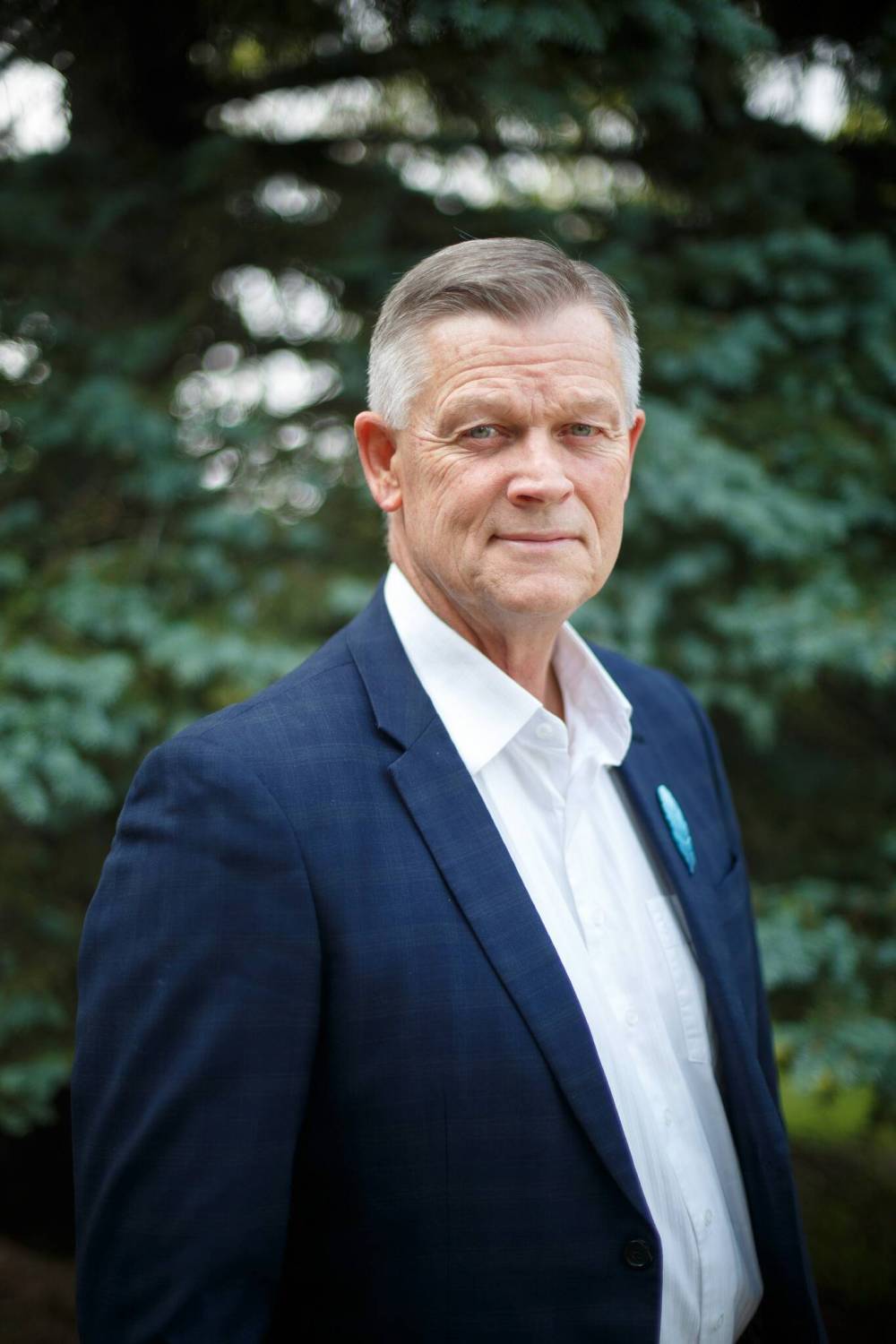
                                'We might be in a little bit of trouble': Frontier School Division Chief Superintendent Reg Klassen.
MIKE DEAL / WINNIPEG FREE PRESS FILES

'We might be in a little bit of trouble': Frontier School Division Chief Superintendent Reg Klassen.

Klassen said finding candidates for limited permits, let alone certified teachers, is a major challenge due to the remote locations of many Frontier sites.

The superintendent called it worrying Manitoba’s overall student population grew by about 4,900 last year, while the total active teacher count dropped by nearly 150.

“We might be in a little bit of trouble,” Klassen said. “I think that we will see this trend of limited teaching permits perhaps get a little bit worse, and that we will have more and more classrooms without certified teachers.”

Citing division reports about recruitment struggles, a provincial spokesperson said the province streamlined the process for such permits to address immediate pressures on a temporary basis.

An internal review is underway at the professional certification unit, with a goal of permanently reducing red tape so more qualified teachers can join the workforce.

maggie.macintosh@freepress.mb.ca

Maggie Macintosh

Maggie Macintosh
Education reporter

Maggie Macintosh reports on education for the Free Press. Originally from Hamilton, Ont., she first reported for the Free Press in 2017. Read more about Maggie.

Funding for the Free Press education reporter comes from the Government of Canada through the Local Journalism Initiative.

Every piece of reporting Maggie produces is reviewed by an editing team before it is posted online or published in print — part of the Free Press‘s tradition, since 1872, of producing reliable independent journalism. Read more about Free Press’s history and mandate, and learn how our newsroom operates.

Our newsroom depends on a growing audience of readers to power our journalism. If you are not a paid reader, please consider becoming a subscriber.

Our newsroom depends on its audience of readers to power our journalism. Thank you for your support.


Report Error Submit a Tip

More Stories

Poilievre’s lips moving, but Canadians aren’t interested in what he’s saying

Tom Brodbeck 5 minute read Preview

Poilievre’s lips moving, but Canadians aren’t interested in what he’s saying

Tom Brodbeck 5 minute read Thursday, Aug. 6, 2026

Pierre Poilievre’s biggest political challenge right now isn’t Prime Minister Mark Carney’s popularity.

It’s the fact that he still seems to be campaigning against a political landscape that no longer exists.

More than a year after the 2025 federal election, the Conservative leader is still relying on the same message, the same themes and the same attacks that defined his party’s campaign before voters went to the polls.

And Canadians appear to be tuning it out.

Read
Thursday, Aug. 6, 2026

Rainbow Stage’s Legally Blonde a lovely legal musical

Holly Harris 6 minute read Preview

Rainbow Stage’s Legally Blonde a lovely legal musical

Holly Harris 6 minute read Friday, Aug. 14, 2026

Omigod, you guys! Rainbow Stage kicked off its penultimate summer production Thursday with a high-octane joy machine bathed in a sea of pink.

Inspired by the 2001 Hollywood film starring Reese Witherspoon, and Amanda Brown’s same-titled novel, the award-winning Legally Blonde: The Musical — featuring a book by Heather Hach, with music/lyrics by Laurence O’Keefe and Nell Benjamin — opened on Broadway in April 2007, followed by a subsequent West End run.

The tale — equal parts cheesy rom-com and potent siren call for female autonomy and empowerment — focuses on quintessential Cali-girl Elle Woods (a pitch-perfect Claire Mac Master). A proud daughter and president of Delta Nu sorority house, she enrols at Harvard Law School to win back her upwardly mobile ex-boyfriend, Warner Huntington III (Duncan Cox).

Laser-focused on marrying a “Jackie, not a Marilyn,” Warner dreams of becoming an American senator, latching onto uber-preppy fellow pupil Vivienne Kensington (Julie Davis), who becomes Elle’s arch nemesis.

Read
Friday, Aug. 14, 2026

Corroded Arlington overpass yields way for new hope of spanning urban chasm

Melissa Martin 6 minute read Preview

Corroded Arlington overpass yields way for new hope of spanning urban chasm

Melissa Martin 6 minute read Yesterday at 2:00 AM CDT

It’s an interesting quirk of timing, perhaps, that the end of two of Winnipeg’s most unlovely features are coming into view in the same few weeks. The rail lines that split the city in half, and the bridge that was built to tie it back together. The original problem, and the solution.

And in the confluence of those two ends, we have an opportunity to dream of what a better Winnipeg can be.

At a news conference on Wednesday, former federal transport minister Lloyd Axworthy laid out a vision for a rail line bypass that would remove more than 120 railway crossings from Winnipeg, route them through Crown and Manitoba Hydro corridor land south of the city, and reclaim 250 acres in the urban core for greenspace and development.

The next step is to focus on how to make it happen. Nothing of this scope comes easy. This new bypass plan emerged from a two-year feasibility study that Premier Wab Kinew had tasked Axworthy with back in 2024. Now, Axworthy will helm a new 90-day feasibility study zooming in on that route specifically.

Read
Yesterday at 2:00 AM CDT

Use of uncertified teachers soars amid pandemic fallout

Maggie Macintosh 5 minute read Preview

Use of uncertified teachers soars amid pandemic fallout

Maggie Macintosh 5 minute read Friday, Oct. 13, 2023

Manitoba schools have become increasingly reliant on adults with limited teaching permits, which can be earned with a Grade 12 diploma and satisfactory criminal record checks, to staff classrooms and deliver lessons.

New data show the education department’s certification branch is approving hundreds more such permits than it did a decade ago — and there have been an excessive number issued since COVID-19 was detected in the province.

“Everybody would like to have a fully certified teacher in every classroom. When that’s not possible, school divisions work to find someone suitable to take that role, remembering that once a person becomes a staff member (they receive ongoing support),” said Barb Isaak, executive director the Manitoba Association of School Superintendents.

“They’re not left on their own to figure it all out.”

Read
Friday, Oct. 13, 2023

Trailblazing Western Scrap Metals heavy-equipment operator relishes role at massive crane’s control

David Sanderson 7 minute read Preview

Trailblazing Western Scrap Metals heavy-equipment operator relishes role at massive crane’s control

David Sanderson 7 minute read Friday, Aug. 14, 2026

Less than five per cent of heavy-equipment operators in the country are women but that number is trending upward, according to a study conducted by trade magazine Crane & Hoist Canada.

It was reported that in Ontario roughly eight per cent of jobs in the transport and heavy-equipment field are currently held by women. Furthermore, in 2024 almost 20 per cent of graduates at an Edmonton-based heavy-equipment operator training school were female, the article stated.

That brings us to Harmony Guspodarchuk, the first female crane operator in the 70-year history of Western Scrap Metals, a family-owned business at 18 Sutherland Ave.

Three years ago, Guspodarchuk literally stepped into the driver’s seat of a 27,500-kilogram, Liebherr C 924 Heavy Lift Litronic crane. The 29-year-old hasn’t looked back much since.

Read
Friday, Aug. 14, 2026

Proposed Transcona development — which could add 20,000 people — gets thumbs down from residents

Joyanne Pursaga 5 minute read Preview

Proposed Transcona development — which could add 20,000 people — gets thumbs down from residents

Joyanne Pursaga 5 minute read Friday, Aug. 14, 2026

Dozens of Winnipeggers fear plans to make way for up to 20,000 more people to live in south Transcona would dramatically alter their neighbourhood and tie hefty fees for new services to their property titles.

If city council adopts the proposed South Transcona secondary plan, all future development applications would need to conform to its goals. The affected area is located south of Dugald Road, north of St. Boniface Road, east of Plessis Road and west of Murdock Road.

Homeowner Virginia Page Jähne fears the plan could add a massive tab to the title of her 4.3-acre property to cover services required for the development.

“My main concern is that they are wanting to put $1.4 million onto my title to pay for this. Now, they say that I will not have to pay it unless I subdivide. But if a person comes by and wants to buy from me … and they see that $1.4 million … what’s the first thing (they’re) going to do?” said Page Jähne, in an interview.

Read
Friday, Aug. 14, 2026