

Ottawa transfers $193M in disaster assistance funds to Manitoba

Advertisement
Read this article for free:
or
Already have an account? Log in here »
To continue reading, please subscribe:

Digital Subscription
One year of digital access for only $205*
- Enjoy unlimited reading on winnipegfreepress.com
- Read the E-Edition, our digital replica newspaper
- Access News Break, our award-winning app
- Play interactive puzzles
*First annual payment billed as $205.00 + GST for one year. This annual subscription will automatically renew at $233.00 + GST every 52 weeks (10% off the regular annual price of $259.35). Offer available to new and qualified returning subscribers only. Cancel any time.
To continue reading, please subscribe:
Add Free Press access to your Brandon Sun subscription for only an additional
$1 for the first 4 weeks*
- Enjoy unlimited reading on winnipegfreepress.com
- Read the E-Edition, our digital replica newspaper
- Access News Break, our award-winning app
- Play interactive puzzles
*Your next Brandon Sun subscription payment will increase by $1.00 and you will be charged $17.95 plus GST for four weeks. After four weeks, your payment will increase to $24.95 plus GST every four weeks.
Read unlimited articles for free today:
or
Already have an account? Log in here »
Hey there, time traveller!
This article was published 14/11/2023 (1066 days ago), so information in it may no longer be current.
Ottawa has transferred more than $193 million to Manitoba for natural disaster recovery aid.
On Tuesday, federal Emergency Preparedness Minister Harjit Sajjan, alongside Manitoba Transportation and Infrastructure Minister Lisa Naylor, outlined five payments totalling $193,720,186 for incidents over the past decade.
The money comes via the Disaster Financial Assistance Arrangements program, which is accessed when provincial and territorial disaster response and recovery costs exceed what they could be “reasonably expected to bear on their own,” a federal government website states.
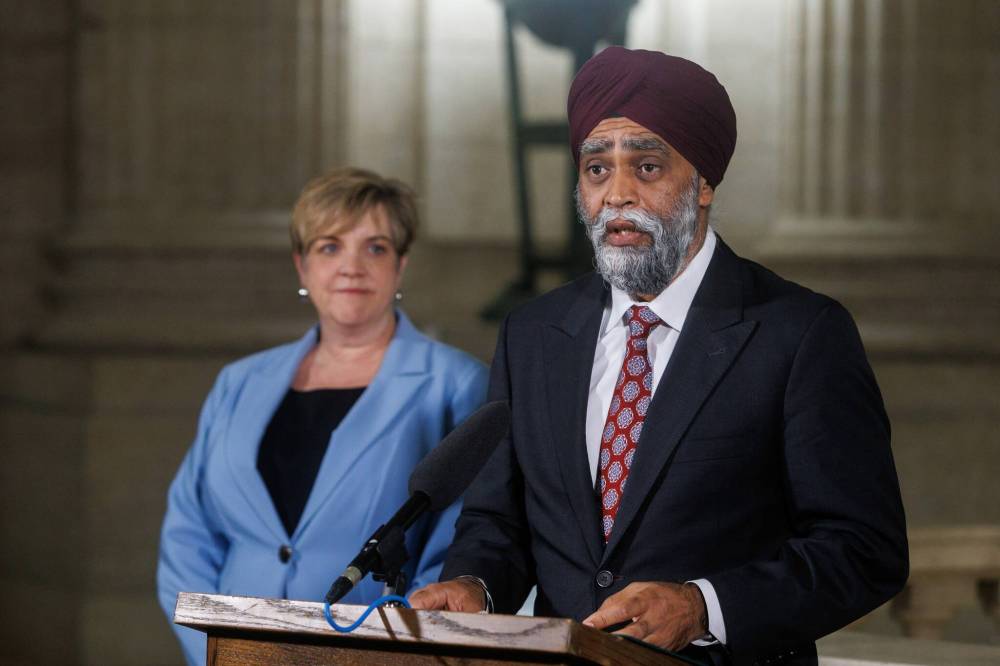
MIKE DEAL / WINNIPEG FREE PRESS
Federal Emergency Preparedness Minister Harjit Sajjan and Provincial Transportation and Infrastructure Minister Lisa Naylor met Tuesday to discuss lessons learned after an historic wildfire season and years of severe floods.
“Natural disasters, as a result of climate change, have devastated our country,” Sajjan said during a news event at the Manitoba Legislative Building. “This province… is no stranger to floods and also the wildfires.”
The majority of funding announced — $168,614,076 — is an advanced payment for 2022 spring flooding. Another $17 million will go towards costs from a June 2020 rainstorm.
An interim payment of $5.8 million will be put towards an October 2019 storm. Final payments of $1.4 million and more than $490,000 are for floods in 2014 and 2016, respectively, Sajjan’s press secretary said.
“Following a large-scale disaster, repair and reconstruction can take a significant amount of time to complete and document,” Joanna Kanga wrote in an email.
Provinces and territories can request advance, interim and final payments based on documentation it submits.
Natural disasters are becoming more frequent and more severe in Canada, Sajjan noted.
This year, 45.7 million acres have burned in more than 6,000 wildfires, the minister said. Upwards of 5,700 firefighters were brought to Canada to help with wildfire control, adding to 10,000 local crew members.
Environment and Climate Change Canada has issued several special air-quality statements for Manitoba this year, due to wildfire smoke.
In July, the provincial government logged 47 active fires. A major wildfire forced the evacuation of Pimicikamak Cree Nation earlier in the year.
“The floods have a significant impact,” Sajjan said. “What we need to do is to invest into making sure that we focus on prevention.”
First Nations devastated by flooding can get funding through Indigenous Services Canada and, sometimes, the disaster financial assistance program, he said.

Ottawa is looking to incorporate more Indigenous knowledge into its disaster response methods, Sajjan stated. It’s also seeking to lean into disaster prevention, he added.
Naylor said she had a productive meeting with Sajjan about their governments’ shared goals and the need to protect Manitobans during emergencies.
Meantime, Ottawa plans to “very soon” launch a national database where Canadians can view designated floodplains and avoid building on such sites, Sajjan said.
The Disaster Financial Assistance Arrangements program began in 1970, and has dispersed more than $7.9 billion in post-incident assistance.
gabrielle.piche@winnipegfreepress.com
Gabrielle Piché reports on business for the Free Press. She interned at the Free Press and worked for its sister outlet, Canstar Community News, before entering the business beat in 2021. Read more about Gabrielle.
Every piece of reporting Gabrielle produces is reviewed by an editing team before it is posted online or published in print — part of the Free Press‘s tradition, since 1872, of producing reliable independent journalism. Read more about Free Press’s history and mandate, and learn how our newsroom operates.
Our newsroom depends on a growing audience of readers to power our journalism. If you are not a paid reader, please consider becoming a subscriber.
Our newsroom depends on its audience of readers to power our journalism. Thank you for your support.
Gabrielle Piché reports on business for the Free Press. She interned at the Free Press and worked for its sister outlet, Canstar Community News, before entering the business beat in 2021. Read more about Gabrielle.
Every piece of reporting Gabrielle produces is reviewed by an editing team before it is posted online or published in print — part of the Free Press‘s tradition, since 1872, of producing reliable independent journalism. Read more about Free Press’s history and mandate, and learn how our newsroom operates.
Our newsroom depends on a growing audience of readers to power our journalism. If you are not a paid reader, please consider becoming a subscriber.
Our newsroom depends on its audience of readers to power our journalism. Thank you for your support.
Advertisement Advertise With Us
Advertisement Advertise With Us