

Ottawa commits $86M to help provinces fill health-care vacancies with foreign-trained professionals

Advertisement
Read this article for free:
or
Already have an account? Log in here »
To continue reading, please subscribe:

Digital Subscription
One year of digital access for only $205*
- Enjoy unlimited reading on winnipegfreepress.com
- Read the E-Edition, our digital replica newspaper
- Access News Break, our award-winning app
- Play interactive puzzles
*First annual payment billed as $205.00 + GST for one year. This annual subscription will automatically renew at $233.00 + GST every 52 weeks (10% off the regular annual price of $259.35). Offer available to new and qualified returning subscribers only. Cancel any time.
To continue reading, please subscribe:
Add Free Press access to your Brandon Sun subscription for only an additional
$1 for the first 4 weeks*
- Enjoy unlimited reading on winnipegfreepress.com
- Read the E-Edition, our digital replica newspaper
- Access News Break, our award-winning app
- Play interactive puzzles
*Your next Brandon Sun subscription payment will increase by $1.00 and you will be charged $17.95 plus GST for four weeks. After four weeks, your payment will increase to $24.95 plus GST every four weeks.
Read unlimited articles for free today:
or
Already have an account? Log in here »
Hey there, time traveller!
This article was published 15/01/2024 (977 days ago), so information in it may no longer be current.
Aiming to fill health-care labour shortages, the federal government is spending $86 million through its foreign credential recognition program to make it easier for more than 6,600 additional professionals to join the workforce.
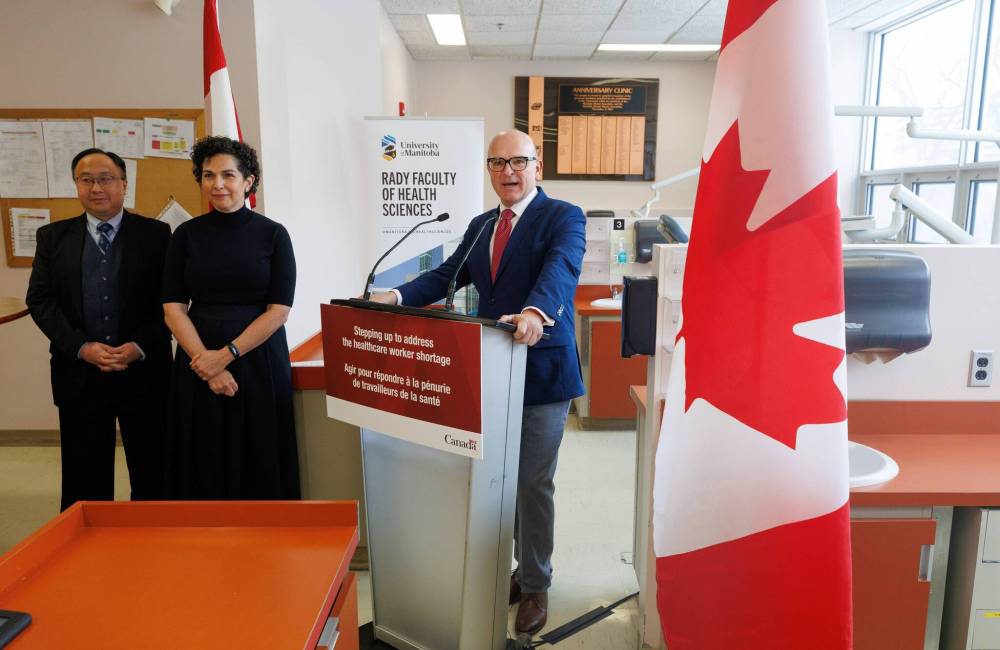
Randy Boissonnault, federal minister of Employment, Workforce Development and Official Languages, announced the funding in Winnipeg Monday.
Speaking at the University of Manitoba’s College of Dentistry, the minister said the funding will be distributed through 15 different projects across the country. The Association of Canadian Faculties of Dentistry, based in Winnipeg, is using its portion of the funding — $8.3 million — to start a pilot program to more quickly train foreign-educated dentists, but the training won’t be rolled out in Manitoba until the pilot project is complete at universities in Alberta, Nova Scotia and Quebec.
The federal funding was included in the 2022 budget; the foreign credential recognition program supplies annual funding to organizations that successfully apply for it. This year, the Association of Canadian Faculties of Dentistry is the only Manitoba-based organization to receive the funding.
Boissonnault visited Manitoba in preparation for meeting with his provincial counterparts, including Jamie Moses, Manitoba minister of Economic Development, Investment, Trade and Natural Resources. Provincial and territorial labour ministers are meeting in Winnipeg Tuesday to discuss Canada’s labour market priorities.
Asked how he will work with provinces to reduce the barriers in place at many regulatory bodies governing health-care professions, Boissonnault said as federal minister responsible for foreign credential recognition, he needs buy-in from the provinces. The regulatory bodies setting rules and regulations for professions are “almost entirely provincial in scope.”
“I also need provincial ministers to work with the federal government to indicate very clearly which are those occupations that we’re going to focus on, and then we’re going to open up and we’re going to make sure that foreign-trained professions have access to that,” Boissonnault said.

“We know where the biggest needs are in the labour market, and I need the support of provincial counterparts to get the work done.”
Canada has more than 90,000 health-care job vacancies, including for physicians and nurses, Boissonnault said.
The accelerated training program through the Association of Canadian Faculties of Dentistry is expected to assess and train internationally educated dentists in a matter of months instead of two to three years. The sped-up training will roll out to all 10 dental schools in Canada after the pilot project is completed at the University of Alberta, the Universite du Laval and Dalhousie University, said association president Jim Lai. More than half of the dentists licensed each year in Canada were educated in other countries.
“Once we have the data, we’ll be able to advocate to the provincial government and the federal government,” said Anastasia Kelekis-Cholakis, dean of U of M’s college of dentistry. “Our huge issue is infrastructure with the dental school. In order to be able to run these programs, you need specific equipment to do so, and we are hampered by the fact we have 30 stations here in this building, no more. So therefore the number of (dentists) that we can assess and help license is limited by the infrastructure that we have.”
katie.may@freepress.mb.ca
Katie May is a multimedia producer for the Free Press.
Our newsroom depends on a growing audience of readers to power our journalism. If you are not a paid reader, please consider becoming a subscriber.
Our newsroom depends on its audience of readers to power our journalism. Thank you for your support.
Katie May is a multimedia producer for the Free Press.
Our newsroom depends on a growing audience of readers to power our journalism. If you are not a paid reader, please consider becoming a subscriber.
Our newsroom depends on its audience of readers to power our journalism. Thank you for your support.
Related Articles
Manitoba hospital strained by 52% nurse vacancy rate
Advertisement Advertise With Us
Advertisement Advertise With Us