Deadly desperation in desolation Unfamiliarity with unforgiving winter weather in this part of the world puts the lives of asylum seekers trying to cross the Canada-U.S. border near Emerson at very real risk, officials warn
Read this article for free:
or
Already have an account? Log in here »
To continue reading, please subscribe:

Digital Subscription
One year of digital access for only $205*
- Enjoy unlimited reading on winnipegfreepress.com
- Read the E-Edition, our digital replica newspaper
- Access News Break, our award-winning app
- Play interactive puzzles
*First annual payment billed as $205.00 + GST for one year. This annual subscription will automatically renew at $233.00 + GST every 52 weeks (10% off the regular annual price of $259.35). Offer available to new and qualified returning subscribers only. Cancel any time.
To continue reading, please subscribe:
Add Free Press access to your Brandon Sun subscription for only an additional
$1 for the first 4 weeks*
- Enjoy unlimited reading on winnipegfreepress.com
- Read the E-Edition, our digital replica newspaper
- Access News Break, our award-winning app
- Play interactive puzzles
*Your next Brandon Sun subscription payment will increase by $1.00 and you will be charged $17.95 plus GST for four weeks. After four weeks, your payment will increase to $24.95 plus GST every four weeks.
Read unlimited articles for free today:
or
Already have an account? Log in here »
Hey there, time traveller!
This article was published 14/02/2024 (965 days ago), so information in it may no longer be current.
EMERSON — The long-closed border crossing on the edge of this Manitoba community has an eerie feel to it these days, with derelict or dormant buildings giving it the appearance of a ghost town.
Once a busy hub, the abandoned Noyes-Emerson East checkpoint still receives regular visitors. It remains one of the most common places people illegally walk across Manitoba’s border with the U.S. for asylum or other reasons.
“Going other places, you might risk freezing or succumb to other elements,” said Cpl. James Buhler, a longtime member of the Manitoba RCMP’s integrated border enforcement team. “It’s a less-dangerous route. However, it does come with recourse there, as far as legality.
“We want to encourage people to do it legally and go to the ports of entry.”
RUTH BONNEVILLE / WINNIPEG FREE PRESS The abandoned Noyes-Emerson East checkpoint still receives regular visitors so it is monitored by U.S. border patrol helicopters.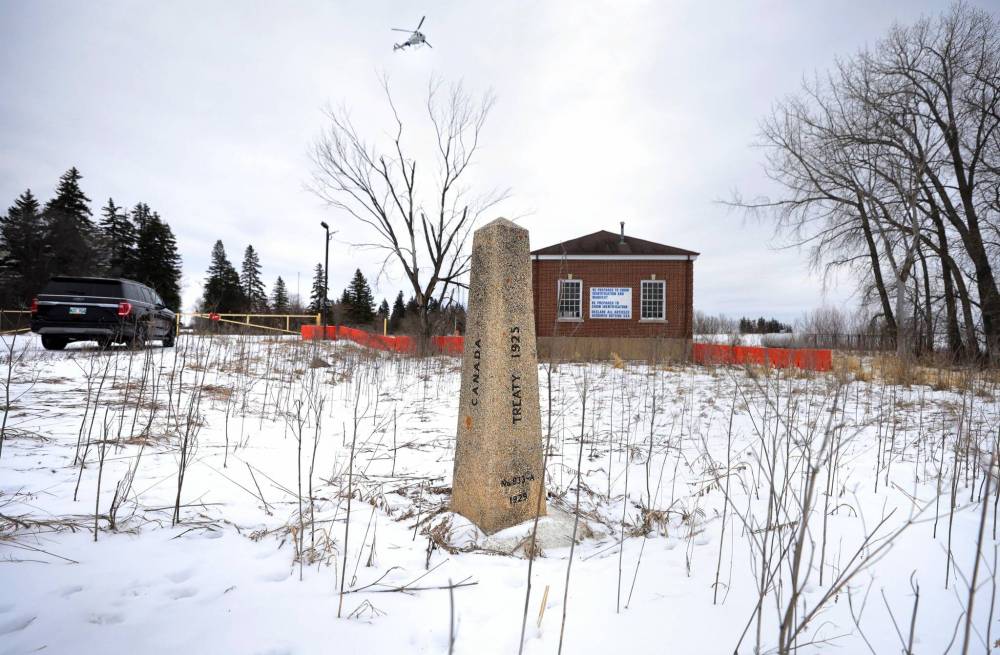
A U.S. border patrol helicopter buzzed overhead Tuesday morning, while Buhler took the Free Press to the site in Emerson, opposite Noyes, Minn., and other spots where people are usually intercepted.
Interceptions have been on the rise on both sides since crossings slowed during COVID-19 pandemic. The January 2022 deaths of a family of four from India have not deterred others from attempting the perilous journey.
Outside of Emerson, about 100 kilometres south of Winnipeg, the land is flat and open, which fools some border-crossers into thinking it will be a simple hike.
In winter, fields and farm roads are usually packed with snow, and there is little shelter from freezing winds. Other seasons typically bring flooding and chilly nights that can still cause harm.
Surrounded by rutted fields at a bend in a dirt road, Buhler stood next to a yellow, south-facing sign that warns anyone attempting to cross just west of the border stations in Emerson and Pembina, N.D.
RUTH BONNEVILLE / WINNIPEG FREE PRESS Many asylum seekers try to cross at night. Some make an attempt when it’s storming, hoping to evade detection, but it just increases the risks and puts officers in danger as well, RCMP Cpl. James Buhler said.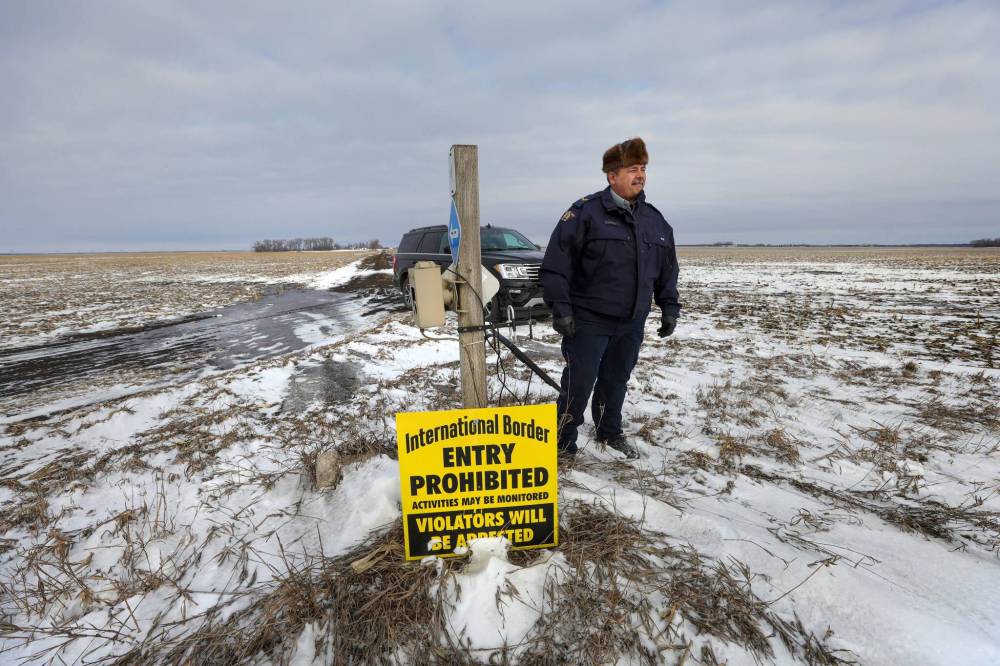
The fields were largely bare and the temperature of -2 C wasn’t typical for February, but that doesn’t mean the trek north or south would have been any easier.
“Today’s conditions would even be tough,” said Buhler. “You can get hypothermia in temperatures like this, easily. People have no clue how hard it actually is to cross.”
When found, they are often exhausted, cold or hungry after walking several kilometres for hours. Some are frostbitten or have injuries from trips or falls.
On Monday, officers found a family of U.S.-bound Romanian nationals, including a baby, after a vehicle got stuck in a ditch west of Gretna, said Buhler.
The public doesn’t hear about most rescues.
Related Articles
‘I feel good being here’: two months, 20,000 kilometres in run for life from Africa














“With our technology, we’ve been able to save quite a few lives,” said Buhler.
Many try to cross at night. Some make an attempt when it’s storming, hoping to evade detection, but it just increases the risks and puts officers in danger as well, he said.
Two years ago, a mother, father and their two children, ages three and 11, froze to death in a field east of Emerson as they tried to walk into the U.S. in a -35 C blizzard at night. Seven other Indian nationals were found by U.S. border officers.
U.S. authorities arrested a 49-year-old Florida man just over the border and charged him with human smuggling, alleging he was part of a wider operation.
“Any loss of life is a horrible call to go to,” said Buhler, who was involved in the search for the family. “When they said it was a large group, a family, in the back of your mind you think it’s not going to end well.”
RUTH BONNEVILLE / WINNIPEG FREE PRESS People learn about Emerson or smuggling networks through social media posts or videos, said Buhler, with most involving some level of organization or coaching.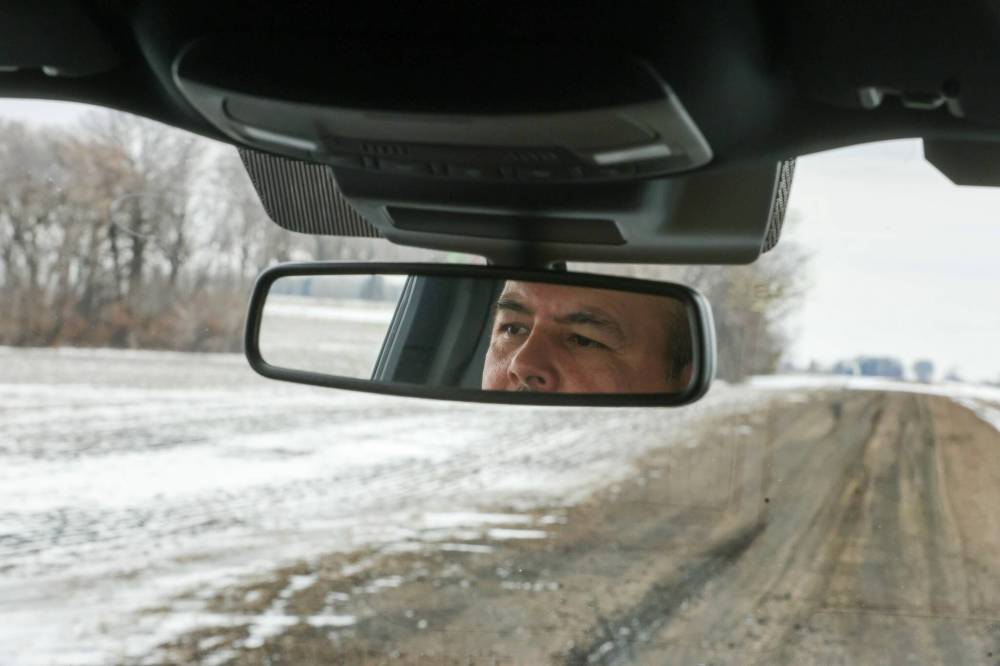
It’s not uncommon for people to travel halfway around the world to try their luck along Manitoba’s border. Some complete a treacherous journey through Latin America and across the Mexico-U.S. border before heading north.
Manitoba’s IBET patrols a roughly 500-kilometre section of the world’s longest international border, where cameras, drones and other equipment help to monitor the vast area and detect crossings.
There are examples of people learning about Emerson or smuggling networks through social media posts or videos, said Buhler.
Buhler said most involve some level of organization or coaching. Some of the smugglers are also refugees, he added.
After crossing, some people are picked up by a waiting vehicle. Others head into the nearest community to call a taxi, seek shelter or request police, believing it will be the start of an asylum claim.
RUTH BONNEVILLE / WINNIPEG FREE PRESS About once a month in summer and less often in winter, someone shows up at Emerson’s Maple Leaf Hotel after crossing, said employee Guri Dhillon. 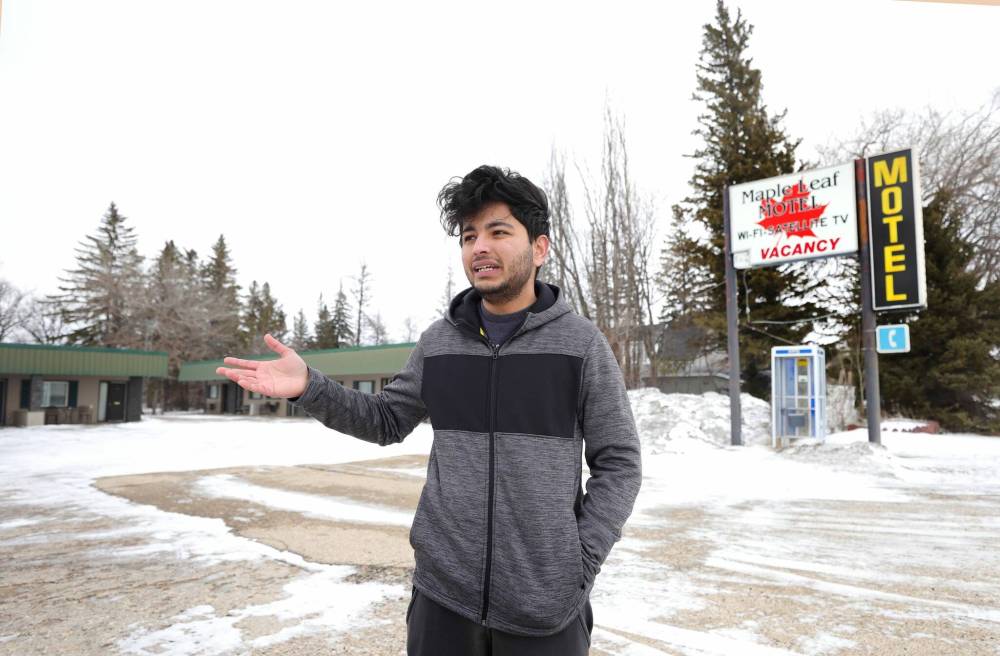
About once a month in summer and less often in winter, someone shows up at Emerson’s Maple Leaf Hotel after crossing, said employee Guri Dhillon. The motel is about 200 metres from the border.
“They ask about a room for a few hours or they ask me to call 911,” said Dhillon.
He recounted a visit from a Colombian man who crossed at 6 a.m. on an October day.
“He was freezing. He was very tired and he asked me to turn on the heater,” said Dhillon, who contacted police at the man’s request. “He said he wanted to go to Pennsylvania. I said, ‘This is Canada, this isn’t America.’”
On Jan. 27, technology on the U.S. side detected seven men from Chad as they walked along a rail line adjacent to the old Noyes-East Emerson border stations.
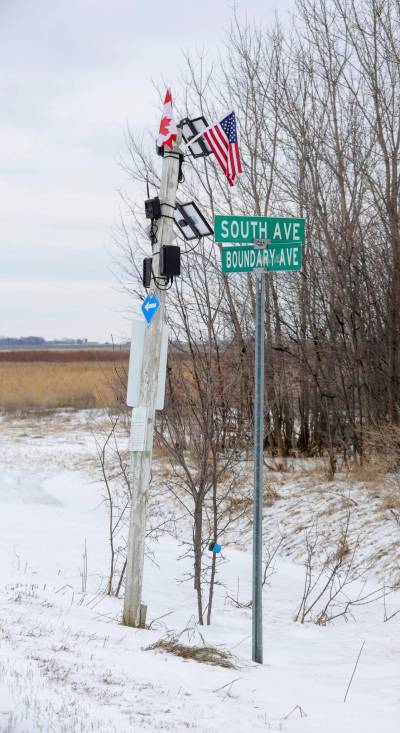
RUTH BONNEVILLE / WINNIPEG FREE PRESS Monitors are attached to a weathered post with Canada and U.S. flags at the corner of South and Boundary avenues in Emerson where asylum seekers try to cross into Canada. 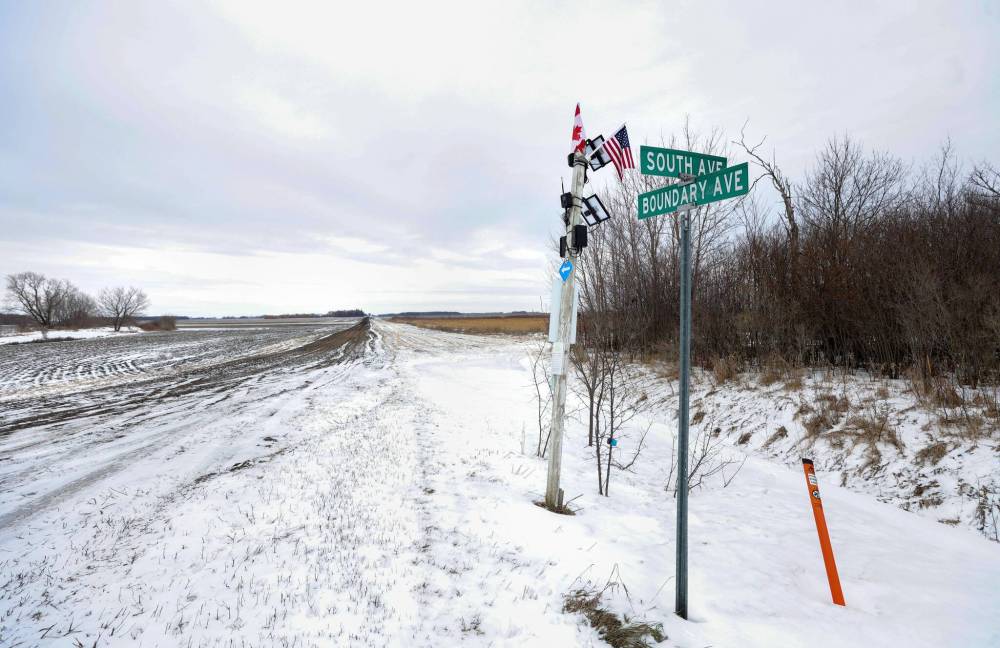
When IBET officers stopped a rented vehicle near Dominion City, they detained the asylum seekers and arrested a 49-year-old Calgary resident on suspicion of human smuggling.
Four men from Chad were found by RCMP after crossing into Emerson in December.
People are often fleeing violent conflicts, persecution or economic hardship. Located in north-central Africa, Chad has been in turmoil since its longtime president President Idriss Déby was killed in 2021.
Buhler said it’s important to look at things from the border-crosser’s perspective and understand why they are taking great risks to enter Canada.
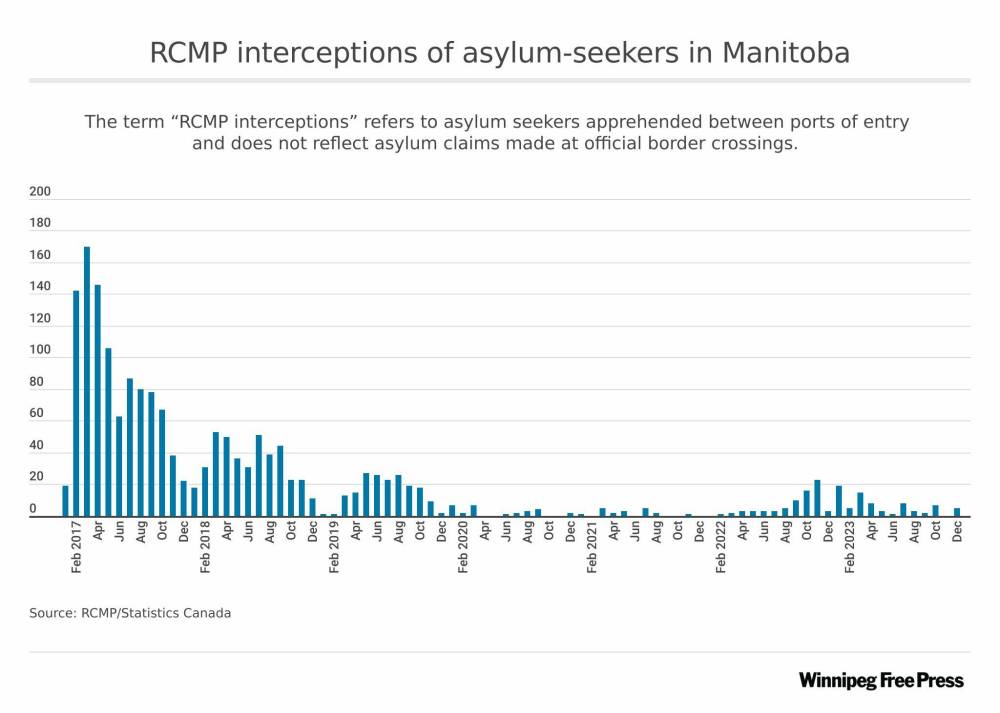
According to federal data, Manitoba RCMP intercepted 77 asylum seekers between ports of entry in 2023. Some 40 per cent of those who attempt to cross are not intercepted, Buhler estimated.
When found, police do extensive background checks to find out if people have a criminal record or are wanted for terrorism or other reasons abroad, he said.
If not, they are turned over to the Canada Border Services Agency for immigration processing.
Last year’s changes to the Canada-U.S. Safe Third Country Agreement require people who enter between ports of entry to be turned back to the U.S., and vice versa, to begin an asylum claim, if found within 14 days.
Limited exceptions allow claimants to remain in Canada, a country many refugees view as being more welcoming than others.
Agreement won’t stop irregular crossings
Organizations that support refugees predicted the expansion of the agreement would not stop irregular crossings.
They warned people would take riskier routes or put themselves in the hands of smugglers who value profit above human life in desperate bids to enter Canada.
“It does encourage people to go into hiding in their first two weeks, when they can submit an inland claim,” Emily Halldorson, a co-ordinator with the Manitoba Association of Newcomer Serving Organizations, told the Free Press last week.
“We predicted people would put themselves in more vulnerable situations. Everyone has the right to claim asylum.”
In the Emerson area, there are more crossings into the U.S. than Canada, said Buhler.
According to U.S. Customs and Border Patrol, some migrants fly to Canada and try to walk across the northern border, because they think it will be easier than crossing the southern border with Mexico.
The U.S. CBP reported 300 “encounters” in the Grand Forks sector, which stretches from North Dakota to Wisconsin, during the October 2022-September 2023 fiscal year. Mexican citizens typically represent the highest proportion of apprehensions.
“Nobody wants to see any bad results”–RCMP Cpl. James Buhler
In January, 18 of the 28 reported “encounters” involved Romanian nationals.
On the Canadian side, Buhler worked through the peak of northbound crossings in 2017, when migrants streamed into Emerson. That year, Manitoba RCMP intercepted a record 1,018 asylum seekers.
The surge was attributed, in part, to tougher policies under former president Barack Obama’s administration and fears of a crackdown on migrants when then-U.S. president Donald Trump took office.
“We had 26 people in one night,” said Buhler.
After 2017, interceptions became less frequent and slowed to a trickle (19) in 2021, after governments imposed COVID-19 travel restrictions.
As he drove along Boundary Avenue, which runs parallel to the border east of Emerson, Buhler scanned the desolate landscape. Officers often patrol the area for signs of people or new crossing sites.
Buhler knows more will follow, but he urged them to think twice.
“You’re risking your safety with the environmental conditions and the terrain,” he said. “Nobody wants to see any bad results.”
chris.kitching@freepress.mb.ca

Chris Kitching is a general assignment reporter at the Free Press. He began his newspaper career in 2001, with stops in Winnipeg, Toronto and London, England, along the way. After returning to Winnipeg, he joined the Free Press in 2021, and now covers a little bit of everything for the newspaper. Read more about Chris.
Every piece of reporting Chris produces is reviewed by an editing team before it is posted online or published in print — part of the Free Press‘s tradition, since 1872, of producing reliable independent journalism. Read more about Free Press’s history and mandate, and learn how our newsroom operates.
Our newsroom depends on a growing audience of readers to power our journalism. If you are not a paid reader, please consider becoming a subscriber.
Our newsroom depends on its audience of readers to power our journalism. Thank you for your support.