

Real journalists matter in an AI world
Advertisement
Read this article for free:
or
Already have an account? Log in here »
To continue reading, please subscribe:

Digital Subscription
One year of digital access for only $205*
- Enjoy unlimited reading on winnipegfreepress.com
- Read the E-Edition, our digital replica newspaper
- Access News Break, our award-winning app
- Play interactive puzzles
*First annual payment billed as $205.00 + GST for one year. This annual subscription will automatically renew at $233.00 + GST every 52 weeks (10% off the regular annual price of $259.35). Offer available to new and qualified returning subscribers only. Cancel any time.
To continue reading, please subscribe:
Add Free Press access to your Brandon Sun subscription for only an additional
$1 for the first 4 weeks*
- Enjoy unlimited reading on winnipegfreepress.com
- Read the E-Edition, our digital replica newspaper
- Access News Break, our award-winning app
- Play interactive puzzles
*Your next Brandon Sun subscription payment will increase by $1.00 and you will be charged $17.95 plus GST for four weeks. After four weeks, your payment will increase to $24.95 plus GST every four weeks.
Read unlimited articles for free today:
or
Already have an account? Log in here »
An algorithm can decide what you see, but it doesn’t report the news. Nunatsiaq News, an award-winning newspaper in Nunavut, recently reported that a so-called “news” website was posting AI-generated articles about the north by stealing real news stories produced by real journalists.
The articles were supposedly written by Nunavut correspondent Leah Qammaniq — a fake journalist, with a fake photo and a fake bio.
Governor General Louise Arbour warned us of fake news in her installation speech in June. She said, “We must continue to protect the public space in which our national debates take place: from schools and universities to the media, political parties, unions and civil society organizations …With instant access to vast amounts of information, it is very tempting to pay little attention to the reliability of sources. The lines between knowledge and belief, between truth and falsehood, between facts and assumptions, are increasingly blurred. AI could be threatening not only the way we live and work, but also the control we exercise over our own destiny.”
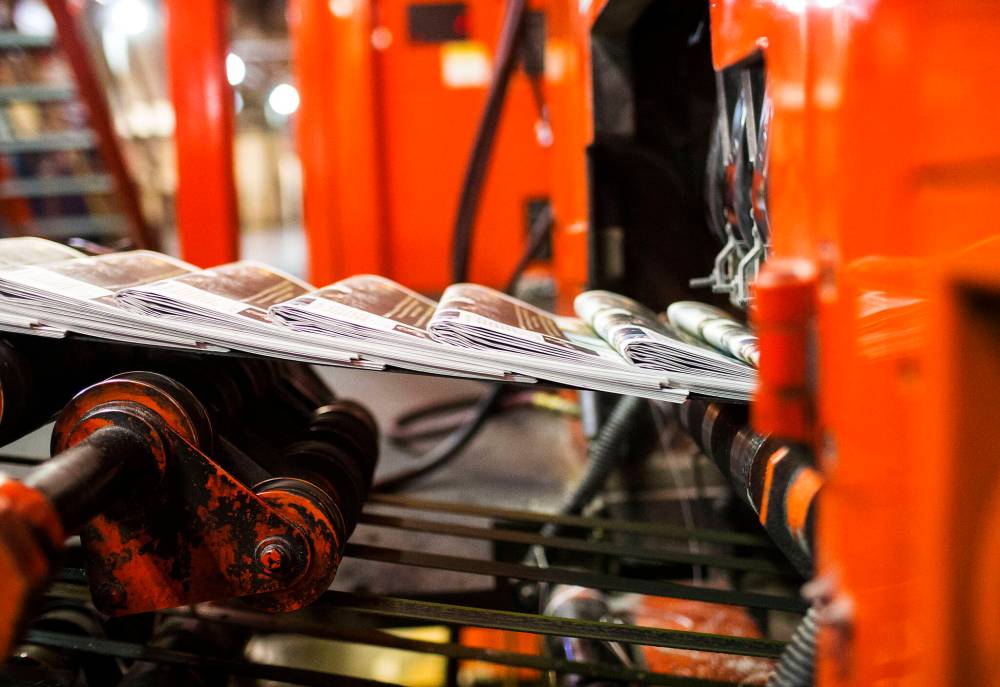
MIKAELA MACKENZIE / FREE PRESS
Newspapers run off the presses at the Free Press.
The Government of Canada has recognized the problem as well. Its recent discussion paper, Enhancing trust in artificial intelligence through increased transparency, stated, “Canadians encounter news reporting, product reviews, and audio-visual content across the internet, often without any indication of whether it was written by a person, generated by an AI system, or produced through some combination of both … A particular concern within this broader landscape is that generative AI greatly enables the creation and dissemination of deceptive or misleading content.”
Yet, the federal government hasn’t taken any action when it comes to the brazen theft of news content by AI companies. Indeed, its highly anticipated report, Canada’s National Artificial Intelligence Strategy: AI for All, didn’t mention the word “copyright” – not even once. At the same time, according to a survey conducted for News Media Canada, 78 per cent of Canadians say they are concerned about fake news and disinformation, underscoring the growing value of credible, professionally produced journalism.
In the face of misinformation and disinformation and threats to Canadian sovereignty, identity, and unity, there is an urgent need to protect and control Canadian trusted, verified intellectual property and to keep its value in Canada, for Canadians.
Fact-based, fact-checked trusted journalistic content is vital to a healthy democracy, and there are concrete steps that can be taken to safeguard this pillar of our democracy.
• First, clearly and unequivocally state that there will be no text and data-mining exception;
• Second, use the power of the federal procurement purse to ensure that these companies stop stealing creator content through robust supplier commitments;
• Third, align with the U.K. competition authority’s approach, which gives publishers an opt-out to control how news content surfaces in Google’s AI answers;
• Fourth, have the industry minister direct the Competition Bureau to conduct a market study into Google’s AI/search crawler;
• Fifth, introduce and pass bad bot legislation similar to the Stealth Bot Prohibition Act, currently before the U.S. Congress.

National Newspaper Week 2026 celebrates the people behind the news and reminds Canadians that trusted journalism is produced by real journalists, who report, investigate, verify, and write it.
This year’s program introduces “Al Gorithm”, a fictional character who highlights an increasingly important distinction — an algorithm can decide what you see, but it doesn’t sit through a council meeting, interview a local business owner, cover a championship game or hold decision-makers accountable.
With the industrial scale theft of copyright-protected news content by AI companies and threats to our cultural and digital sovereignty from the U.S., our federal government can help sustain real journalism by real journalists by maintaining the Online News Act (which is seeing $100 million flowing annually from Google to news businesses), maintaining the Canadian Journalism Labour Tax Credit at 35 per cent, maintaining the Local Journalism Initiative, and earmarking 25 per cent of federal advertising spending to trusted news outlets.
Digital and cultural sovereignty matter. Canadian stories matter. Facts matter. Real journalists matter.
Paul Deegan is president and chief executive officer of News Media Canada.