Speeders pinched on Perimeter cry foul Police won’t say how many drivers snared in initial photo-radar campaign
Read this article for free:
or
Already have an account? Log in here »
To continue reading, please subscribe:

Digital Subscription
One year of digital access for only $205*
- Enjoy unlimited reading on winnipegfreepress.com
- Read the E-Edition, our digital replica newspaper
- Access News Break, our award-winning app
- Play interactive puzzles
*First annual payment billed as $205.00 + GST for one year. This annual subscription will automatically renew at $233.00 + GST every 52 weeks (10% off the regular annual price of $259.35). Offer available to new and qualified returning subscribers only. Cancel any time.
To continue reading, please subscribe:
Add Free Press access to your Brandon Sun subscription for only an additional
$1 for the first 4 weeks*
- Enjoy unlimited reading on winnipegfreepress.com
- Read the E-Edition, our digital replica newspaper
- Access News Break, our award-winning app
- Play interactive puzzles
*Your next Brandon Sun subscription payment will increase by $1.00 and you will be charged $17.95 plus GST for four weeks. After four weeks, your payment will increase to $24.95 plus GST every four weeks.
Read unlimited articles for free today:
or
Already have an account? Log in here »
Hey there, time traveller!
This article was published 27/03/2024 (927 days ago), so information in it may no longer be current.
Speeding fines of up to $1,412 have been handed out since Winnipeg police started using mobile photo radar in a massive construction zone on the south Perimeter Highway — possibly for the first time — but opponents are crying foul.
Since March 15, mobile units have been set up east and west of St. Mary’s Road, where crews are building an interchange, to catch drivers who disobey the designated work zone’s speed limit, which is usually 80 km/h.
“The ultimate goal is to get people to slow down,” said Insp. Marc Philippot, who oversees the Winnipeg Police Service photo radar program. “The message is simple: abide by the posted speed limit and avoid a violation.”
Philippot said he didn’t yet have the total number of tickets that had been issued. The highest speed recorded to date was 132 km/h, resulting in a $1,412 fine.
“The message is simple: abide by the posted speed limit and avoid a violation.”–Insp. Marc Philippot
“That is a significant speed, even if there wasn’t construction and you had a posted limit of 100 km/h,” said Philippot. “At those speeds, obviously, the consequences won’t be very forgiving.”
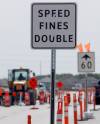
Fines are doubled in designated construction zones.
Philippot said the WPS received complaints about excessive and dangerous speeds, which put workers and drivers at risk, before photo radar vehicles were deployed.
Winnipeg police had shared its plans for photo radar via social media.
“We’re trying to be proactive, rather than reactive,” he said.
While the Perimeter is a provincial highway and the RCMP is its primary enforcer of traffic laws, the Winnipeg Police Service has the lawful authority to use photo enforcement in the zone, because it is within city limits and meets all the requirements of image-capturing enforcement regulations, said Philippot.
“We’ve heard from a number of people who’ve decided they are going to plead not guilty and wait for a trial to come. We’re looking forward to challenging it.”–Todd Dube
To his knowledge, it is the first time mobile photo radar has been used on the Perimeter.
Winnipeg’s most vocal photo radar opponents are trying to mobilize a challenge in a bid to get tickets quashed.
Todd Dube, co-founder of Wise Up Winnipeg, disputed the WPS’ claim of lawful authority on the basis of jurisdiction.
“We’ve heard from a number of people who’ve decided they are going to plead not guilty and wait for a trial to come,” he said. “We’re looking forward to challenging it.”
Philippot said people have the right to dispute a ticket, but provincial legislation is clear, and road signs that give advance warning of the construction zone are “plentiful.”
The WPS will soon take over from the RCMP and become the primary enforcer of traffic laws on the southern half of the Perimeter Highway. The tentative start date is May 1, said Philippot.
Cole Lagasse, who lives east of Winnipeg, was ticketed for speeding on March 16 and 18, when he didn’t know photo radar was in use.
The fines — for speeds of 93 km/h and 96 km/h — total $860. He intends to plead not guilty.
“I think it’s pretty unfair, because there are no signs or anything saying there is photo enforcement,” he said. “I was following the flow of traffic.
“It’s dangerous to slow down while in the flow of traffic, because people whipping past me doesn’t interest me.”
No work was taking place where photo radar was set up, said Lagasse.
“I can only imagine how many other people got these tickets,” he said.
BROOK JONES / FREE PRESS Todd Dube of Wise Up Winnipeg holds a sign alerting drivers to slow down in the construction zone on the south Perimeter Highway near St. Mary's Road.
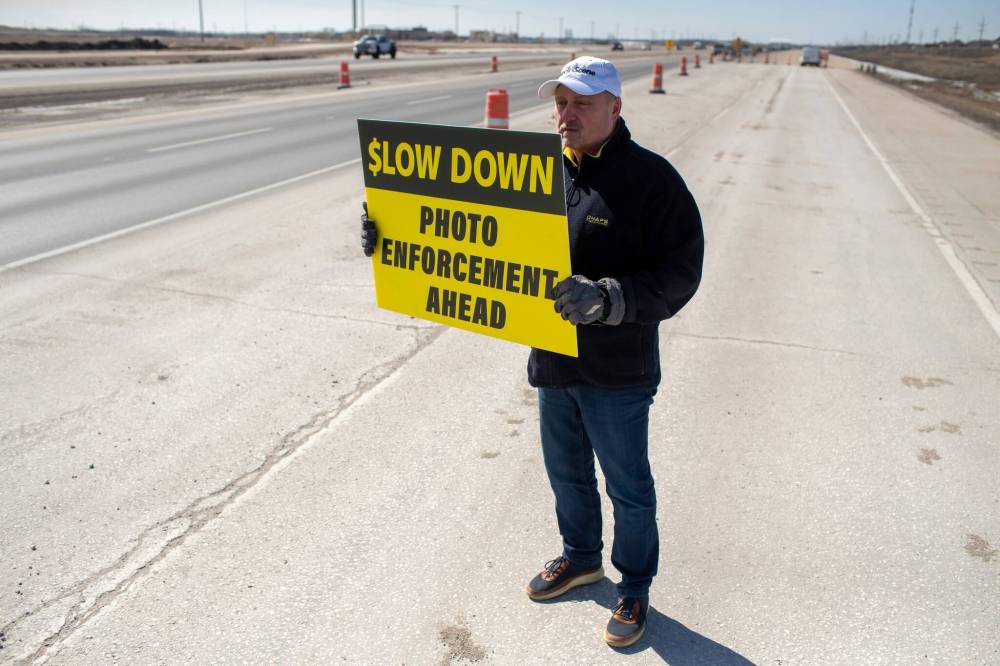
Earlier this week, Dube held up a sign that read, “$low down — photo enforcement ahead,” to warn drivers as they approached the construction zone.
He said photo radar vehicles park near the entrances of the zone, far away from workers or actual work activity.
Dube said the zone is a “lucrative” site for photo radar, which he claims is purely a “cash grab.”
Philippot disagrees with people who hold that view of the program.
“I look at it as we’re just trying to reduce speeds here as best we can,” he said. “If it brings down the speed and that keeps people safe, that’s the ultimate goal here.”
Last year, photo radar vehicles that were set up south of the Perimeter on St. Mary’s Road sparked complaints from drivers, who said the units were far from actual construction work.

Dube said one ticket was thrown out in court, after the recipient successfully argued photo radar units were not set up within a construction zone, and a second case was stayed.
A spokeswoman for Manitoba Transportation and Infrastructure said public concerns in February led to a road safety audit of the construction area. It prompted additional signage, lighting, reflectors, barrier cleaning and snow removal.
“Additionally, the department installed virtual speed indicators, to display vehicle speed to drivers, and signs indicating that speed fines are doubled in the construction zone,” the spokeswoman wrote in an email.
The Manitoba government has faced calls to review decades-old photo radar legislation.
The WPS has said legislation limits the program to 2002 technology and prohibits expansion.
“The province is engaged in positive, collaborative dialogue with the Winnipeg Police Service about its ongoing challenges with photo enforcement and the desire to continue working to improve photo enforcement as a balanced tool to improve road safety,” the government spokeswoman wrote.
chris.kitching@freepress.mb.ca

Chris Kitching is a general assignment reporter at the Free Press. He began his newspaper career in 2001, with stops in Winnipeg, Toronto and London, England, along the way. After returning to Winnipeg, he joined the Free Press in 2021, and now covers a little bit of everything for the newspaper. Read more about Chris.
Every piece of reporting Chris produces is reviewed by an editing team before it is posted online or published in print — part of the Free Press‘s tradition, since 1872, of producing reliable independent journalism. Read more about Free Press’s history and mandate, and learn how our newsroom operates.
Our newsroom depends on a growing audience of readers to power our journalism. If you are not a paid reader, please consider becoming a subscriber.
Our newsroom depends on its audience of readers to power our journalism. Thank you for your support.