

Parents who used surrogate claim discrimination after benefits denied
Not eligible for mat leave top-up pay through union

Advertisement
Read this article for free:
or
Already have an account? Log in here »
To continue reading, please subscribe:

Digital Subscription
One year of digital access for only $205*
- Enjoy unlimited reading on winnipegfreepress.com
- Read the E-Edition, our digital replica newspaper
- Access News Break, our award-winning app
- Play interactive puzzles
*First annual payment billed as $205.00 + GST for one year. This annual subscription will automatically renew at $233.00 + GST every 52 weeks (10% off the regular annual price of $259.35). Offer available to new and qualified returning subscribers only. Cancel any time.
To continue reading, please subscribe:
Add Free Press access to your Brandon Sun subscription for only an additional
$1 for the first 4 weeks*
- Enjoy unlimited reading on winnipegfreepress.com
- Read the E-Edition, our digital replica newspaper
- Access News Break, our award-winning app
- Play interactive puzzles
*Your next Brandon Sun subscription payment will increase by $1.00 and you will be charged $17.95 plus GST for four weeks. After four weeks, your payment will increase to $24.95 plus GST every four weeks.
Read unlimited articles for free today:
or
Already have an account? Log in here »
Hey there, time traveller!
This article was published 25/06/2024 (835 days ago), so information in it may no longer be current.
A Manitoba couple say an “archaic” piece of union jargon has resulted in them being denied full maternity leave benefits because their daughter was born through a surrogate.
Jaclyn and Tim Blazanovic were overjoyed when, after 15 years of trying for a child and multiple failed in vitro fertilization attempts, their daughter, Amelia, was born through surrogacy in October. But almost immediately, they faced a new hurdle when Jaclyn, who works at the Pan Am Clinic as an operating room assistant, was told she would not be eligible for the top-up maternity benefits offered to parents through her union.
The Canadian Union of Public Employees Local 204’s collective agreement offers a supplemental top-up benefit that would give her 93 per cent of her total pay if the employee provides a “certificate of a duly qualified medical practitioner certifying that the employee is pregnant and specifying the estimated date of their delivery.”
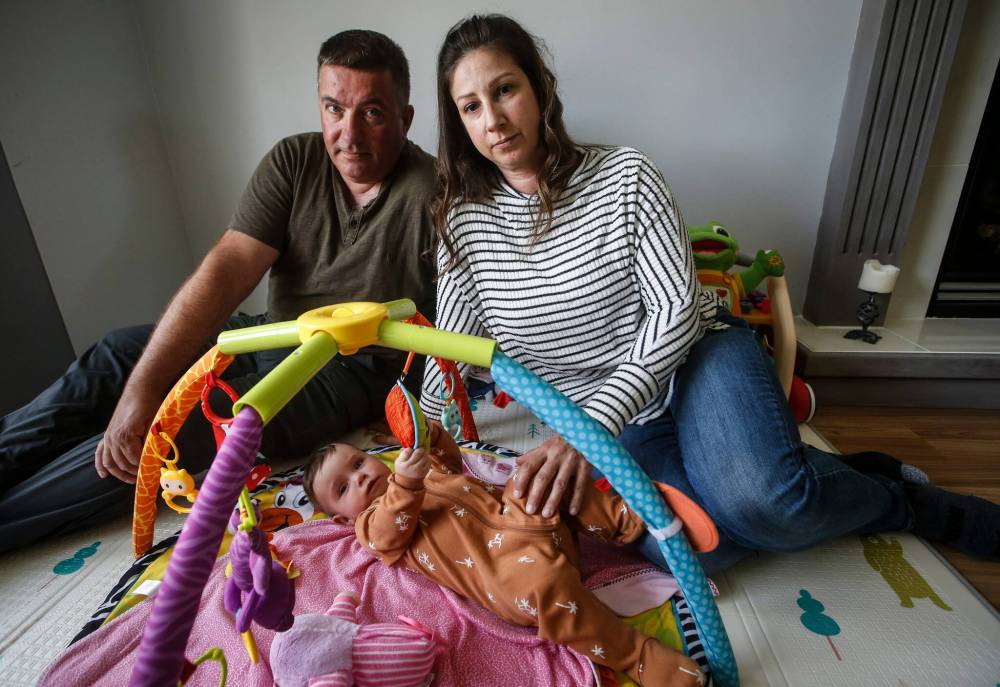
JOHN WOODS / FREE PRESS
Tim and Jaclyn Blazanovic used a surrogate to have baby Amelia — now Jaclyn is receiving 33 per cent of her pay while on maternity leave instead of the 93 per cent she was expecting.
Despite meeting every other requirement, and paying the same union dues as other new mothers, Jaclyn is now receiving 33 per cent of her pay, the federal standard for extended parental leave benefits, a shock she and Tim are calling discrimination against surrogate parents.
“I never thought it was going to be a problem because it’s my child, it’s our our child,” Jaclyn said.
“It’s heartbreaking, it’s disheartening. How would you feel?” Tim said. “You’d feel left at the side of the curb, forgotten about, ignored.”
Over the last eight months, the couple has gone to the Manitoba Labour Board, the province’s ombudsman, the Legal Aid Society and even the Manitoba Human Rights Commission — all said the couple’s only recourse was to file a union grievance. Jaclyn said her boss and Pan Am’s human resource department were sympathetic, but said their hands were tied by the collective agreement.
The couple said they were originally told by Jaclyn’s employer that she would qualify for the top-up, and recently purchased a house. Now, she is considering going back to work early, but said it’s been impossible to find a daycare.
Their lives have been thrown into disarray.
“If we didn’t have (help from) family — for somebody else, how would this have turned out for them? They would’ve lost their house, they would have lost everything, and been on the street with a baby,” Tim said.
CUPE 204 has filed a grievance with the Winnipeg Regional Health Authority and a hearing is scheduled for July 2.
“I never thought it was going to be a problem, because it’s my child, it’s our our child.”–JaclynBlazanovic
Shannon McAteer, the union’s health-care co-ordinator, said in her 18 years as a union representative, this is the first time she’s seen this issue be raised.
“This is unique, and this is the first time it’s come into my realm. It was surprising,” she said.
The union is currently in the middle of bargaining after its last collective agreement expired in March. McAteer declined to comment on the grievance but said it being brought forward was an opportunity to discuss how parenting is defined in the collective agreement.
“If nothing else, it shone a light on something that no one really had, I think, given too much mind to until it came up. Because, if it hasn’t come up before, we may not have known that there was an issue,“ she said.
Manitoba has been slow to update its legislation around surrogacy in the past, making the Blazanovic’s struggle less surprising for Angela Truppe, the founder of national advocacy group Canadian Surrogacy Community.
Before 2021, parents who conceived children through assisted reproduction were not legally considered the child’s parents without a court order or adoption, which could be a lengthy and expensive process. At the time, other provinces such as Ontario, British Columbia and Saskatchewan already had new laws in place.
Truppe, who has provided support to the Blazanovics, said she has yet to hear of a collective agreement requiring a biological parent to qualify for any aspect of parental benefits in any other province.

“This is not something I think exists in any other province, not that I’m aware of … the parents in the birth registration, if the birth is registered to you, that’s all you need to present, you don’t have to prove you gave birth,” she said.
“This is unique, and this is the first time it’s come into my realm. It was surprising.”–Shannon McAteer, union health-care co-ordinator
She called the situation a “very clear human rights violation.”
“Every person that moves into this position of having to advocate for new legislation or new changes within anything surrogacy, they’re in for a fight,” she said.
“I think we need people like Tim and Jackie to be able to go, ‘No, actually, this isn’t right.’ This is 2024.”
malak.abas@freepress.mb.ca
Malak Abas is a city reporter at the Free Press. Born and raised in Winnipeg’s North End, she led the campus paper at the University of Manitoba before joining the Free Press in 2020. Read more about Malak.
Every piece of reporting Malak produces is reviewed by an editing team before it is posted online or published in print — part of the Free Press‘s tradition, since 1872, of producing reliable independent journalism. Read more about Free Press’s history and mandate, and learn how our newsroom operates.
Our newsroom depends on a growing audience of readers to power our journalism. If you are not a paid reader, please consider becoming a subscriber.
Our newsroom depends on its audience of readers to power our journalism. Thank you for your support.
Malak Abas is a city reporter at the Free Press. Born and raised in Winnipeg’s North End, she led the campus paper at the University of Manitoba before joining the Free Press in 2020. Read more about Malak.
Every piece of reporting Malak produces is reviewed by an editing team before it is posted online or published in print — part of the Free Press‘s tradition, since 1872, of producing reliable independent journalism. Read more about Free Press’s history and mandate, and learn how our newsroom operates.
Our newsroom depends on a growing audience of readers to power our journalism. If you are not a paid reader, please consider becoming a subscriber.
Our newsroom depends on its audience of readers to power our journalism. Thank you for your support.
Advertisement Advertise With Us
Advertisement Advertise With Us