Kinew: the patriot Premier explains renewed love of Canada
Read this article for free:
or
Already have an account? Log in here »
To continue reading, please subscribe:
Digital Subscription
One year of digital access for only $1.44 a week*
- Enjoy unlimited reading on winnipegfreepress.com
- Read the E-Edition, our digital replica newspaper
- Access News Break, our award-winning app
- Play interactive puzzles
*Billed as $5.77 plus GST every four weeks. After 52 weeks, price increases to the regular rate of $19.95 plus GST every four weeks. Offer available to new and qualified returning subscribers only. Cancel any time.
To continue reading, please subscribe:
Add Free Press access to your Brandon Sun subscription for only an additional
$1 for the first 4 weeks*
- Enjoy unlimited reading on winnipegfreepress.com
- Read the E-Edition, our digital replica newspaper
- Access News Break, our award-winning app
- Play interactive puzzles
*Your next Brandon Sun subscription payment will increase by $1.00 and you will be charged $17.95 plus GST for four weeks. After four weeks, your payment will increase to $24.95 plus GST every four weeks.
Read unlimited articles for free today:
or
Already have an account? Log in here »
Hey there, time traveller!
This article was published 28/06/2024 (847 days ago), so information in it may no longer be current.
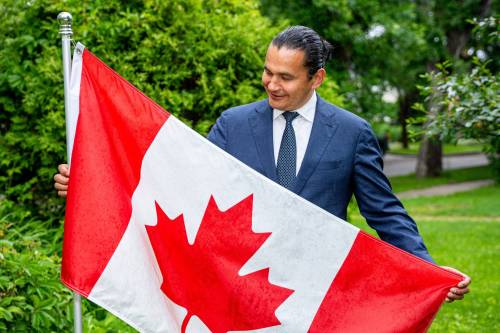
Manitoba’s First Nations premier says his feelings are so strong for Canada, that he proudly flies the Maple Leaf in front of his home.
“I’m a patriot. I’m a proud Canadian. I’m a proud Manitoban and I encourage other people, young Indigenous people in particular, to view themselves in the same way,” Wab Kinew said ahead of Canada’s 157th birthday.
Queen Victoria remains in storage
The Queen Victoria statue that stood in front of the Manitoba legislature before it was toppled and decapitated on July 1, 2021, by demonstrators protesting the discovery of potential gravesites at a B.C, residential school, remains in storage.
The Queen Victoria statue that stood in front of the Manitoba legislature before it was toppled and decapitated on July 1, 2021, by demonstrators protesting the discovery of potential gravesites at a B.C, residential school, remains in storage.
“It’s going to remain there till we’re moving forward with our future plans,” Premier Wab Kinew said earlier this week. “It’s something we’ll make public next year.”
Crowds pulled down the massive statue from its base using ropes. The head was removed and later plucked from the Assiniboine River.
The former Progressive Conservative government said last year that the statue was beyond repair and rejected the idea of replicating it due to an estimated cost of more than $500,000.
Historians have said the wrecked statue of the colonial queen is an important part of Manitoba’s story and should be put on display somewhere in the appropriate historical context.
The sentiment is in sharp contrast to three years ago, when the discovery of potential gravesites at former residential schools sparked the toppling of the giant Queen Victoria statue in front of the Manitoba legislature by Indigenous protesters. One year later, The Forks scrubbed the word “Canada” from its July 1 celebrations.
Kinew, who is also Manitoba’s minister for reconciliation, said he bought the flag after returning home from D-Day ceremonies in Normandy earlier this month.
“The reason why I did that is because of the immense privilege and humility — that I get to serve as a part of our democracy, and in recognition of the people who paid the price of admission for us to be part of this thing,” Kinew said in an interview Thursday.
“The trip to Normandy put into very clear terms the shared project that is our country and the role that we play in the world, and Indigenous peoples are part of that,” he said. “We had so many powerful, moving experiences.”
The premier recalled meeting a French citizen who was in tears as she described the Canadians who stormed the beaches on June 6, 1944, when she was a nine-year-old girl, to begin the liberation of Europe.
In that battle-scarred corner of France, he saw Canadian flags flying everywhere.
His group visited cemeteries where thousands of soldiers are buried to honour Canada’s war dead. The gravestones were marked with crosses, stars of David and names from an array of backgrounds, including familiar Indigenous names such as Beardy, Chartrand and Genaille, Kinew said.
“I cannot tell you what it feels like, the patriotism that you feel in your heart when you sing our national anthem in a cemetery surrounded by 2,000 white tombstones commemorating our soldiers who gave their lives in the name of democracy — and you’re there with the survivors of D-Day and veterans of D-Day who are 99 or 100 or over 100.”
NIC ADAM / FREE PRESS Premier Wab Kinew purchased and installed a Canadian flag at his home after an eye-opening trip to Normandy as part of D-Day ceremonies earlier this month.
The premier listened to young people from Pimicikamak Cree Nation at Beny-sur-Mer cemetery as they paid tribute to gunner Rose Beardy, who was from their community and died fighting for democracy. Kinew later saw them at a monument honouring Canada’s First Nations veterans.
Those Indigenous soldiers, many of whom had attended residential schools, didn’t have the right to vote or the opportunities available to other Canadians, the premier noted.
“In spite of those barriers and the challenges they faced, they still answered the call of duty. They fought for our country and a higher ideal of liberty, justice, democracy and freedom — just like their fellow Canadian soldiers from every other walk of life in this country,” said Kinew, who spoke to the Pimicikamak youth.
“I said, ‘There’s only one world and you’re a part of it. I hope you always remember that someone just like you, from your community, paid the price of the ticket for you to be part of this thing. I hope you remember you have just as much of a right to participate — not just in Pimicikamak, but in Manitoba and in Canada’,” the premier said.
“My pride in who I am as a Canadian, as a Manitoban, as an Anishinaabe person, is not a denial of any of the challenging parts of our past. It’s a recognition of the fact that people have sacrificed so much for somebody like me to have the opportunities that I do today. It’s an embrace of the hope that we’re going to continue moving forward, as a province and a country, to advance the journey that we’re on to make this the best place that it can be in the future.”
Flying the Canadian flag is a way to show it, he said.
“When I say ‘I am celebrating Canada Day with family,’ I really do mean that I will be celebrating Canada Day,” said the premier, who will be in Alberta this long weekend to watch one of his sons play in a football tournament.
Canada Day message from Lt-Gov. Anita Neville
“Canada Day is a time to come together as a province and a nation in celebration of all we have accomplished as a country, but also to pause and reflect on our collective journey and commit to the work that lies ahead.
The Canadian flag, with its iconic maple leaf, has long been recognized around the world as a symbol of peace, freedom, acceptance and dignity. Today, in communities large and small, our flag will be central to a shared celebratory spirit of the greatness and very promising future it represents.
“Canada Day is a time to come together as a province and a nation in celebration of all we have accomplished as a country, but also to pause and reflect on our collective journey and commit to the work that lies ahead.
The Canadian flag, with its iconic maple leaf, has long been recognized around the world as a symbol of peace, freedom, acceptance and dignity. Today, in communities large and small, our flag will be central to a shared celebratory spirit of the greatness and very promising future it represents.
While we celebrate this great nation we call home, we must also acknowledge the truths of the past that were extremely harmful to Indigenous people, and the pain that remains. As Canadians we must all commit to listening and learning, and working together to ensure that all citizens have equal opportunity to succeed and thrive.
Whether you are Canadian by birth or by choice, now more than ever, we must focus on what unites us all, as we go forward. We all have the power to effect change. Simple acts of kindness, respect for differing opinions, taking care of our families, neighbours, communities, our environment, our physical and mental health.
I have great optimism for our future. On this Canada Day, and every day, I encourage everyone to take time for reflection and gratitude, to better appreciate where we have been and where we are going, as we continue to work together to build a better future for all.”
In Winnipeg, The Forks will host Canada Day events once again after controversially removing “Canada” from its July 1 programming in 2022 and calling it “New Day at The Forks.”
At the time, it upset former Winnipeg Liberal cabinet minister Lloyd Axworthy, who was instrumental in the creation of The Forks and later endorsed Kinew for premier.
“There is a pattern developing where we almost are awkward to call ourselves Canadians,” Axworthy said in 2022.
This year, Canada Day at The Forks will be celebratory and reflective and seen through a “lens of reconciliation,” spokesperson Zach Peters said.
In 2022, after the discovery of more potential residential school gravesites, New Day at The Forks focused on reflection, reconciliation and Indigenous teachings rather than a celebration.
On Monday, it’s expected Canadian flags, orange reconciliation shirts and all kinds of cultural attire will be on display.
“It’s wonderful to see this fantastic mix of individuals coming down,” Peters said.
carol.sanders@freepress.mb.ca

Carol Sanders
Legislature reporter
Carol Sanders is a reporter at the Free Press legislature bureau. The former general assignment reporter and copy editor joined the paper in 1997. Read more about Carol.
Every piece of reporting Carol produces is reviewed by an editing team before it is posted online or published in print — part of the Free Press‘s tradition, since 1872, of producing reliable independent journalism. Read more about Free Press’s history and mandate, and learn how our newsroom operates.
Our newsroom depends on a growing audience of readers to power our journalism. If you are not a paid reader, please consider becoming a subscriber.
Our newsroom depends on its audience of readers to power our journalism. Thank you for your support.