A decade of distress, determination, dismay Tina Fontaine’s slaying 10 years ago helped to bring the national tragedy of missing and murdered Indigenous women and girls into focus; the anguish and anger that followed produced calls to action, but little else
Read this article for free:
or
Already have an account? Log in here »
To continue reading, please subscribe:

Digital Subscription
One year of digital access for only $205*
- Enjoy unlimited reading on winnipegfreepress.com
- Read the E-Edition, our digital replica newspaper
- Access News Break, our award-winning app
- Play interactive puzzles
*First annual payment billed as $205.00 + GST for one year. This annual subscription will automatically renew at $233.00 + GST every 52 weeks (10% off the regular annual price of $259.35). Offer available to new and qualified returning subscribers only. Cancel any time.
To continue reading, please subscribe:
Add Free Press access to your Brandon Sun subscription for only an additional
$1 for the first 4 weeks*
- Enjoy unlimited reading on winnipegfreepress.com
- Read the E-Edition, our digital replica newspaper
- Access News Break, our award-winning app
- Play interactive puzzles
*Your next Brandon Sun subscription payment will increase by $1.00 and you will be charged $17.95 plus GST for four weeks. After four weeks, your payment will increase to $24.95 plus GST every four weeks.
Read unlimited articles for free today:
or
Already have an account? Log in here »
Hey there, time traveller!
This article was published 09/08/2024 (760 days ago), so information in it may no longer be current.
He was just eight years old when Tina Fontaine’s body — wrapped in plastic and a duvet cover and weighed down by rocks — was pulled from the Red River near the Alexander Docks.
Elroy Fontaine is now 18, three years older than his big sister was, and it’s clear the 10th anniversary of her death — she was last seen alive on Aug. 8, 2014, her body discovered in the river nine days later — is devastating for him.
The soft-spoken teen describes his upbringing, marred by “sorrow and pain,” after she was gone.
“Tina was the only one who was very motherly and caring towards me, and growing up in the city after she passed, and knowing what happened to my sister, and being in care and how the system failed her, it was very scary,” he says.
RUTH BONNEVILLE / FREE PRESS Elroy Fontaine looks out over the the Alexander Docks just off Waterfront drive where the remains of his sister, Tina, were found in the water 10 years ago. 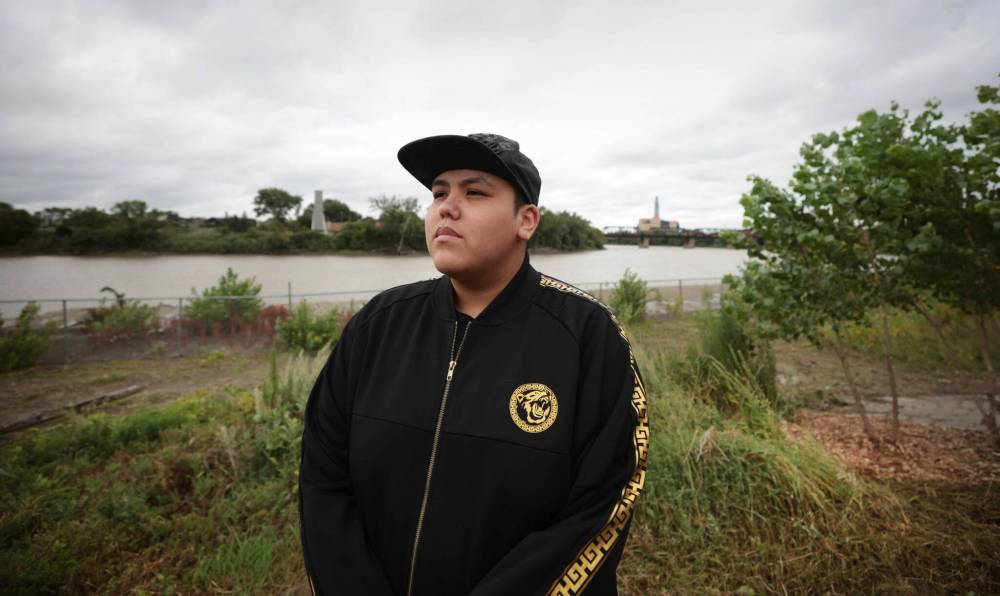
While small in stature at five-foot-three and 72 pounds at the end of her short life, the impact of her tragic death created massive shock waves across the country, leading to the National Inquiry into Missing and Murdered Indigenous Women and Girls, along with grassroot local groups such as Drag the Red and the Bear Clan.
But as national and provincial politicians and organizations talked policy, Elroy struggled; he was in and out of hospitals, group homes, homeless shelters and perpetually involved with Child and Family Services. He was terrified, convinced that he was pre-destined to live a similar life — and suffer a similar death — that his sister and so many other Indigenous youths in Manitoba experience.
“It made me worry a lot and think, ‘Am I going to be next? Am I going to end up like my sister?’” he says. “That was my main worry growing up in life without her.”
A few months ago, he decided to open up about the abuse he endured as a child at the hands of a family member. He’s a regular face at marches and protests in support of finding other missing Indigenous women, be it through landfill searches or reopened missing-persons cases.
“It made me worry a lot and think, ‘Am I going to be next? Am I going to end up like my sister?’”–Elroy Fontaine
He has organized a vigil Saturday evening at the Alexander docks, near the spot where Tina was found, to mark a decade since her death.
He knows his sister’s memory was, and is, a transformative force in Manitoba — there is “a lot more awareness and more groups of people who are coming out and doing things to help the community and to keep the community safe,” he says.
But his difficult life, more than half of it informed by a heartache that never fades, makes him wonder if any of the gaps that Tina fell through have closed.
“The community has changed,” he says. “But not the systems.”
For most of the last 10 years, Manitoba has been governed by Progressive Conservatives. Brian Pallister defeated NDP premier Greg Selinger in 2016, followed, briefly, by Kelvin Goertzen and, later, by Heather Stefanson, who lost to Premier Wab Kinew’s NDP last October.
The Tories went on the offensive during last summer’s election season, incorporating Stefanson’s decision not to fund a landfill search to find the remains of two slain Indigenous women into the party’s campaign ads. Stefanson defended the ads until the the day before the election.
She apologized for the ads after losing the election.
Preparations to search Prairie Green Landfill north of Winnipeg for two of admitted serial killer Jeremy Skibicki’s victims are moving forward.
Premier Wab Kinew says his decision to enter politics began, in part, with Tina’s story.
“When we have contemporary issues, like searching the landfill or making the investment in (MMIWG) endowment, these are things we’re doing today to try and prevent situations like this and to help families in similar situations, but it does trace its way back to Tina,” Kinew told the Free Press this week.
FACEBOOK Tina Fontaine, 15, was reported missing on August 9, 2014.
The province will release its formal strategy on MMIWG in a few weeks. Part of that strategy is a $15-million endowment fund announced May 5, coinciding with Red Dress Day, a national day of advocacy for missing and murdered Indigenous people.
The grant-based funding will be provided, in part, to Indigenous-led organizations providing on-the-ground support to families of missing and murdered Indigenous women, girls and two-spirit people, but will also be provided directly to families.
Both Families Minister Nahanni Fontaine and Minister of Housing, Addictions and Homelessness Bernadette Smith clearly remember the day Tina was found.
“I remember just crying and thinking, ‘This is it, this is the galvanization of people coming together around something so sacred — this little girl is bringing people together in such a tragic way,’” Smith says.
Her own sister, Claudette Osborne, went missing in 2008 and her case remains unsolved.
Fontaine rushed home to Sagkeeng First Nation. She remembers promising Thelma Favel, Tina’s great aunt and caregiver, that the community would gather to remember the 10-year anniversary of her death.
And it will. Fontaine will be at the First Nation Saturday for a memorial walk and a community feast.
Tina is buried there.
“It just so happens that now, as government, as ministers, we’re able to host something and put some action behind it, and that was a promise that I made to her many, many years ago.”
Five years after Tina was slain, a report commissioned by the Manitoba Advocate for Children and Youth painted a bleak picture of the safety nets that failed to catch her.
Born to a 17-year-old mother in CFS care and traumatized by her father’s beating death in 2011, she began to miss school, ran away from home, engaged in self-harm and was sexually exploited by men while living in Winnipeg, 125 kilometres southwest of her Sagkeeng home.
Nine days before her body was found, she was taken to hospital after being found unconscious in a back alley. A doctor there had concerns she had been “sexually exploited in some way,” and she was placed in a hotel with a CFS worker. That was the last time she was seen alive.
JOHN WOODS / THE CANADIAN PRESS FILES Copies of a report on the death of fifteen year old Tina Fontaine released by Daphne Penrose in 2019.
The 115-page document calls for sweeping improvements to child-welfare agencies, youth addictions treatment and schools. Author Daphne Penrose called Tina’s struggles part of a “shameful legacy” rooted in colonialism in Canada.
“Children are going to die if we don’t make changes,” she said at the time “This can’t be another report that gets shelved.”
Her story was one of many that inspired the national inquiry into MMIWG, which produced 231 calls for justice in 2019. Five years later, few have been completed.
Hilda Anderson-Pyrz leads the National Family and Survivors Circle, established in response to the inquiry.
Some of the most important calls that have yet to be completed, she says, focus on establishing independent accountability measures outside of the federal government, agencies that could receive complaints and concerns from Indigenous groups and individuals.
“(Without that), we’re going to continue to see a lack of action, and that lack of action results in the continuance of the violence we experience, how we go missing and how we end up murdered,” she says.
A report commissioned by the federal government published in June said many of the 600-plus people interviewed for the report believed there was “little action compounded by a lack of accountability” on the issue and outlined a timeline that could see a national ombudsperson and 13 regional counterparts in place by 2025.
Investments into the calls for justice and improved supports for at-risk Indigenous youths have been made since Tina’s death, but limited progress means the suffering continues.
“The change has been very slow. Is it fast enough? Absolutely not… the nation should be deeply concerned that this national crisis is still ongoing,” Anderson-Pyrz says.
Raymond Cormier, the man acquitted in 2018 of second-degree murder in Tina’s death, died in Ottawa in April.
Cormier met Tina in 2014, and he admitted to arguing with her shortly before she died but denied killing her.
The investigation that led to his arrest included surveillance bugs in his apartment and interviews with undercover police officers. No DNA evidence was ever found.
When Manitoba Keewatinowi Okimakanak Grand Chief Garrison Settee thinks about Tina, he also thinks about injustice.
“That is the thing that is so unfortunate about her passing, is that there’s no justice for Tina Fontaine, and that should never happen in this country,” he says.
“That is the thing that is so unfortunate about her passing, is that there’s no justice for Tina Fontaine, and that should never happen in this country.”–MKO Grand Chief Garrison Settee
He believes Indigenous youths are made vulnerable because of things that aren’t entirely obvious to people outside of First Nations communities. A recent concern brought to his attention, for example, is young girls forced to evacuate their homes with their families because of wildfires.
Some have been approached in city hotels by adults who could be predators, he said.
In 2017, MKO created its MMIWG liaison unit with the goal of establishing a safe place for families to find comfort and support with each other. The unit provides counselling, shows up to trials and tries to provide holistic, culturally informed support to at-risk youth, Settee says.
“That’s what we are doing, preventative measures and being proactive,” he says. “That needs to continue to happen.”
Statistics Canada data released in 2022 found that Manitoba had the highest rate of Indigenous homicide victims in the country.
Community members in Gods Lake Narrows still gather where 15-year-old Leah Anderson was found brutally beaten to death in 2013 to call for justice. No arrests have been made in relation to her death.
Last week, 18-year-old Kendara Ballantyne’s loved ones held their annual walk in her memory. She was found dead in The Pas in 2019 and her case is still unsolved.
Tina’s legacy is in those walks, in the advocacy work MKO and other organizations do and in families fighting to keep Indigenous women and girls safe, Settee says.
“I think it woke us up,” he says. “It woke up the nation and showed that this is a real epidemic and that something must be done, and leadership must be involved.”
malak.abas@freepress.mb.ca

Malak Abas is a city reporter at the Free Press. Born and raised in Winnipeg’s North End, she led the campus paper at the University of Manitoba before joining the Free Press in 2020. Read more about Malak.
Every piece of reporting Malak produces is reviewed by an editing team before it is posted online or published in print — part of the Free Press‘s tradition, since 1872, of producing reliable independent journalism. Read more about Free Press’s history and mandate, and learn how our newsroom operates.
Our newsroom depends on a growing audience of readers to power our journalism. If you are not a paid reader, please consider becoming a subscriber.
Our newsroom depends on its audience of readers to power our journalism. Thank you for your support.
Related Articles
Honoring Tina Fontaine’s legacy in Canada’s journey towards reconciliation






History
Updated on Friday, August 9, 2024 7:29 PM CDT: Makes grammatical change