Undelivered justice, unimaginable pain A history of indifference and broken promises made to Canada’s permanently grief-stricken Indigenous Peoples is in sharp focus on the eve of an accused serial killer’s Winnipeg murder trial
Read this article for free:
or
Already have an account? Log in here »
To continue reading, please subscribe:

Digital Subscription
One year of digital access for only $205*
- Enjoy unlimited reading on winnipegfreepress.com
- Read the E-Edition, our digital replica newspaper
- Access News Break, our award-winning app
- Play interactive puzzles
*First annual payment billed as $205.00 + GST for one year. This annual subscription will automatically renew at $233.00 + GST every 52 weeks (10% off the regular annual price of $259.35). Offer available to new and qualified returning subscribers only. Cancel any time.
To continue reading, please subscribe:
Add Free Press access to your Brandon Sun subscription for only an additional
$1 for the first 4 weeks*
- Enjoy unlimited reading on winnipegfreepress.com
- Read the E-Edition, our digital replica newspaper
- Access News Break, our award-winning app
- Play interactive puzzles
*Your next Brandon Sun subscription payment will increase by $1.00 and you will be charged $17.95 plus GST for four weeks. After four weeks, your payment will increase to $24.95 plus GST every four weeks.
Read unlimited articles for free today:
or
Already have an account? Log in here »
Hey there, time traveller!
This article was published 26/04/2024 (868 days ago), so information in it may no longer be current.
Nestled next to her bed, Susan Caribou keeps a wooden table — painted in four colours sacred to First Nations people — that features a large portrait of her smiling niece, Tanya Nepinak, who disappeared 13 years ago.
The picture is gently placed alongside a smudge bowl, traditional medicines and a wooden figure of a girl in which Caribou sees one of the untold victims of Canada’s crisis of missing and murdered Indigenous women and girls.
“That little round table is Tanya’s table. I smudge her picture, and I smudge this little girl I have that’s holding an eagle feather,” says Caribou, tears rolling down her cheeks.
Tanya Nepinak (File) 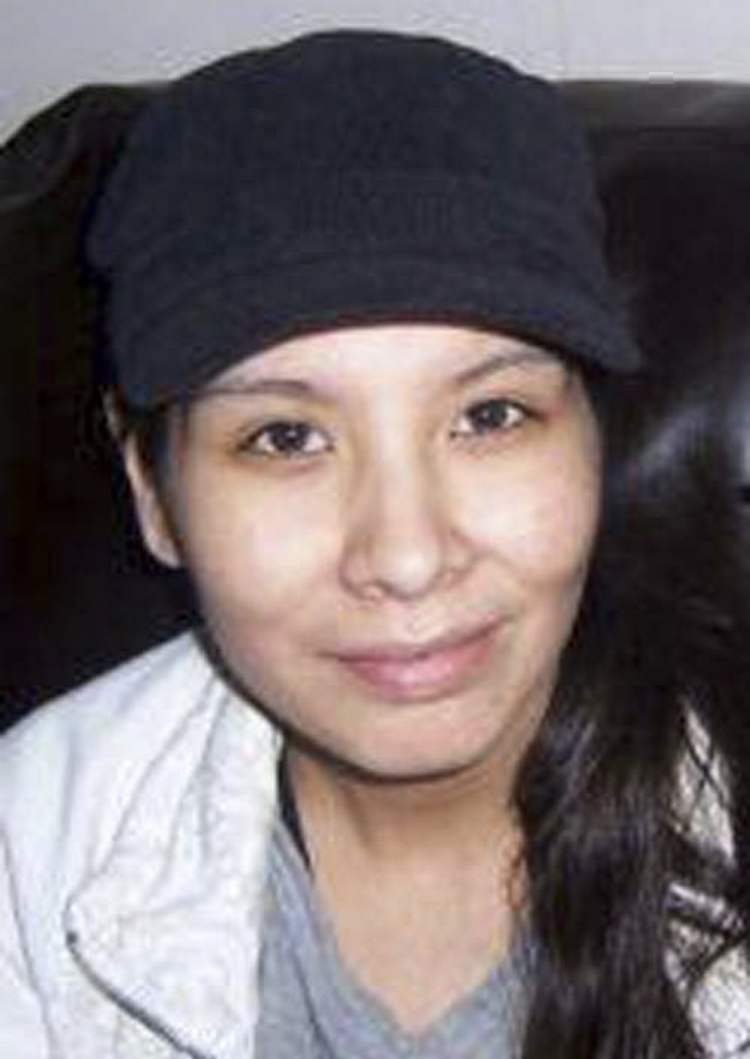
“That little girl there that’s holding that feather, I picture my niece holding a feather and asking for help, and nobody is responding to her.
“So, I keep smudging her, and I pray all the time for justice — for us to find Tanya so we can have that closure.”
Nepinak, 31, vanished the night of Sept. 13, 2011, after leaving her Sherbrook Street home to walk to a pizza restaurant.
Winnipeg police believe she was slain by a serial killer and her body put in a garbage bin that was deposited in the city-run Brady Road landfill, some 20 kilometres away.
The mother of two was not found during a landfill search that lasted less than a week. The Crown later stayed a second-degree murder charge against her alleged killer.
Nepinak’s family, who said they — and many other Indigenous families — were failed, still cling to hope that she will be found.
Her disappearance was among the high-profile cases that escalated calls for an eventual national inquiry into MMIWG, which produced 231 calls for justice in 2019. Few have been completed.
When it begins hearing evidence May 8, the trial of a different alleged serial killer is expected to put a spotlight on the crisis, and Winnipeg, its epicentre.
In that case, Jeremy Skibicki is charged with four counts of first-degree murder in the 2022 deaths of Rebecca Contois, Morgan Harris, Marcedes Myran and an unidentified woman, who was given the name Mashkode Bizhiki’ikwe (Buffalo Woman) by elders. All were Indigenous.
Some of Contois’ remains were recovered from the Brady Road landfill. A section of privately owned Prairie Green Landfill, just north of Winnipeg, will be searched for Harris, Myran and Buffalo Woman, after the provincial and federal governments each committed $20 million.

Caribou has followed the case closely. She has attended rallies and other events to call for landfill searches. She is committed to ensuring her niece is not forgotten.
She recalled Nepinak as someone who was caring, generous and loved to sing.
“Tanya was beautiful inside and out. She was one of a kind,” says Caribou.
While there are no present commitments, she hopes Brady Road will be searched again for Nepinak, who would have turned 45 later this year, and other people who may be there.
“What if it was their loved one? Would they leave their loved one in the dump and offer a monument up there?” says Caribou, who is Cree.
“What if it was their loved one? Would they leave their loved one in the dump and offer a monument up there?” –Susan Caribou
“That’s what they offered my family. I don’t want a monument, because she doesn’t belong up there. Nobody belongs in the landfill.”
Various organizations and the RCMP have tried to come up with estimates, but the precise number of missing and murdered Indigenous women and girls in Canada isn’t known.
The Native Women’s Association of Canada has estimated it to be 4,000.
A 2015 report by the RCMP cited 1,224 deaths or disappearances between 1980 and 2012. Advocates have said the true number is much higher due to under-reporting, misclassifications or other factors.
Susan Caribou's niece Tanya Nepinak, 31, vanished the night of Sept. 13, 2011, after leaving her Sherbrook Street home to walk to a pizza restaurant. (Ruth Bonneville / Winnipeg Free Press)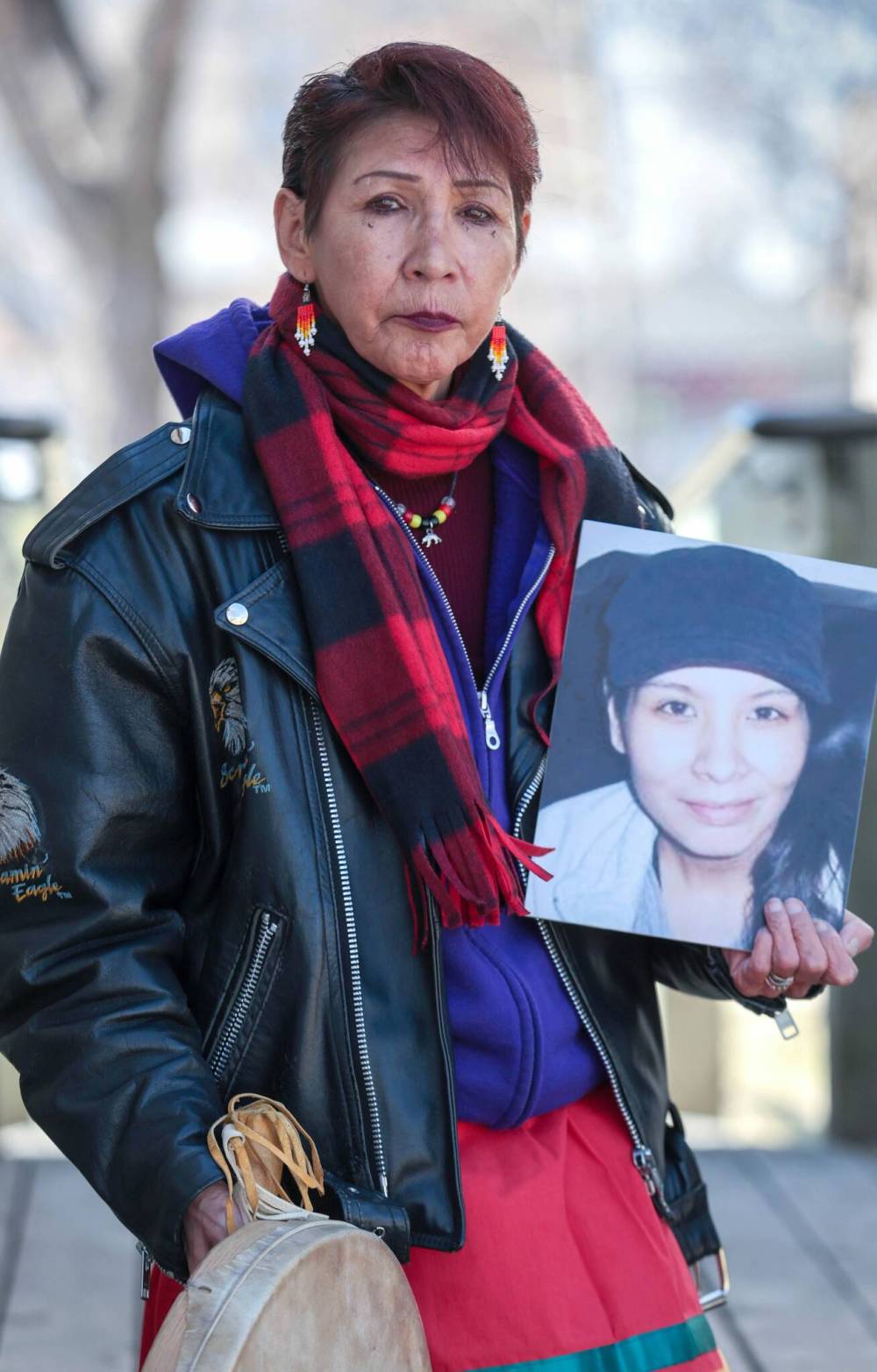
Advocates and groups, such as Amnesty International, have raised concerns some deaths or disappearances were not properly investigated.
It may be difficult to find a First Nations family or community in Manitoba that hasn’t been affected by the crisis.
“I can talk to anybody and they can share a story with me as to how they’re impacted, and as to how they lost a loved one,” says Grand Chief Cathy Merrick of the Assembly of Manitoba Chiefs.
In 2022, Manitoba reported the highest number of Indigenous female (16) and male (45) homicide victims of any province or territory.
The province had the fourth-largest Indigenous population (237,190) in Canada in the 2021 census. Winnipeg had the largest urban Indigenous population (102,080).
Multiple studies have shown Indigenous Peoples are more likely to be victims of violent crime. They are overrepresented among people accused of crimes or incarcerated.
“I can talk to anybody and they can share a story with me as to how they’re impacted, and as to how they lost a loved one.”–Grand Chief Cathy Merrick
For Indigenous women and girls, the data is stark and sobering.
They are six times more likely to be a victim of homicide than non-Indigenous women and girls, according to a Statistics Canada study of cases between 2009 and 2021.
But they don’t need studies to tell them what they already know.
“It’s just so obvious. It’s just so seen,” says Nicole Murdock, a Cree and Anishinaabe student of criminal justice and Indigenous studies at the University of Winnipeg.
“It’s fact. It’s lived experience.”
Research has linked violent victimization of Indigenous Peoples to colonial policies, including the residential school system, forced apprehension of children, marginalization and institutionalized racism, StatCan has noted in studies.
Those policies have disrupted community and family structures, and caused intergenerational trauma, which are linked to violent victimization, the agency said.
Caribou, a residential school survivor who has lost multiple family members to violence, including her parents, carries the weight of that trauma.

“The justice system already failed us, when we were put in residential schools,” she says.
Women and girls are often subjected to the worst consequences, including violence, in many communities that struggle with issues such as poverty, addictions and discrimination or poor mental health, the StatCan study said.
A majority of homicides of women and girls, regardless of background, between 2009 and 2021 were classified as “cleared” by police, meaning a suspect was identified.
Most female victims are killed by an intimate partner, family member or someone they know, the study said.
StatCan said 45 per cent of the cases involving Indigenous women and girls resulted in a guilty finding, compared with 43 per cent of cases involving non-Indigenous victims.

A guilty decision was returned in 33 per cent of cases where the victim was an Indigenous man or boy. Merrick says many Indigenous young men also go missing or are murdered.
“We also need to look at that, and look at it through the same process as MMIWG,” she says.
Among Indigenous communities, there is historic mistrust of colonial governments and their systems, including criminal justice, and law enforcement.
“Generally, the common-law system hasn’t been a place for Indigenous Peoples,” says Marc Kruse, director of Indigenous legal learning and services in the University of Manitoba’s law school. “It’s a main tool of dispossession and oppression of Indigenous Peoples.”
It makes little sense to expect the system that continues to perpetuate harm in Indigenous communities will bring justice for MMIWG, Murdock says.
“I personally don’t know or believe that we can ever have reconciliation within the system as it exists today,” she says.
“I personally don’t know or believe that we can ever have reconciliation within the system as it exists today.”–Nicole Murdock
Indigenous people do not feel heard or seen, or they regard the system as one that doesn’t respect their autonomy, says Kruse, a criminal defence lawyer.
Manitoba has faced calls to create Indigenous courts that take a restorative justice approach.
“We’re really only left with this colonial system and structure, which wasn’t designed for Indigenous world views,” he says.
Nepinak was someone who lived by routine. Whenever she left home, she let her family know where she was going and when she would return, Caribou says.
When she didn’t come home the night of Sept. 13, 2011, her worried family began looking for her.
“You know your own loved ones, right?” says Caribou.
She says the family felt brushed off when they initially reported Nepinak missing.
The following June, suspected serial killer Shawn Lamb was charged with second-degree murder in the deaths of Nepinak, Lorna Blacksmith, 18, and Carolyn Sinclair, 25, who was pregnant.
Sinclair’s body was found behind a Notre Dame Avenue apartment building. Blacksmith was discovered in a backyard on Simcoe Street.
In October 2012, police searched part of the Brady Road landfill for Nepinak, but the effort ended after six days.
Nepinak’s family wanted the search to continue until she was found, and said the investigators were focusing on the wrong area of the dump.
The way the search played out is a painful and frustrating subject for Caribou.
“It was a joke,” she says. “It was to shut my family up.”
Related Articles
Potential search of landfills painful reminder for aunt of missing woman













Lamb, meanwhile, was sentenced to 20 years in prison in November 2013 after admitting to manslaughter in the deaths of Blacksmith and Sinclair as part of a plea deal.
Days later, the Crown confirmed the murder charge in Nepinak’s death was stayed because there wasn’t enough evidence to secure a conviction. Lamb, then 54, denied killing her.
In Blacksmith and Sinclair’s deaths, the entire case was based on confessions Lamb made to police while in custody on an unrelated matter.
The Crown was forced to make a deal with Lamb — a drug addict and career criminal — on the strong likelihood his admissions would be tossed out of court at trial, the Free Press reported at the time.
Police later confirmed they paid Lamb $600 to do the interview in which he admitted to killing Blacksmith and Sinclair in his Notre Dame Avenue apartment.
Less than a year after he was sentenced, the death of missing 15-year-old Tina Fontaine amplified calls for the national inquiry. The Sagkeeng First Nation teen’s body was found in the Red River in August 2014.
In the hours before she went missing, she had contact with police, health-care and child-welfare staff.
“When you don’t have closure, you’re not at ease in your life. Your sleeping patterns, your eating habits, your health just goes down, because you’re carrying so much hurt, worry and loss.”–Susan Caribou
Justice has also eluded Fontaine’s family.
A jury found Raymond Cormier, then 56, not guilty of second-degree murder in February 2018. He was recently found dead in Ontario.

“When you don’t have closure, you’re not at ease in your life,” says Caribou. “Your sleeping patterns, your eating habits, your health just goes down, because you’re carrying so much hurt, worry and loss.
“You think of your loved one every day.”
June 3 will mark five years since the National Inquiry into Missing and Murdered Indigenous Women and Girls presented its final report.
Persistent and deliberate human and Indigenous rights violations and abuses committed and condoned by the Canadian state represent genocide against Indigenous women, girls and 2SLGBTQQIA people, it concluded.

The two-volume document called for transformative legal and social changes to resolve the crisis.
It delivered 231 calls for justice to governments, institutions, social services, industries and Canadians. With few completed, Indigenous leaders and advocates have demanded more urgency.
“A lot of times, these inquiries collect dust, because nobody is really pushing or nobody is really calling them out to ensure the recommendations are being looked at and are being fulfilled the way they should be,” says Merrick.
“The Aboriginal Justice Inquiry (of Manitoba, commissioned in 1988, with its report released in 1991) was kind of set aside, too.
“We have to be at the table. We cannot allow anybody else to make decisions on our behalf anymore.”
Murdock says it boils down to a lack of will by governments and others.
She worries some people may be losing hope, after promises of reconciliation were made when the Truth and Reconciliation Commission of Canada released its final report in 2015.
To help solve the MMIWG crisis, Murdock says, answers lie in social organizations that fill gaps and tend to the needs of people and families and the education of children.
“We need to, on a broad scale, just value the human life in whatever shape or form, and recognize that people are valuable and deserve dignity,” she says.
Systemic underfunding and under-supporting of Indigenous Peoples or their communities must be addressed, Kruse says.
“There’s not just one system that’s broken. It’s the entire way of treating Indigenous Peoples and thinking about Indigenous Peoples,” he says.
“There’s not just one system that’s broken. It’s the entire way of treating Indigenous Peoples and thinking about Indigenous Peoples.”–Marc Kruse
Merrick and Caribou say people who come to Winnipeg from First Nations — for medical appointments, education or other purposes — lack supports.
“When you’re urban, you don’t belong anywhere,” says Caribou. “A lot of us go missing and murdered, because we don’t have a home. We don’t have a community that will help us.”
Governments and police agencies are among those who’ve made promises to listen to and work with Indigenous Peoples to advance reconciliation and solve the MMIWG crisis.
Manitoba’s NDP government this year budgeted $20 million for a provincial MMIWG2S+ strategy. The work is a direct response to the calls for justice, and it will begin their implementation, the government said.
Some of the funds will go toward 24-7 safe spaces and Indigenous-led programs, Families Minister Nahanni Fontaine said.
The province has also appointed an adviser and set up a matriarch circle to identify priorities and solutions.
“The only way we’re going to tackle this issue is if we empower our women and our communities,” says Fontaine, chair of the MMIWG2S+ and gender-based violence committee of cabinet.
She has noticed progress toward awareness, education and support since she started working on MMIWG in 1999, a time when advocates were dismissed.
In last fall’s election, Manitoba elected Wab Kinew, its first First Nations premier, who promised a search of Prairie Green Landfill.

The incumbent Progressive Conservatives were condemned for campaigning on their opposition to a search.
“(The Tories) were wholly rejected by Manitobans who said that is unacceptable. That was an important moment in our history in Manitoba,” Fontaine says.
“To me, there is no greater example of how far we actually have come. Having said that, there is still so much work to be done.”
In 2021, the federal government launched an action plan and pathway to end the crisis. The 2024 budget contains initial funding for a regional Red Dress Alert system to notify the public of missing Indigenous women, girls and two-spirit people.
Manitoba RCMP and Indigenous leaders announced a joint action circle in December to develop MMIWG strategies.
“The Manitoba RCMP is committed to a path forward in addressing violence and discrimination against Indigenous women, girls and (LGBTTQ+) peoples,” spokeswoman Cpl. Julie Courchaine wrote in an email.
RCMP and the Winnipeg Police Service said they are partnering with Indigenous leaders and organizations to help build trust and relationships.
Both provide trauma-informed and cultural awareness training to officers and civilian staff, and have made attempts to hire more Indigenous people.
“We can make a big difference by working together,” said WPS community engagement Supt. Bonnie Emerson, who is Indigenous. “We are partnering and establishing relationships, and not trying to take the space.”
chris.kitching@freepress.mb.ca

Chris Kitching is a general assignment reporter at the Free Press. He began his newspaper career in 2001, with stops in Winnipeg, Toronto and London, England, along the way. After returning to Winnipeg, he joined the Free Press in 2021, and now covers a little bit of everything for the newspaper. Read more about Chris.
Every piece of reporting Chris produces is reviewed by an editing team before it is posted online or published in print — part of the Free Press‘s tradition, since 1872, of producing reliable independent journalism. Read more about Free Press’s history and mandate, and learn how our newsroom operates.
Our newsroom depends on a growing audience of readers to power our journalism. If you are not a paid reader, please consider becoming a subscriber.
Our newsroom depends on its audience of readers to power our journalism. Thank you for your support.