

Bunibonibee Cree Nation’s 2,500 residents evacuated because of wildfire

Advertisement
Read this article for free:
or
Already have an account? Log in here »
To continue reading, please subscribe:

Digital Subscription
One year of digital access for only $205*
- Enjoy unlimited reading on winnipegfreepress.com
- Read the E-Edition, our digital replica newspaper
- Access News Break, our award-winning app
- Play interactive puzzles
*First annual payment billed as $205.00 + GST for one year. This annual subscription will automatically renew at $233.00 + GST every 52 weeks (10% off the regular annual price of $259.35). Offer available to new and qualified returning subscribers only. Cancel any time.
To continue reading, please subscribe:
Add Free Press access to your Brandon Sun subscription for only an additional
$1 for the first 4 weeks*
- Enjoy unlimited reading on winnipegfreepress.com
- Read the E-Edition, our digital replica newspaper
- Access News Break, our award-winning app
- Play interactive puzzles
*Your next Brandon Sun subscription payment will increase by $1.00 and you will be charged $17.95 plus GST for four weeks. After four weeks, your payment will increase to $24.95 plus GST every four weeks.
Read unlimited articles for free today:
or
Already have an account? Log in here »
Hey there, time traveller!
This article was published 14/08/2024 (764 days ago), so information in it may no longer be current.
A growing wildfire and threatening winds are forcing some 2,500 residents of a remote northern Manitoba community to flee.
On Wednesday, a 5,747-hectare fire was raging 10 kilometres south of Bunibonibee Cree Nation.
“It’s a full evacuation of the community,” Canadian Red Cross spokesman Jason Small said Wednesday.
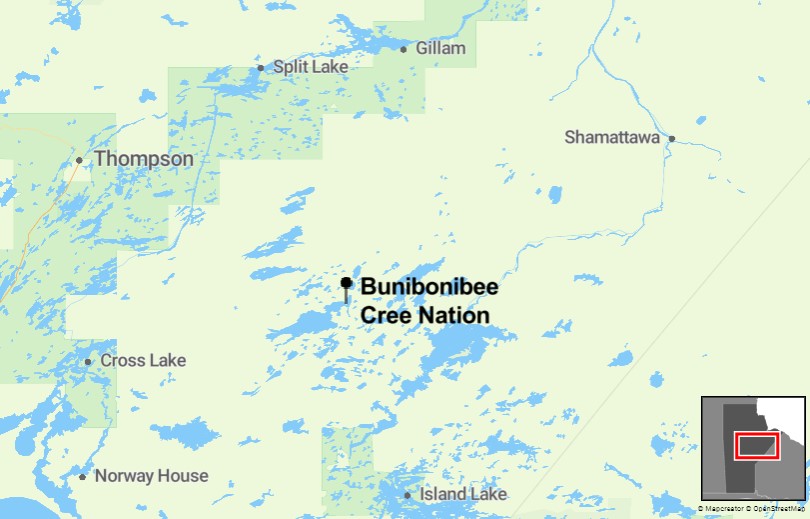
With a south wind on the way Wednesday, the fire could edge closer to the First Nation 950 kilometres northeast of Winnipeg, the Manitoba government said in a wildfire update.
Sprinklers were set up in the community and more resources were being sent there Wednesday.
Harjit Sajjan, the federal minister of emergency preparedness, said Wednesday he had approved a request by the province for the Canadian Armed Forces to help with the evacuation.
In addition to Bunibonibee, vulnerable residents were being moved from three other northern communities because of air quality concerns: Nisichawayasihk Cree Nation (formerly known as Nelson House), Tataskweyak Cree Nation, York Factory First Nation.
“It has been very smoky since Monday morning,” Nisichawayasihk Cree Nation Chief Angela Levasseur said by phone Wednesday.
She said 175 NCN citizens, including 17 residents from its personal care home, were transported Tuesday night and Wednesday morning from the First Nation 850 kilometres north of Winnipeg to Brandon, 944 km to the south. The elderly, those with chronic health conditions, asthma and newborn babies were removed from the community as a safety precaution, the chief said.
As northern communities struggle with poor air quality, the province issued a heat warning for the region Wednesday.
The communities of Brochet, Tadoule Lake, Gillam, Island Lake, Shamattawa, Churchill and York have seen recent daytime temperatures of 29 C or higher, a news release stated.
An Emergency Management Organization update issued Tuesday said three wildfires are burning approximately 45 kilometers west of NCN.
The partial evacuation planned for York Factory residents hadn’t yet begun, Small said. Evacuees from other northern communities, however, have been away from home for weeks.
“We’re still supporting people from four other First Nations that evacuated at the end of the month or early August,” Small said.
The Red Cross is also helping some evacuees return home. Small said some community members from Gods Lake, St. Theresa Point First Nation, Wasagamack First Nation, Red Sucker Lake Anisininew Nation and Manto Sipi Cree Nation have returned home.
Residents of Marcel Colomb First Nation remain in hotels. The evacuation of the community 800 km northwest of Winnipeg began July 23. Some 260 residents have been staying in Winnipeg, Thompson, The Pas and Lynn Lake.
“The return home is up to the leadership of their communities to determine when it’s safe for the folks to go back,” Small said.
The Red Cross co-ordinates the flights and accommodations but could not say how many wildfires evacuees are in Manitoba.
“Our team is working to pull together numbers,” Small said. “We register people once they arrive where they stay, but I don’t have anything concrete.”
Small said the Red Cross works with First Nations’ leadership “to support whatever they need,” including recreation and other activities for evacuees.

The largest fire burning in Manitoba is more than 35,000 hectares — 35 km north of Garden Hill, 22 km south of Gods Lake Narrows and 40 km west of Red Sucker Lake.
Another fire 23 km east of Pukatawagan is about 21,900 hectares. A fire 60 km northeast of Thompson and 55 km west of Split Lake is an estimated 18,000 hectares.
The province said there are 71 active wildfires across the province and a total of 233 wildfires so far this year.
“Lightning and human-caused fires continue to persist with hot and dry conditions, although there could be some scattered and isolated showers across Manitoba over the next few days,” the wildfire update said.
carol.sanders@freepress.mb.ca
Carol Sanders
Legislature reporter
Carol Sanders is a reporter at the Free Press legislature bureau. The former general assignment reporter and copy editor joined the paper in 1997. Read more about Carol.
Every piece of reporting Carol produces is reviewed by an editing team before it is posted online or published in print — part of the Free Press‘s tradition, since 1872, of producing reliable independent journalism. Read more about Free Press’s history and mandate, and learn how our newsroom operates.
Our newsroom depends on a growing audience of readers to power our journalism. If you are not a paid reader, please consider becoming a subscriber.
Our newsroom depends on its audience of readers to power our journalism. Thank you for your support.
Carol Sanders
Legislature reporter
Carol Sanders is a reporter at the Free Press legislature bureau. The former general assignment reporter and copy editor joined the paper in 1997. Read more about Carol.
Every piece of reporting Carol produces is reviewed by an editing team before it is posted online or published in print — part of the Free Press‘s tradition, since 1872, of producing reliable independent journalism. Read more about Free Press’s history and mandate, and learn how our newsroom operates.
Our newsroom depends on a growing audience of readers to power our journalism. If you are not a paid reader, please consider becoming a subscriber.
Our newsroom depends on its audience of readers to power our journalism. Thank you for your support.
Related Articles
Saskatchewan First Nation calls for help after community evacuated due to wildfire

Advertisement Advertise With Us
Advertisement Advertise With Us
History
Updated on Wednesday, August 14, 2024 7:46 PM CDT: Adds more information