Manitoba bans cellphones for K-8 students New rules announced in bid for ‘distraction-free’ classes; high schoolers must also power down
Read this article for free:
or
Already have an account? Log in here »
To continue reading, please subscribe:
Digital Subscription
One year of digital access for only $1.44 a week*
- Enjoy unlimited reading on winnipegfreepress.com
- Read the E-Edition, our digital replica newspaper
- Access News Break, our award-winning app
- Play interactive puzzles
*Billed as $5.77 plus GST every four weeks. After 52 weeks, price increases to the regular rate of $19.95 plus GST every four weeks. Offer available to new and qualified returning subscribers only. Cancel any time.
To continue reading, please subscribe:
Add Free Press access to your Brandon Sun subscription for only an additional
$1 for the first 4 weeks*
- Enjoy unlimited reading on winnipegfreepress.com
- Read the E-Edition, our digital replica newspaper
- Access News Break, our award-winning app
- Play interactive puzzles
*Your next Brandon Sun subscription payment will increase by $1.00 and you will be charged $17.95 plus GST for four weeks. After four weeks, your payment will increase to $24.95 plus GST every four weeks.
Read unlimited articles for free today:
or
Already have an account? Log in here »
Hey there, time traveller!
This article was published 15/08/2024 (797 days ago), so information in it may no longer be current.
Manitoba has announced a ban on cellphones in elementary schools and strict rules to silence devices and keep them out of sight during Grade 9-12 lessons next month.
Kindergarten to Grade 8 students will be barred from using phones at any point in the school day, including during lunch and recess.
High schoolers will be asked to leave their phones in their locker, with a teacher or at the principal’s office when classes are in session.
Teenagers can access their devices on breaks and when a classroom teacher approves usage for educational purposes.
Exemptions will be made for medical and accessibility reasons.
“Distraction-free environments are learning environments,” Education Minister Nello Altomare told reporters during a news conference at the Manitoba legislature on Thursday.
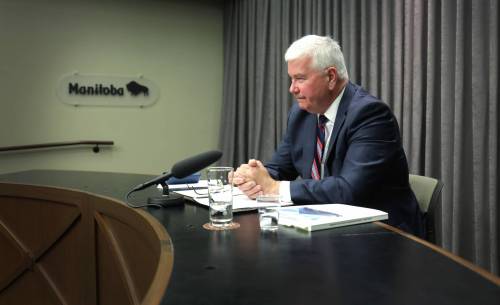
MIKAELA MACKENZIE / FREE PRESS Education minister Nello Altomare shows new school signage (related to the cell phone ban) in his office at the Manitoba Legislative Building.
“Let’s not forget a lot of these apps, a lot of these programs are meant to distract you — they’re meant to take you off task.”
In rolling out the directive, the NDP government cited studies showing it can take up to 20 minutes for a child to refocus on what they were learning after a distraction.
Nico De Guzman, 15, said he often gets sucked into spending far too much time watching videos and scrolling social media on his phone.
“I always want to be on my phone,” said the Winnipeg student who’s entering Grade 10.
He said he’s conflicted about the phone ban for that reason, although he believes it will ultimately make students more engaged in course content and force them to socialize face-to-face.
Many local schools have created their own building-specific bans to discourage in-class texting and mindless scrolling over the last year.
The francophone division was the first to take wide-ranging action across its 24 schools in September 2023.
A provincewide mandate will give teachers a “backbone” to enforce limited screentime, said Lindsay Girard, an elementary school teacher from Oak Bluff who has three school-aged children of her own.
“Parenting has gone by the wayside. We see it in schools all the time — kids have zero respect, they have no manners, teachers are left to teach kids absolutely everything. They’re coming to school with zero (preparation),” Girard said.
NIC ADAM / FREE PRESS Melissa Walker (right), a mother of four from Birds Hill, is pictured alongside her sons Ethan Fillion, 8, and David, 14, outside their house.
“I think it’s because they’ve been shoved in front of a device since they were a toddler.”
The teacher of 18 years said cyberbullying has become a growing issue and it is negatively impacting student wellbeing.
School phone restrictions won’t solve the problem entirely, but they will limit online interactions during the week and force students to set boundaries with their devices, she said.
The Canadian Centre for Child Protection also threw its “full support” behind the changes.
“This is a crucial step to help model and promote healthy digital habits for children in Manitoba — habits that will serve them well into their lives, making them less vulnerable to online harms,” education director Noni Classen said in a statement.
Manitoba is the last province in western Canada to bar phones from classrooms ahead of the 2024-25 school year.
School division leaders and private school principals have also been asked to ensure they have clear guidelines on employee phone use in their buildings.
Sean Kilpatrick / The Canadian Press files
The Progressive Conservatives had been calling on the NDP to follow the lead of Alberta, Ontario and Saskatchewan, the last of which announced a universal school phone ban on Aug. 6. British Columbia, Quebec and Nova Scotia have similar policies in place.
A spring survey conducted by a think tank based out of Toronto Metropolitan University found nearly eight in 10 Canadian residents support a cellphone ban in K-12 classrooms.
Critics have expressed concerns about wanting to be in touch with their children throughout the school day and how outlawing devices will affect digital literacy.
As far as Melissa Walker is concerned, Manitoba’s policy should go further and entirely restrict the use of phones in high schools.
Walker, a mother of four, confiscated her 13-year-old’s phone over the summer break to force him to go outside, get exercise and socialize with his friends face-to-face in Birds Hill.
In her experience, children and youth are not mature enough to manage their screen time.
“They think that they’re only on it for 10 minutes, but they’re on it for an hour and then it affects their behaviour because it’s all they want to do and then if you don’t let them do that, there’s lots of tantrums,” Walker said.
The education minister, who is a retired principal, said local school leaders will be in charge of specifics surrounding phone confiscation and other penalties for repeat offenders.
The Public Schools Act requires divisions to establish use-of-technology policies tailored to local needs.
The Manitoba Teachers’ Society welcomed the prospect of a blanket ban addressing the repetitive status-quo involving members constantly reminding students to put their phones away.
Union president Nathan Martindale said he wants to know how members will be expected to police phone use, what will happen if a confiscated device is damaged or lost, and how the policy will impact workloads overall.
No additional provincial dollars have been earmarked for phone storage infrastructure or enforcement efforts.
maggie.macintosh@freepress.mb.ca

Maggie Macintosh
Education reporter
Maggie Macintosh reports on education for the Free Press. Originally from Hamilton, Ont., she first reported for the Free Press in 2017. Read more about Maggie.
Funding for the Free Press education reporter comes from the Government of Canada through the Local Journalism Initiative.
Every piece of reporting Maggie produces is reviewed by an editing team before it is posted online or published in print — part of the Free Press‘s tradition, since 1872, of producing reliable independent journalism. Read more about Free Press’s history and mandate, and learn how our newsroom operates.
Our newsroom depends on a growing audience of readers to power our journalism. If you are not a paid reader, please consider becoming a subscriber.
Our newsroom depends on its audience of readers to power our journalism. Thank you for your support.
Related Articles
Cellphones — the good, the bad and the addictive















History
Updated on Thursday, August 15, 2024 12:12 PM CDT: Adds new details, quotes.
Updated on Thursday, August 15, 2024 12:37 PM CDT: Adds teacher comment from news release; minor edits
Updated on Thursday, August 15, 2024 6:38 PM CDT: Adds fresh art, more details