Near-equal split on need for new, more representative Manitoba flag, poll suggests
Read this article for free:
or
Already have an account? Log in here »
To continue reading, please subscribe:
Digital Subscription
One year of digital access for only $1.44 a week*
- Enjoy unlimited reading on winnipegfreepress.com
- Read the E-Edition, our digital replica newspaper
- Access News Break, our award-winning app
- Play interactive puzzles
*Billed as $5.77 plus GST every four weeks. After 52 weeks, price increases to the regular rate of $19.95 plus GST every four weeks. Offer available to new and qualified returning subscribers only. Cancel any time.
To continue reading, please subscribe:
Add Free Press access to your Brandon Sun subscription for only an additional
$1 for the first 4 weeks*
- Enjoy unlimited reading on winnipegfreepress.com
- Read the E-Edition, our digital replica newspaper
- Access News Break, our award-winning app
- Play interactive puzzles
*Your next Brandon Sun subscription payment will increase by $1.00 and you will be charged $17.95 plus GST for four weeks. After four weeks, your payment will increase to $24.95 plus GST every four weeks.
Read unlimited articles for free today:
or
Already have an account? Log in here »
Hey there, time traveller!
This article was published 19/08/2024 (792 days ago), so information in it may no longer be current.
New polling data shows Manitobans are divided on their opinions of the provincial flag, with some feeling the banner should be redesigned to remove British colonial symbols.
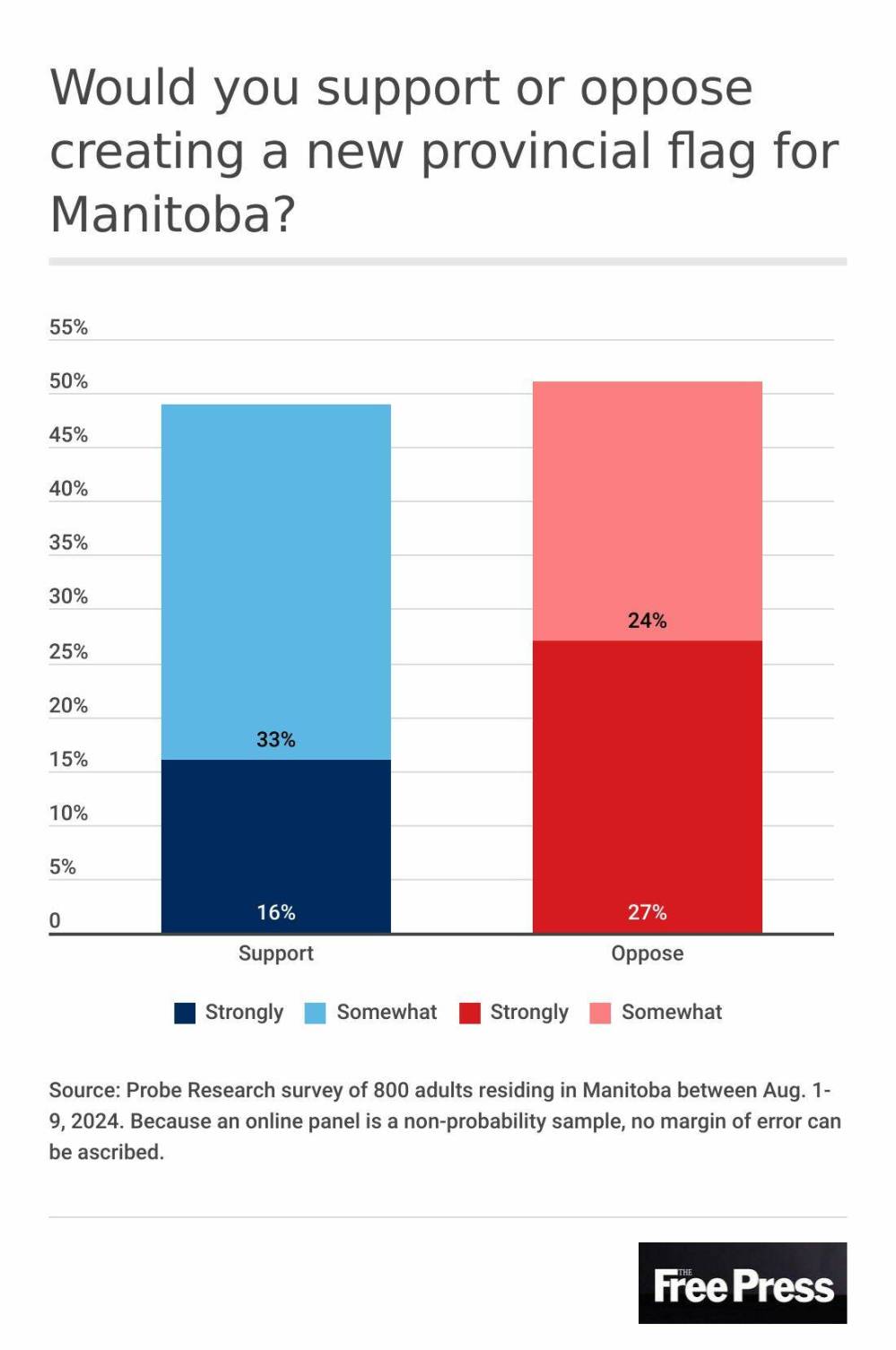
A Probe Research poll conducted earlier this month found an almost equal split on the flag. Approximately 49 per cent of respondents would like it replaced and 51 per cent want it left as is. Of the latter group, 27 per cent strongly oppose any change.
“There are always going to be people who think the existing symbols, the existing way of things works fine and we shouldn’t mess with it,” Probe principal Curtis Brown told the Free Press Monday.
“When we end up in these discussions about cultural touchstones, they can become pretty controversial.”
MIKAELA MACKENZIE / FREE PRESS Mathew Hobson, a sales associate at The Flag Shop on Osborne Street, displays the current Manitoba flag. According to a Probe Research poll, 49% of Manitobans would support creating a new flag for the province.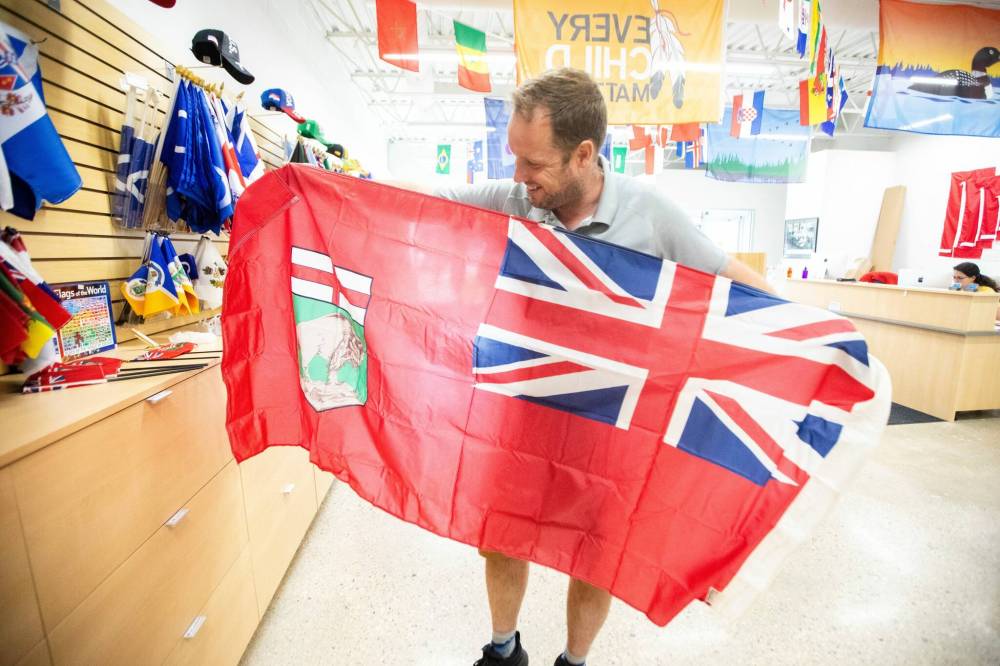
Probe chose to undertake the survey, which included responses from 800 people, to explore the “appropriateness of Manitoba’s provincial symbols,” it said.
Those who responded to the online survey are members of Probe Research’s proprietary panel, as well as members of another national online panel. Because an online panel is a non-probability sample, no margin of error can be ascribed.
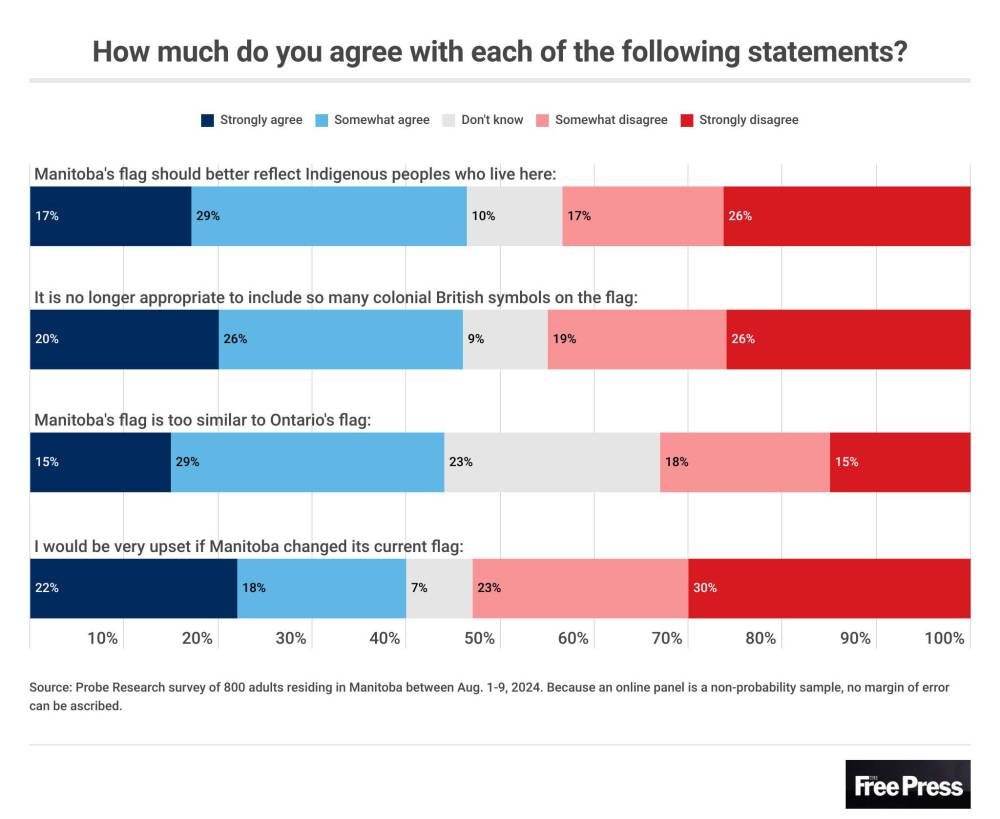
Respondents were evenly split on whether the flag should better reflect Manitoba’s Indigenous population. The response was similar to a question about whether the Union Jack and St. George’s Cross should remain.
“I think there has been a broader discussion about… British colonial symbols being officially part of the public record and our identity,” Brown said. “Now, we have a First Nations premier and a pretty diverse cabinet and government. That’s why I do wonder whether there would be any appetite to make that change.”
Manitoba’s current flag is similar to the Red Ensign that Canada used as a national flag before adopting the Maple Leaf design in 1965. It features a red background with a Union Jack in the upper left corner, and a shield bearing the provincial coat of arms.
According to the Manitoba government’s official description of the flag, the shield includes a bison to represent Indigenous people, who used the animal for food and clothing; the cross of St. George represents the patron saint of England.
“This cross was also found on the arms of the Hudson’s Bay Company, which originally governed the territory from which Manitoba was established,” the description says.
The province’s recognition of its colonial roots has sparked controversy in recent years, including on Canada Day in 2021, when protesters toppled a statue of Queen Victoria on the Manitoba legislature grounds, Brown said.
Elsewhere in Winnipeg, Bishop Grandin Boulevard was renamed to Abinojii Mikanah last year, removing the reference to a key architect of the residential school system.
“We appreciate Manitobans’ interest in the flag because it speaks to our collective desire to constantly improve our province. We’re proud of Manitoba’s flag.”–Glen Simard, minister responsible for culture and heritage
The Probe survey found younger adults and people living in Winnipeg are more likely to want a new flag. However, fewer than one in five said they were strongly in favour, and the remaining respondents said they were only somewhat supportive.
Older people and those living in rural Manitoba are more likely to be strongly opposed.
Voters who support the New Democratic Party government are more than three times as likely as Progressive Conservative voters to want change, the data shows.
The NDP said Monday it’s not considering any changes.
“We appreciate Manitobans’ interest in the flag because it speaks to our collective desire to constantly improve our province. We’re proud of Manitoba’s flag,” Glen Simard, the minister responsible for culture and heritage, said in an email statement.
“While we have no plans to redesign the flag, we’ll keep listening to Manitobans on this and other issues, with a focus on working together to build One Manitoba.”
Tory interim leader Wayne Ewasko also expressed little interest in changing the flag, saying politicians should focus on more critical issues.
Members of Manitoba’s former NDP government sought to change the flag in 2009, describing it as “outdated and a relic from the days of our former British colonial heritage.”
The Progressive Conservatives, then the Official Opposition, rejected the idea.
Brown said the current government might not want to waste political capital on what might be considered a trivial issue.
“I haven’t known a different flag than the current flag, so to see that change, it would have to be something that speaks to the majority of Manitobans,” said Mathew Hobson, a sales associate at The Flag Shop on Osborne Street.
“However, with new designs, there’s obviously the potential to fix some issues with old designs.”
Vexillologists (people who study flags) often cite Manitoba’s banner as an example of poor design, Hobson said.
The flag is nearly identical to Ontario’s provincial banner, which has the same layout with a different coat of arms. The similarities make it difficult for people unfamiliar with the flags to distinguish between the provinces, he said.
The North American Vexillological Association ranked the flags of 72 states, provinces, territories and districts in 2001. Ontario and Manitoba placed 43rd and 44th, respectively.
Hobson noted it is not unusual for governments throughout the world to change flags, with the practice becoming more commonplace in North America in recent years.

Generally speaking, the best flags feature simple, bold designs that represent the shared heritage and history of a group of people, he said.
He described the bison as “iconic and suitable for Manitoba” but said the overall design could be made more distinct.
If the province decides to change the flag in the future, it should form a committee to accept and review submissions from the public, Hobson said.
Manitoba Keewatinowi Okimakanak — a non-profit, political advocacy organization representing 26 First Nations in northern Manitoba — said it would welcome the opportunity to help design a new provincial flag, should the government move in that direction.
The Assembly of Manitoba Chiefs declined to comment.
tyler.searle@freepress.mb.ca

Tyler Searle is a multimedia producer who writes for the Free Press’s city desk. A graduate of Red River College Polytechnic’s creative communications program, he wrote for the Stonewall Teulon Tribune, Selkirk Record and Express Weekly News before joining the paper in 2022. Read more about Tyler.
Every piece of reporting Tyler produces is reviewed by an editing team before it is posted online or published in print — part of the Free Press‘s tradition, since 1872, of producing reliable independent journalism. Read more about Free Press’s history and mandate, and learn how our newsroom operates.
Our newsroom depends on a growing audience of readers to power our journalism. If you are not a paid reader, please consider becoming a subscriber.
Our newsroom depends on its audience of readers to power our journalism. Thank you for your support.