Largest tax hike in decades set in stone Mayor calls increase no-brainer since there’s no wiggle room in budget
Read this article for free:
or
Already have an account? Log in here »
To continue reading, please subscribe:

Digital Subscription
One year of digital access for only $205*
- Enjoy unlimited reading on winnipegfreepress.com
- Read the E-Edition, our digital replica newspaper
- Access News Break, our award-winning app
- Play interactive puzzles
*First annual payment billed as $205.00 + GST for one year. This annual subscription will automatically renew at $233.00 + GST every 52 weeks (10% off the regular annual price of $259.35). Offer available to new and qualified returning subscribers only. Cancel any time.
To continue reading, please subscribe:
Add Free Press access to your Brandon Sun subscription for only an additional
$1 for the first 4 weeks*
- Enjoy unlimited reading on winnipegfreepress.com
- Read the E-Edition, our digital replica newspaper
- Access News Break, our award-winning app
- Play interactive puzzles
*Your next Brandon Sun subscription payment will increase by $1.00 and you will be charged $17.95 plus GST for four weeks. After four weeks, your payment will increase to $24.95 plus GST every four weeks.
Read unlimited articles for free today:
or
Already have an account? Log in here »
Hey there, time traveller!
This article was published 24/12/2024 (634 days ago), so information in it may no longer be current.
Mayor Scott Gillingham has no plans to back down from the city’s highest proposed property tax hike in decades, despite his promise in the 2022 election to limit the annual increase to 3.5 per cent.
If council approves the preliminary 2025 budget as is on Jan. 29, the 5.95 per cent increase would mark the largest one-year hike since the 1990s.
A series of budget meetings with debates and public feedback will take place before the final vote.
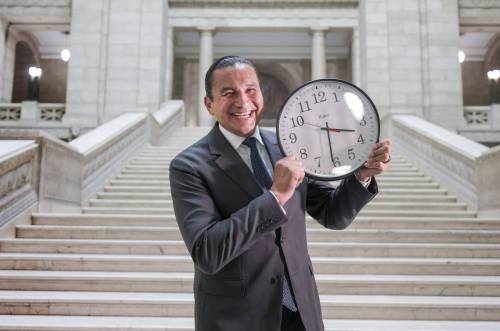
Mayor Scott Gillingham sits down to a year-end interview with the Free Press in his office at City Hall. (Mikaela MacKenzie / Free Press)
The mayor says he’s open to feedback but wouldn’t vote in favour of any motion to reduce the tax hike.
“I wouldn’t support it. The reality is, we need to continue to control expenses. There’s instruction within the proposed budget that calls on our (chief financial officer) to do (that) work… But we also need more revenue at the same time. So, the 5.95 per cent property tax increase will begin to get us the revenues we need,” said Gillingham, during a year-end interview.
Mayor Scott Gillingham (Mikaela MacKenzie / Free Press)
He stressed more revenue is desperately needed to support key budget plans, such as hiring 36 more police officers over the next two years and devoting $169 million to road renewal in 2025.
Gillingham has repeatedly argued more revenue is needed, partly because he has yet to secure a new growth funding model from the province that he linked to his pledge to stick to lower tax hikes.
The mayor stressed a property tax hike is also needed to reduce the risk of rising city costs, just as the municipal government expects to drain its rainy day by the end of 2024.
“There’s risk on workers compensation costs for fire, paramedics, transit. There’s risk on firefighter overtime. There’s risk on snow-clearing costs. So, there’s still a lot of risks within the budget that we have not fully funded, even with a 5.95 per cent property tax increase… We need to cover off some of those risks and we need to deliver services for a city that is growing rapidly. We have grown by 65,000 people over the last three years,” said Gillingham.
The mayor said he’s received “mixed” feedback on the proposed tax hike, but his office received fewer emails than he had expected. He said it appears most residents understand the financial pressure faced by the city.
Related Articles
Kinew puts stamp on 2024
Gillingham stressed maintaining and boosting key services is a high priority for Winnipeggers, which is why the budget increased funding for services such as the long-awaited “neighbourhood action teams” he promised during his 2022 election campaign.
In a mayoral campaign pledge, he promised to add 30 workers to those teams by “2023-24,” who would be cross-trained to plow, plant, patch, repair and replace, as needed.
The city set aside funding for 16 of those staff in 2024, while just eight have been hired and are still being trained, officials confirmed. The budget proposes to add 12 full-time positions to the teams next year.
The mayor said the first round of staff should officially be in action soon, following delays in recruiting and assigning them to unions.
“I expect them to be fully deployed… probably in the spring,” said Gillingham.
Mayor Scott Gillingham in his office at City Hall (Mikaela MacKenzie / Free Press)
The mayor described the cross-training as the biggest shift in public works service delivery in decades.
“Our departments are in silos in the delivery of services. This cross-trains people, breaks down some of the silos and empowers a team to get out there… (and) do a variety of jobs,” said Gillingham.
Meanwhile, the mayor also defended a controversial pilot project to raise the threshold to trigger snow removal on residential streets next winter. The budget proposal would increase that threshold to 15 cm of snow from 10 cm, starting next fall.
Mayor Scott Gillingham in a year-end interview with the Free Press (Mikaela MacKenzie / Free Press)
“Before making any permanent change, we’re just saying to residents, we’d like to test something out. Can you be patient with us while we test… to see if there’s an impact? If it’s positive, then maybe we could implement a permanent change. If the results are really negative, then maybe we keep things the way they are,” said Gillingham.
The mayor insisted the change would not mark a service cut, since it is not being considered on a permanent basis at this point.
When asked about efforts to combat homelessness and reduce the number of people who live in encampments, Gillingham said he expects more progress on that front in 2025. The mayor said that work should include addressing safety concerns at encampments near schools, daycares and rail lines.
“Some of the discussion that we’re having with (Manitoba Housing) Minister (Bernadette) Smith is about where we can make sure areas are safe… We have to have places for people (who are homeless) to go and live. It’s got to be stable housing with wrap-around support, so we could really begin to address the needs that they have,” said Gillingham.
joyanne.pursaga@freepress.mb.ca
X: @joyanne_pursaga

Joyanne is city hall reporter for the Winnipeg Free Press. A reporter since 2004, she began covering politics exclusively in 2012, writing on city hall and the Manitoba Legislature for the Winnipeg Sun before joining the Free Press in early 2020. Read more about Joyanne.
Every piece of reporting Joyanne produces is reviewed by an editing team before it is posted online or published in print — part of the Free Press‘s tradition, since 1872, of producing reliable independent journalism. Read more about Free Press’s history and mandate, and learn how our newsroom operates.
Our newsroom depends on a growing audience of readers to power our journalism. If you are not a paid reader, please consider becoming a subscriber.
Our newsroom depends on its audience of readers to power our journalism. Thank you for your support.
History
Updated on Tuesday, December 24, 2024 10:07 AM CST: Rearranges photos