MMF command centre gives evacuees ‘retail therapy’ Donations line walls of McGregor Street building, where people can grab essentials, get online and eat a hot meal
Read this article for free:
or
Already have an account? Log in here »
To continue reading, please subscribe:

Digital Subscription
One year of digital access for only $205*
- Enjoy unlimited reading on winnipegfreepress.com
- Read the E-Edition, our digital replica newspaper
- Access News Break, our award-winning app
- Play interactive puzzles
*First annual payment billed as $205.00 + GST for one year. This annual subscription will automatically renew at $233.00 + GST every 52 weeks (10% off the regular annual price of $259.35). Offer available to new and qualified returning subscribers only. Cancel any time.
To continue reading, please subscribe:
Add Free Press access to your Brandon Sun subscription for only an additional
$1 for the first 4 weeks*
- Enjoy unlimited reading on winnipegfreepress.com
- Read the E-Edition, our digital replica newspaper
- Access News Break, our award-winning app
- Play interactive puzzles
*Your next Brandon Sun subscription payment will increase by $1.00 and you will be charged $17.95 plus GST for four weeks. After four weeks, your payment will increase to $24.95 plus GST every four weeks.
Read unlimited articles for free today:
or
Already have an account? Log in here »
Hey there, time traveller!
This article was published 06/06/2025 (428 days ago), so information in it may no longer be current.
A tired-looking man walked into the Manitoba Métis Federation’s makeshift command centre for people displaced by wildfires with a simple request Friday afternoon.
“I just want to get settled in,” he told a group of volunteers that gathered around him at the building’s entrance.
The man arrived in Winnipeg earlier that day, one of more than 18,000 Manitobans who have had to flee their homes due to out-of-control wildfires across portions of the province. He knows he needs toiletries, and would appreciate a snack, but isn’t sure what else he might need.
A volunteer gestured toward the wall-to-wall piles of organized donations.
“Let’s get you some retail therapy.”
MIKE DEAL / FREE PRESS Kit Carleton, a staff member at the Louis Riel Institute, volunteers at the MMF’s emergency centre.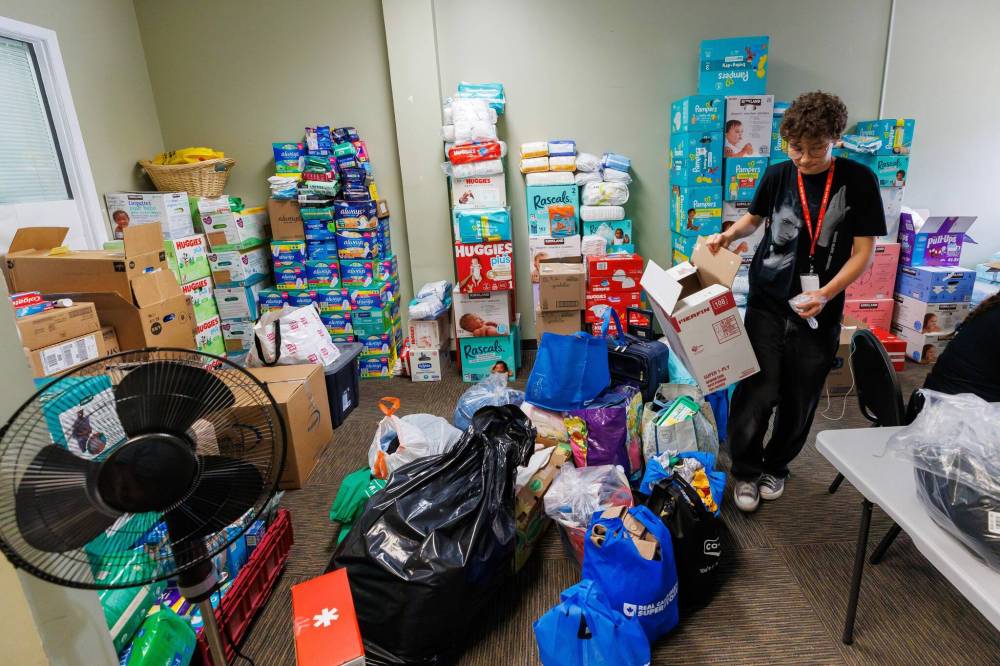
The building, at 406 McGregor St., thrums with activity. Thousands of donations fill every room and line the walls — food, drinks, stacks of folded clothes, books, baby formula, children’s activities and hygiene products.
In the back are some of the most hotly requested items: wheelchairs, walkers, baby chairs, strollers — assistive supports that people were forced to leave behind in the rush to get to safety.
Volunteers of all ages run from room to room, helping visitors and organizing donations.
In the front of the building, more immediate needs are met. Computers with Wi-Fi are arranged on a table for people to get online, a kids movie is projected on a rare empty wall, and colouring pages and toys are strewn about. Individual Saran-wrapped pieces of bannock with jam are popular with people walking in.
The doors are open for any evacuee who needs it, Red River Métis or otherwise, and MMF-sponsored buses pick up people staying in hotels who may be short on essentials, or for those just looking for something to do.
They’re encouraged to take their time and browse — volunteers and organizers describe it as shopping, and a break from the emergency that’s defined their lives for the last while.
“It’s a little bit of normalcy, and it’s a little bit of something that’s pleasant and good and gives them some choices, in a world where they haven’t had a ton of choices,” said MMF spokesperson Kat Patenaude, who has also taken on a liaison role in wildfire support evacuee efforts.
MIKE DEAL / FREE PRESS Stephanie Meilleur (right) director of Red River Métis community resources department talks to MMF media relations advisor is Kat Patenaude (left) in the command centre. 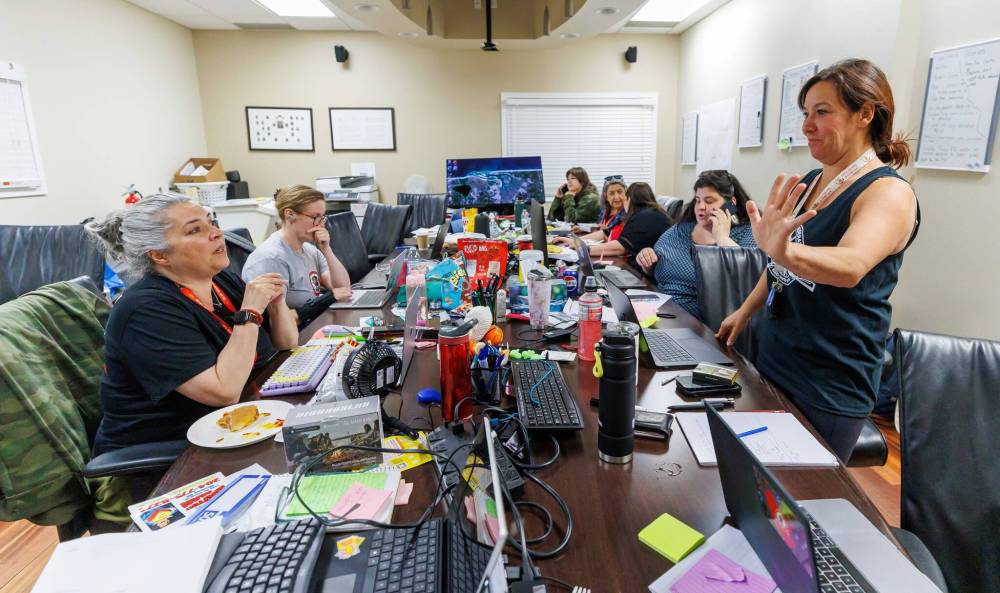
Mandatory evacuation orders are in place for at least 27 communities in Manitoba. While some are staying with family or friends, others are in hotel rooms or staying on cots in evacuee shelters.
Patenaude says hundreds of evacuees have passed through the doors in the weeks since the wildfires first broke out.
When it became clear the MMF wouldn’t have trouble soliciting donations or ensuring the needs of their membership were met, they began to strategize on how best to ensure people were getting the highest standard of care they could, with an Indigenous-led focus, said Stephanie Meilleur, the MMF’s community resources department director.
On the ground, it presents itself in different ways, she said: products for elders, mothers and infants stacked high, and hot cooked meals in the evenings consisting of staples like corn, fish, fry bread and soups — what someone visiting might have eaten at home.
“Evacuees are sitting in congregate shelters in other areas, and they’re being fed pizza and Subway and foods that they are not used to, and they are looking for that Indigenous warm meal, and we are happy to provide those meals at supper time every night here,” she said.
MIKE DEAL / FREE PRESS Savannah Sauvé (left) and Shelby Broatch put together a hamper of sandwiches for evacuees and volunteers. 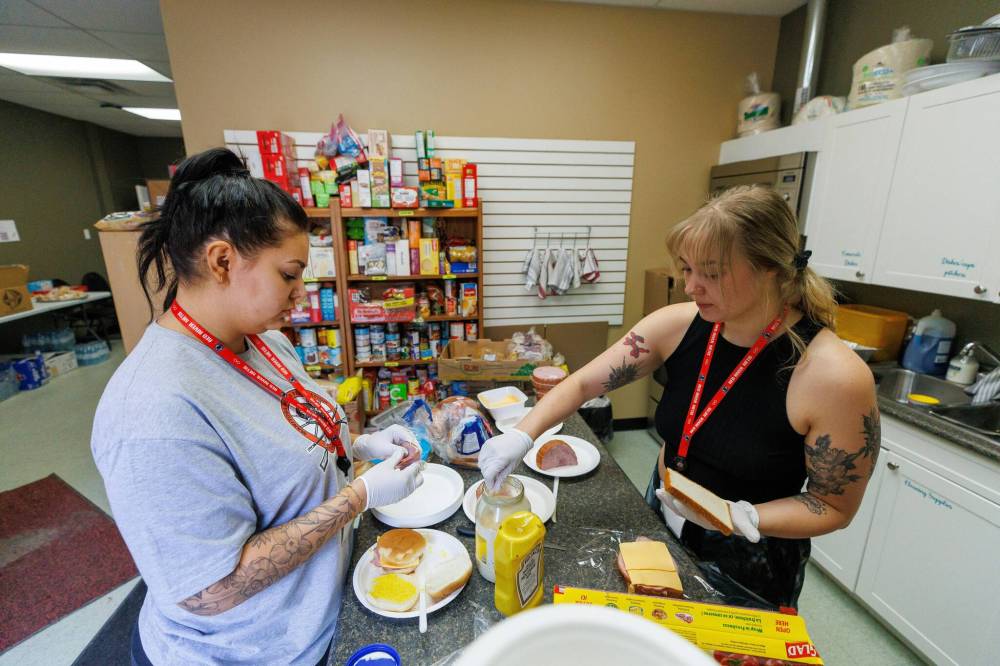
There are still a few high-demand products the centre seeks, namely baby formula, suitcases and luggage, strollers, and grocery carts. Meilleur said that evacuations, and the wildfires themselves, remain unpredictable, and they’re taking the level of need day-by-day.
“We are setting ourselves up to potentially be doing this long term. No one knows anything,” she said.
Meanwhile, at Red River College Polytech, therapy dogs were brought in Friday — but not for stressed-out students.
More than 100 evacuees were set to arrive at RRC Polytech’s Notre Dame campus Friday, where a temporary shelter with 180 cots has been set up in the North Gym.
The college has brought in counselors, and is making use of the educational tools at their disposal by offering tutoring services and programming for school-age evacuees.
“We’re stepping up for whatever it is that the the evacuees need, we’re going to be able to figure out a way to help them,” spokesperson Jodi Pluchinski said.
MIKE DEAL / FREE PRESS Volunteers load up a trailer headed to The Pas at 406 McGregor St. 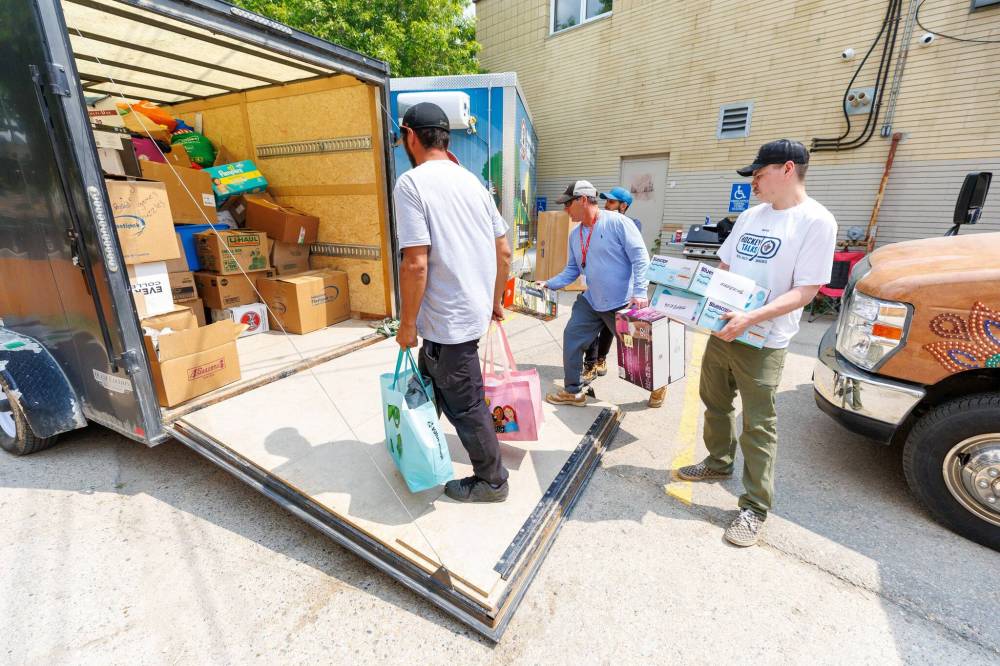
Other shelters, like the one set up in Winkler’s Meridian Exhibition Centre, are waiting on standby.
Winkler Mayor Henry Siemens said the entire city leapt to action when the province said evacuees could be sent their way. Within 24 hours, the building was filled with cots and basic supplies. Local businesses, religious organizations, and the neighbouring city of Morden reached out to ask how they could help.
“We mobilized extremely quickly,” Siemens said.
Despite around 800 Manitoba evacuees having been sent to hotels in Ontario, Winkler’s shelter remains empty. Siemens said around 40 evacuees are staying in hotels in the city.
He knows that could change at a moment’s notice, and said Winkler’s emergency response team is on high alert.
“At this time, our facility is fully ready,” he said.
“We have everything in place.”
malak.abas@freepress.mb.ca

Malak Abas is a city reporter at the Free Press. Born and raised in Winnipeg’s North End, she led the campus paper at the University of Manitoba before joining the Free Press in 2020. Read more about Malak.
Every piece of reporting Malak produces is reviewed by an editing team before it is posted online or published in print — part of the Free Press‘s tradition, since 1872, of producing reliable independent journalism. Read more about Free Press’s history and mandate, and learn how our newsroom operates.
Our newsroom depends on a growing audience of readers to power our journalism. If you are not a paid reader, please consider becoming a subscriber.
Our newsroom depends on its audience of readers to power our journalism. Thank you for your support.