

Residents riled over neighbourhood’s overgrown, neglected railway tracks

Advertisement
Read this article for free:
or
Already have an account? Log in here »
To continue reading, please subscribe:

Digital Subscription
One year of digital access for only $205*
- Enjoy unlimited reading on winnipegfreepress.com
- Read the E-Edition, our digital replica newspaper
- Access News Break, our award-winning app
- Play interactive puzzles
*First annual payment billed as $205.00 + GST for one year. This annual subscription will automatically renew at $233.00 + GST every 52 weeks (10% off the regular annual price of $259.35). Offer available to new and qualified returning subscribers only. Cancel any time.
To continue reading, please subscribe:
Add Free Press access to your Brandon Sun subscription for only an additional
$1 for the first 4 weeks*
- Enjoy unlimited reading on winnipegfreepress.com
- Read the E-Edition, our digital replica newspaper
- Access News Break, our award-winning app
- Play interactive puzzles
*Your next Brandon Sun subscription payment will increase by $1.00 and you will be charged $17.95 plus GST for four weeks. After four weeks, your payment will increase to $24.95 plus GST every four weeks.
Read unlimited articles for free today:
or
Already have an account? Log in here »
Hey there, time traveller!
This article was published 23/07/2025 (434 days ago), so information in it may no longer be current.
Raymond Godoski looks across the street at train tracks surrounded by knee-high weeds — a scruffy patch that’s a blight on his neighbourhood.
He needs to keep his yard and the boulevard trimmed, so it’s only fair for railways to do the same, the longtime resident of Shaughnessy Park told the Free Press Wednesday.
“It’s not right. Certain levels of government have different rules,” he said. “The rules should be the same for all of us.”
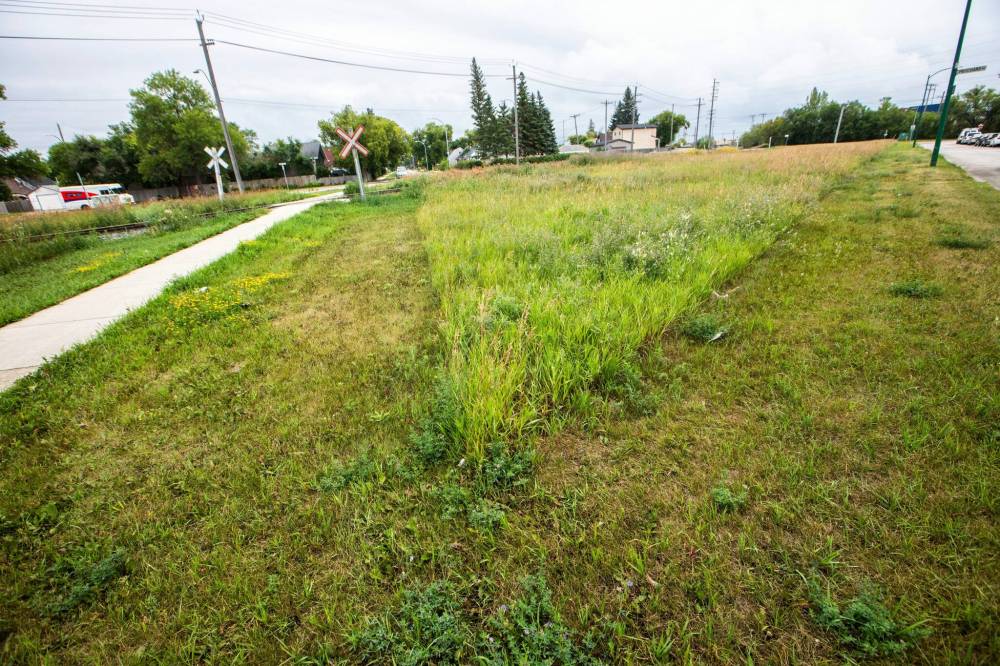
MIKAELA MACKENZIE / FREE PRESS
Property lines are clearly delineated by shorn lawn on the city side and longer grasses and wildflowers along the tracks between Burrows and Sheppard on Tuesday.
The 59-year-old, who has lived on Magnus Avenue across from the tracks for more than 50 years, said the rail line is neglected.
Godoski said he has complained to all three levels of government and the Canadian Pacific Kansas City railway, which has a facility nearby, about the uncut weeds, but nothing has been done.
On the stretch of tracks between Sheppard and Railway streets bordered by Selkirk and Burrows avenues, city crews have trimmed the area immediately adjacent to the streets and the sidewalks. The rest is unruly vegetation.
The overgrown weeds are a nuisance because the seeds blow into his yard, making it difficult to maintain his garden, Godoski said. It also creates a breeding ground for mosquitoes, he added.
“The city can step on the little guy, but it won’t press a federally regulated company,” Godoski said. “They just can’t do a thing,” he said with resignation.
The city’s Neighbourhood Liveability Bylaw requires owners to maintain grass and herbaceous plants at a height no taller than 15 centimetres (six inches). Failure to comply can result in warnings, remedial orders and, in some cases, city crews will cut the grass and the cost will be passed on to the homeowner.
The manager of a neighbourhood business echoed Godoski’s view.
“If that was anybody else in the city that left their property growing like that, they’d get a fine,” he said, declining to give his name.
The City of Winnipeg isn’t responsible for trimming the grass along tracks. Both CN Rail and Canadian Pacific Kansas City are privately owned, and rail maintenance is technically a federal issue under Transport Canada.
“Railways, airports and waterways fall under federal jurisdiction. As a result, the city does not cut, ticket or issue orders related to federally regulated jurisdictions,” Julie Dooley, acting manager of corporate communications for the city, said in an email. “If an issue arises we would refer it to the appropriate entity.”
Tabitha Robinson, who lives close by and owns the Miss Mary Jane’s cannabis shop at 1635 Burrows Ave., said she picks up garbage in the community, including the train tracks.
The weeds hide myriad needles, pieces of broken glass and other detritus, which could hurt pedestrians, she said, noting Sisler High School, a track field and playground are located on Burrows. The grass attracts stray cats, mice and even coyotes, she said.
“I’ve noticed there’s a lot more garbage there now than there was in previous years, because it’s obviously being trapped in the brush… it’s just concerning,” she said.
“High school children (cross), you never know what could be there, never mind the possibility of if there’s a needle or something that someone could step on.”
A spokesman for Canadian Pacific Kansas City said Transport Canada requires it to maintain the track bed.
“Our vegetation management includes annual herbicide treatment of the ballast, plus the cutting of trees, shrubs and brush so that train crews can see railway signals, and vegetation management around public and private crossings clearing sight lines at grade crossings for public and train safety,” spokesman Terry Cunha said.
A CN rail spokesman said they had heard concerns about overgrowth and had sent out staff to clean their part of the track.
“Part of maintaining and operating a safe railway is ensuring vegetation is managed along our network,” he said in an email. “CN also has an obligation pursuant to the Rail Safety Act to ensure vegetation on or along our railway right-of-way is controlled.”
Vivian Santos, the councillor for the area, said yearly maintenance hasn’t been up to snuff.
Her office has found it “challenging” to request CN Rail and CPKC trim the corridors along train tracks, and have come up with their own solution. She calls the federal government via the local Liberal MP.
“We’ve worked with (Winnipeg North MP) Kevin Lamoureux’s office, and we kind of use him as our leeway into the federal jurisdiction. He’s been really good at getting the lines cleaned,” she said. “But then I know from what I’ve done in the past that they only clean it once a year.”
When nudged, the response is usually quick, Santos said.
Lamoureux said facilitating cleanup calls from the city to railway companies is an occasional part of his job.
“That is a responsibility that they have and, unfortunately, at times, they need to be reminded of their responsibility,” he said.
It’s not the source of a high number of complaints in his community, he said, but Canada’s rail companies have a particular responsibility when their lines run through residential areas.

“At the end of the day, (CPKC) should be treated in the same fashion as local residents,” he said. “That’s what’s fair and, obviously, they’ve got to give more attention to all parts of their property.”
Santos said she’s been working on what she calls a “rails to trails” project, that would involve decommissioned rail lines being transformed into walking paths as part of the rail relocation study currently headed by former federal cabinet minister Lloyd Axworthy.
Santos said there was recently some confusion over who was technically responsible for the maintenance of a decommissioned railway lines in the Weston and Brooklands neighbourhoods, but CN Rail was quick to act after learning it was its responsibility.
malak.abas@freepress.mb.ca
matthew.frank@freepress.mb.ca
Malak Abas is a city reporter at the Free Press. Born and raised in Winnipeg’s North End, she led the campus paper at the University of Manitoba before joining the Free Press in 2020. Read more about Malak.
Every piece of reporting Malak produces is reviewed by an editing team before it is posted online or published in print — part of the Free Press‘s tradition, since 1872, of producing reliable independent journalism. Read more about Free Press’s history and mandate, and learn how our newsroom operates.
Our newsroom depends on a growing audience of readers to power our journalism. If you are not a paid reader, please consider becoming a subscriber.
Our newsroom depends on its audience of readers to power our journalism. Thank you for your support.
Malak Abas is a city reporter at the Free Press. Born and raised in Winnipeg’s North End, she led the campus paper at the University of Manitoba before joining the Free Press in 2020. Read more about Malak.
Every piece of reporting Malak produces is reviewed by an editing team before it is posted online or published in print — part of the Free Press‘s tradition, since 1872, of producing reliable independent journalism. Read more about Free Press’s history and mandate, and learn how our newsroom operates.
Our newsroom depends on a growing audience of readers to power our journalism. If you are not a paid reader, please consider becoming a subscriber.
Our newsroom depends on its audience of readers to power our journalism. Thank you for your support.
Related Articles
Winnipeg-Gimli commuter line proposed in rail relocation talks


Advertisement Advertise With Us
Advertisement Advertise With Us
History
Updated on Thursday, July 24, 2025 12:03 PM CDT: Adds comment from CN rail
Updated on Friday, July 25, 2025 2:17 PM CDT: Clarifies CN comment.