WEATHER ALERT

Polar bears share their prey U of M research underscores importance of species to future of Arctic

Polar bears are generous hunters whose leftovers feed many other animals, new research shows, casting the protected species as a major provider, not just a vulnerable predator in a province that attracts thousands of polar bear watchers every fall.

Read this article for free:

or

Already have an account? Log in here »

To continue reading, please subscribe:

Subscribe and receive a limited-edition Free Press branded hat or tote.

Digital Subscription

One year of digital access for only $205*

  • Enjoy unlimited reading on winnipegfreepress.com
  • Read the E-Edition, our digital replica newspaper
  • Access News Break, our award-winning app
  • Play interactive puzzles

*First annual payment billed as $205.00 + GST for one year. This annual subscription will automatically renew at $233.00 + GST every 52 weeks (10% off the regular annual price of $259.35). Offer available to new and qualified returning subscribers only. Cancel any time.

To continue reading, please subscribe:

Add Free Press access to your Brandon Sun subscription for only an additional

$1 for the first 4 weeks*

  • Enjoy unlimited reading on winnipegfreepress.com
  • Read the E-Edition, our digital replica newspaper
  • Access News Break, our award-winning app
  • Play interactive puzzles
Start now

*Your next Brandon Sun subscription payment will increase by $1.00 and you will be charged $17.95 plus GST for four weeks. After four weeks, your payment will increase to $24.95 plus GST every four weeks.

Hey there, time traveller!
This article was published 28/10/2025 (257 days ago), so information in it may no longer be current.

Polar bears are generous hunters whose leftovers feed many other animals, new research shows, casting the protected species as a major provider, not just a vulnerable predator in a province that attracts thousands of polar bear watchers every fall.

Arctic foxes, wolverines, eagles, hawks, gulls and even younger bears are among at least 11 species who feast on the prey left behind by polar bears. The latest study calculates the leftovers: 7.6 million kilograms per year in picked-over seal carcasses left on sea ice.

That’s a conservative estimate, said biologist and University of Manitoba PhD candidate Holly Gamblin, lead author of the study published Tuesday in the journal Oikos from the Nordic Ecological Society.
San Diego Zoo Wildlife Alliance
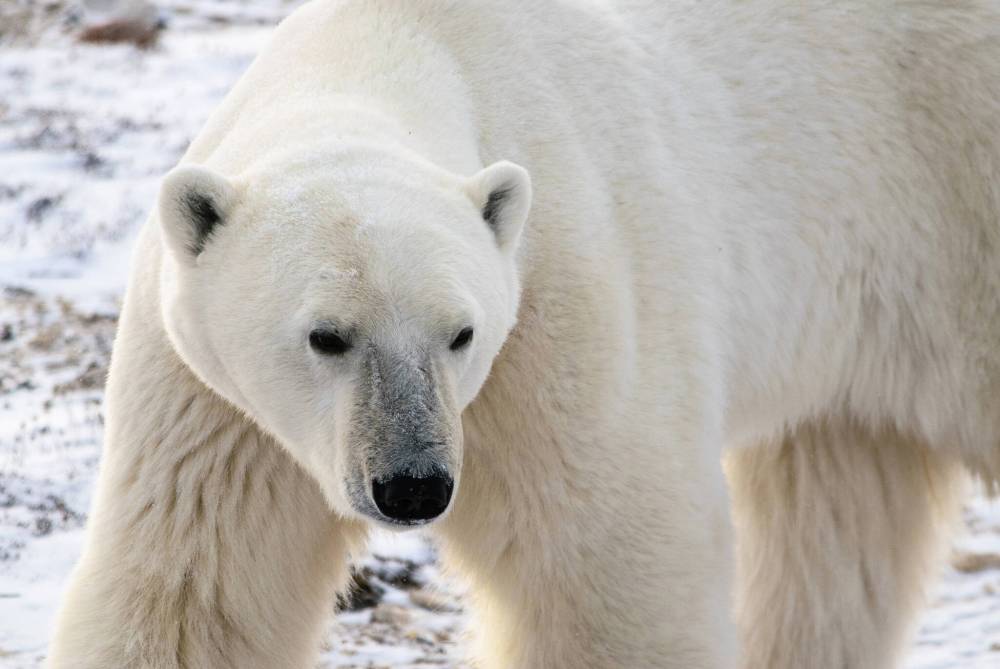
                                New research shows at least 11 species feast on the prey left behind by polar bears suggesting they play a key role in supporting their subarctic and Arctic ecosystems.

San Diego Zoo Wildlife Alliance

New research shows at least 11 species feast on the prey left behind by polar bears suggesting they play a key role in supporting their subarctic and Arctic ecosystems.

“A bunch of my co-authors are in that polar bear research world and have been thinking about investigating (this issue), knowing that it’s this really under-represented and under-studied component of the story, when we think about polar bears as apex predators,” said Gamblin, who has studied Arctic foxes. “They had had this idea for a while and I was just sort of in the right place at the right time.”

The research, a collaboration between the U of M and the San Diego Zoo Alliance, with contributions from the University of Alberta and Environment and Climate Change Canada, lays the foundation for fieldwork to document how polar bears support the subarctic and Arctic ecosystems in Churchill and Pond Inlet, NT.

The study used data modelling to estimate how much the bears leave behind after they feast on ringed seals.

Because they are “blubber specialists,” Gamblin said, the bears eat much of the seal fat, but unlike some other carnivores, they don’t guard or hoard their prey. Dragging their prey — seals or even narwhals — up onto the sea ice helps scavengers survive.

“What our research group is interested in doing is showing that when we lose sea ice, we’re losing this energy source for all kinds of different species.”

Even rare scavengers, such as grizzly bears and snowy owls, have come to the table for the spoils of a polar bear’s hunt, the study found. Previous research from Gamblin’s lab at U of M has found the Arctic fox population is directly linked to polar bears’ “hunting success.”

This study points to the importance of conservation efforts.

“This just highlights one other potential impact of climate change, but it really comes down to making changes on a global scale that will reduce the loss of sea ice,” Gamblin said.

The ecological benefits provided by the bears are irreplaceable, she said.

“We already know how the Arctic is warming at a rate of four times the rest of the world, and we know that we’re experiencing loss of sea ice, and so what our research group is interested in doing is showing that when we lose sea ice, we’re losing this energy source for all kinds of different species,” she said.

“It has the potential to impact much further down into the food web.”

The issue of climate change hits home in the polar bear capital of the world.

Supplied
                                Drew Hamilton, a co-owner of Discover Churchill Tours.

Supplied

Drew Hamilton, a co-owner of Discover Churchill Tours.

There are fewer polar bears in and around Churchill: one study, published in 2022, estimated there are roughly 600 — half of the number of polar bears that roamed the area 35 years earlier, according to Polar Bears International. The bears attract thousands of tourists to Churchill each year: more than 25,000 travellers visited in 2023. Tourism in Churchill contributes $99.8 million to Manitoba’s economy, a 2024 economic impact study shows.

“It’s always good to see knowledge like this formalized, but I think it will come as no surprise to anyone who’s spent some time watching bears that they have a very important role in supporting ecosystems and everything that lives around them,” said Drew Hamilton, co-owner of Discover Churchill Tours.

Polar bear season in the northern town, traditionally in October and November, has recorded above-seasonal temperatures this year.

When Hamilton looked out his window Tuesday, it was raining, not snowing.

“It’s the talk of the town; everybody’s wondering what the next couple of months are going to hold… as the sea ice comes or it doesn’t, these bears stick around. The tourists all leave, but the bears stick around. So then, you have to take a hard look at what it takes to co-exist with polar bears,” Hamilton said, pointing to practical concerns such as the need for a bear-proof trash management system in town.

Hamilton, who has worked in Churchill for about a decade and said he’s “been in the bear business” since the late ’90s in Alaska and other areas, said he and other Churchill residents are witnessing the realities of climate change, and they need systems in place to protect the bears, both for the environment and the economy.

“This is changing before our eyes, and hopefully that sparks some urgency in both looking at polar bear conservation and confronting climate change,” he said.

katie.may@freepress.mb.ca

Katie May

Katie May
Multimedia producer

Katie May is a multimedia producer for the Free Press.

Our newsroom depends on a growing audience of readers to power our journalism. If you are not a paid reader, please consider becoming a subscriber.

Our newsroom depends on its audience of readers to power our journalism. Thank you for your support.

Report Error Submit a Tip

More Stories

Mayoralty race off to glacial start

Joyanne Pursaga 5 minute read Preview

Mayoralty race off to glacial start

Joyanne Pursaga 5 minute read Yesterday at 2:02 AM CDT

Just a few months before voters select their next city council, Winnipeg’s mayoral race has barely begun.

Mayor Scott Gillingham, who registered his re-election bid May 1, has yet to share a single promise about what he would do if re-elected.

That decision could reflect several circumstances of this particular race, including the current slate of mayoral candidates, according to a local political expert.

“It could be (Gillingham’s) just keeping his powder dry … I think he’s likely waiting to see what shakes out for his opponents, if there will be somebody of a higher profile, like a Kevin Klein, or somebody from the right or left of him (entering the race),” said Christopher Adams, an adjunct professor of political science at the University of Manitoba.

Read
Yesterday at 2:02 AM CDT

U of M research underscores importance of polar bears to future of Arctic

Katie May 5 minute read Preview

U of M research underscores importance of polar bears to future of Arctic

Katie May 5 minute read Tuesday, Oct. 28, 2025

Polar bears are generous hunters whose leftovers feed many other animals, new research shows, casting the protected species as a major provider, not just a vulnerable predator in a province that attracts thousands of polar bear watchers every fall.

Arctic foxes, wolverines, eagles, hawks, gulls and even younger bears are among at least 11 species who feast on the prey left behind by polar bears. The latest study calculates the leftovers: 7.6 million kilograms per year in picked-over seal carcasses left on sea ice.

That’s a conservative estimate, said biologist and University of Manitoba PhD candidate Holly Gamblin, lead author of the study published Tuesday in the journal Oikos from the Nordic Ecological Society.

“A bunch of my co-authors are in that polar bear research world and have been thinking about investigating (this issue), knowing that it’s this really under-represented and under-studied component of the story, when we think about polar bears as apex predators,” said Gamblin, who has studied Arctic foxes. “They had had this idea for a while and I was just sort of in the right place at the right time.”

Read
Tuesday, Oct. 28, 2025

Marla Somersall devoted her life to people in need

Zoe Pierce 6 minute read Preview

Marla Somersall devoted her life to people in need

Zoe Pierce 6 minute read Yesterday at 6:00 AM CDT

Whether it was helping women build businesses in rural Tunisia, leading homeless and addiction support organizations or delivering meals to vulnerable Manitobans, Marla Somersall spent her life dedicated to lessening other people’s suffering.

Over a career that took her from North Africa to Prince Edward Island and back to Manitoba, Somersall held leadership roles in a range of social service and non-profit organizations, always drawn to work that centred on supporting people in need.

Most recently, she served as executive director of Meals on Wheels Winnipeg — a non-profit organization that provides meals to people who are unable to prepare them for themselves.

Kelly Scrivener, client co-ordinator with Meals on Wheels, said Somersall was a very calm and respectful person who led with gentle direction and fostered a collaborative workplace.

Read
Yesterday at 6:00 AM CDT

Rage politics meets its serious counterpart

David McLaughlin 5 minute read Preview

Rage politics meets its serious counterpart

David McLaughlin 5 minute read Yesterday at 2:02 AM CDT

Serious times call for serious politics. That means serious leaders offering serious solutions.

If all this sounds like a campaign slogan for the establishment, you’re probably right. But its rising resonance may well prove the unravelling of the conservative populist rage that has been driving politics in Canada, the United States and Europe.

Already we are seeing signs that the “burn it all down” rhetoric of more than a decade of MAGA Trump in the United States, Brexit and Faragism in the United Kingdom, and the angry and anti- establishment brand of Poilievre conservatism in Canada, has crested. Today, voters are yearning for stability and real solutions, the exact opposite of what divisive populist politics promise.

Events, current and past, rightly fuelled the anger. The 2008 financial crisis marked the beginning of our current “end times.” It was followed in short order by the first triumph of Donald Trump’s Make America Great Again movement in 2016, Brexit in Britain in 2016, the COVID-19 pandemic in 2020, Russia’s invasion of Ukraine in 2022, the Oct. 7, 2023, Hamas atrocities in Israel and that country’s two-year invasion and war in Gaza, and the triumphant return of Trump and MAGA in 2024. Now comes the ongoing war with Iran launched by the U.S. and Israel.

Read
Yesterday at 2:02 AM CDT

Ottawa mum on joining legal case against Trump’s sanctioning of Canadian ICC judge

Dylan Robertson, The Canadian Press 4 minute read Preview

Ottawa mum on joining legal case against Trump’s sanctioning of Canadian ICC judge

Dylan Robertson, The Canadian Press 4 minute read Updated: Yesterday at 9:54 AM CDT

OTTAWA - Ottawa won't say whether it will intervene in support of a Winnipeg-born global judge who is asking a U.S. court to reverse sanctions ordered by U.S. President Donald Trump, which have left her unable to use a credit card or most major online vendors.

Washington sanctioned International Criminal Court judge Kimberly Prost nearly a year ago, over her work on a case involving American troops in Afghanistan. Unlike France, Canada has never criticized that decision.

"We haven't said anything about that," said Sabine Nolke, a former senior Canadian diplomat whose career focused on international law.

"We do have fairly solid human rights credentials, but we can certainly stand (to be) speaking out more about them."

Read
Updated: Yesterday at 9:54 AM CDT

Fort Garry Hotel on Métis federation’s radar

Scott Billeck 4 minute read Preview

Fort Garry Hotel on Métis federation’s radar

Scott Billeck 4 minute read Friday, Jul. 10, 2026

One of Winnipeg’s most iconic buildings, the Fort Garry Hotel on Broadway, is next on the Manitoba Métis Federation’s list of acquisitions.

“We are not done with our commitment to investing in Winnipeg’s downtown,” president David Chartrand said Friday, the same day the federation announced it has purchased the former National Research Council property on Ellice Avenue downtown.

“One potential new acquisition we’re considering, if the price is right and the partnership is positive, is the Fort Garry Hotel. It is an iconic part of Winnipeg’s history and its future, just like the Red River Métis,” Chartrand said.

The 113-year-old hotel was co-listed for sale in May by real estate brokerage firms Avison Young and Cushman & Wakefield Winnipeg, but doesn’t have a list price.

Read
Friday, Jul. 10, 2026