A renewed call for action Decades-long fight to repeal discriminatory second-generation cut-off rekindled on Parliament Hill
Read this article for free:
or
Already have an account? Log in here »
To continue reading, please subscribe:

Digital Subscription
One year of digital access for only $205*
- Enjoy unlimited reading on winnipegfreepress.com
- Read the E-Edition, our digital replica newspaper
- Access News Break, our award-winning app
- Play interactive puzzles
*First annual payment billed as $205.00 + GST for one year. This annual subscription will automatically renew at $233.00 + GST every 52 weeks (10% off the regular annual price of $259.35). Offer available to new and qualified returning subscribers only. Cancel any time.
To continue reading, please subscribe:
Add Free Press access to your Brandon Sun subscription for only an additional
$1 for the first 4 weeks*
- Enjoy unlimited reading on winnipegfreepress.com
- Read the E-Edition, our digital replica newspaper
- Access News Break, our award-winning app
- Play interactive puzzles
*Your next Brandon Sun subscription payment will increase by $1.00 and you will be charged $17.95 plus GST for four weeks. After four weeks, your payment will increase to $24.95 plus GST every four weeks.
Read unlimited articles for free today:
or
Already have an account? Log in here »
Hey there, time traveller!
This article was published 31/10/2025 (292 days ago), so information in it may no longer be current.
First Nations women who’ve spent a lifetime fighting for the right to belong in their own communities have been again travelling to Parliament Hill this fall, repeating their calls for change and their wish: for their children and grandchildren not to be excluded as they were.
Since September, more than 50 people have appeared before the Standing Senate Committee on Indigenous Peoples to speak on Bill S-2, which is primarily meant to restore Indian status to about 6,200 people whose descendants were stripped of the designation through a process known as “enfranchisement.”
The committee hearings have not been limited to the current bounds of S-2, but have focused on the reality that four decades after First Nations women began regaining some of their rights to status, federal legislation continues to erase the same rights for their descendants through what’s referred to as the “second-generation cut-off.”
The cut-off is a formula that applies to First Nations people born after April 16, 1985. It holds that if a status First Nations person has a child with someone without status, their child receives a lesser form of status known as 6(2). If that child also grows up to parent with a non-status person, their child is not eligible for status at all.
The cut-off was introduced in 1985 as part of Bill C-31, which ended the federal government’s practice — over more than 150 years — of stripping status from First Nations women who married non-status men.
Indian status is the primary vehicle for First Nations people to access the rights they are entitled to, including medical and dental benefits, the possibility of post-secondary educational funding and tax exemption for income earned on-reserve. But status can also be something of a stand-in for belonging: in emotional, cultural and practical ways. It can mean the difference between someone being allowed to live on-reserve or not.
For Sharon McIvor, who appeared before the committee in October, her message was the same as it’s been since 1989 when she began — and nearly two decades later, won — a historic court case that granted her son status, along with thousands of other First Nations people.
Her message to the senators: the exclusion of women and their descendants from status, and from their communities, is a matter of life and death, between surviving and thriving.
Jonathan Hayward / The Canadian Press Sharon McIvor has been fighting for changes to the Indian Act for four decades.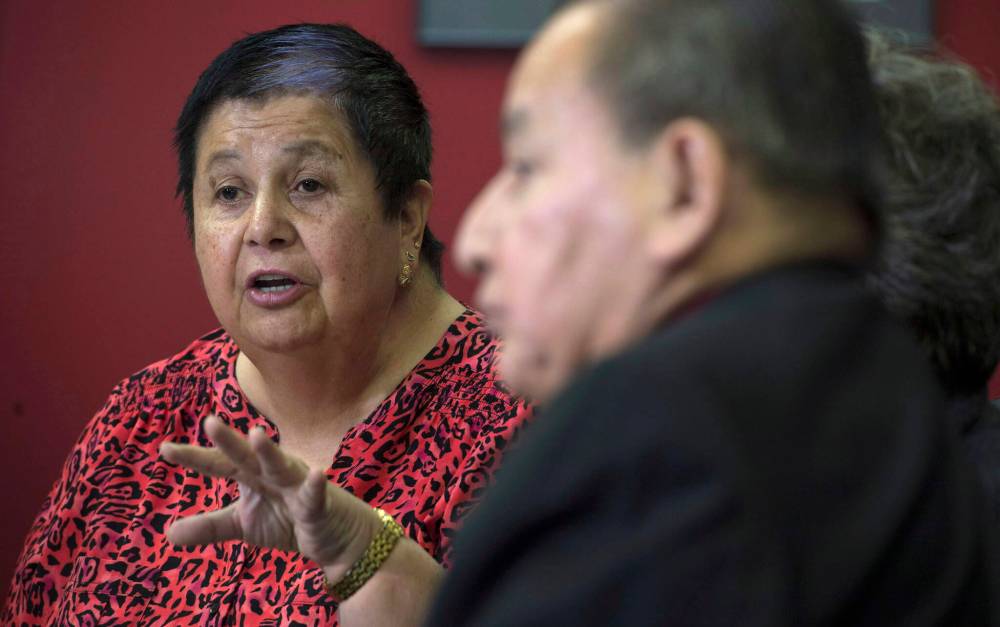
“We do a lot of talking, lobbying, begging, over the years — I’ve kind of lost track of the number of ministers of Indian affairs that I’ve interacted with, I think it’s probably 18, but I’m not sure,” said the 77-year-old lawyer and member of the Lower Nicola Indian Band in B.C., who appeared at the committee on behalf of the Indian Act Sex Discrimination Working Group.
Except for one, each minister promised that if McIvor just waited, problems with the Indian Act — highly controversial legislation that determines who, legally speaking, is an “Indian” – would be fixed.
“As you can see, the promises were never fulfilled because here we are talking about it again,” she said.
Nearly every witness before the Senate committee has said that while they support Bill S-2, it does not go far enough. They’ve urged legislators to remove the cut-off, as well as a part of the legislation that would bar newly entitled registrants from seeking compensation in the courts. And they’ve called for the government to stop making “piecemeal” amendments, while allowing “legislative extinction” to continue through the cut-off.
In the coming weeks, senators will decide whether to move forward with the bill in its current form, as encouraged by Indigenous Services Minister Mandy Gull-Masty, or, to make the amendments sought by First Nations leaders and advocates.
These are not new issues for this Senate committee. In 2022, it heard from some of the same witnesses in its preparation of the report “Make it Stop! Ending the remaining discrimination in Indian registration,” which “urgently” recommended the cut-off be repealed. Longtime committee members noted the recurrent nature of the debates, without government action; as one legislator put it, “we’ve seen this movie before.”
As the Free Press has previously reported, the cut-off raised concerns before it even became law, with legislators in 1982 saying it would likely lead to “another series of inequities.”
Pamela Palmater, a lawyer and member of the Eel River Bar First Nation in New Brunswick who has spent more than 20 years focused on issues of Indigenous identity, status and membership, told the committee in October that she worried the notion of consultation is being “weaponized” by the government to delay necessary changes: as if all 634 First Nations in Canada don’t agree on a path forward, then the status quo must continue.
“There are some things that the federal government can’t consult on — whether or not to discriminate on the basis of race or sex, whether or not to maintain a legislative extinction formula and contribute to an act of genocide,” said Palmater, who’s also a part of the Indian Act Sex Discrimination Working Group.
“What you can consult on, however, is how do you support First Nations, how do you support the people who are newly registered, how do you ensure there’s enough housing and infrastructure,” she added.
Sean Kilpatrick / The Canadian Press Minister of Indigenous Services Mandy Gull-Masty has told the Senate committee that she is fully committed to working on the cut-off issue.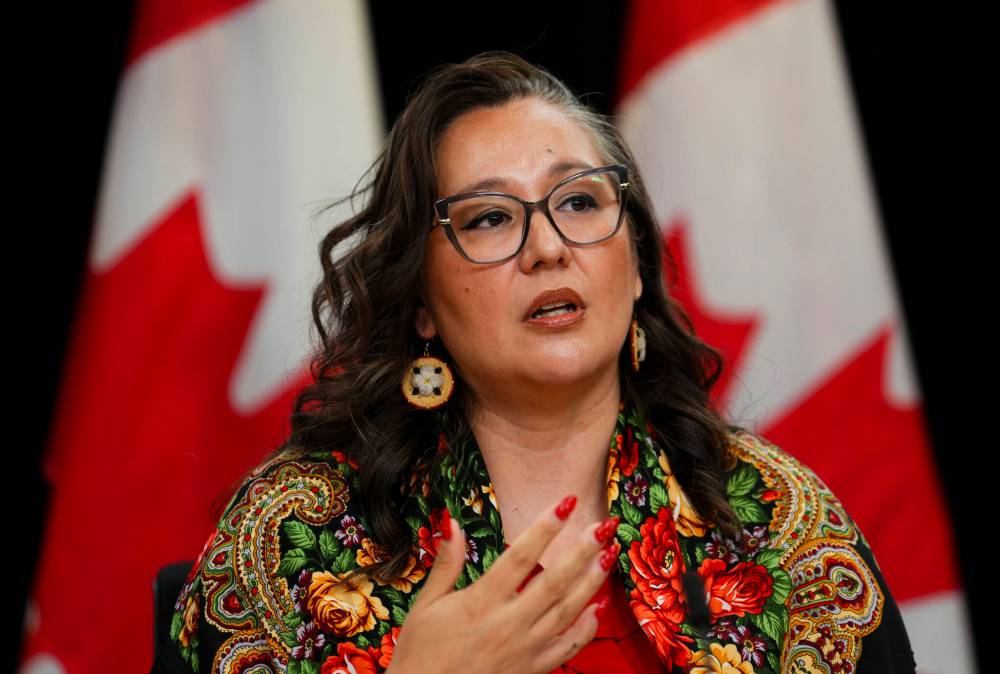
Gull-Masty told the committee that consultations are currently underway regarding the cut-off and that she is “fully committed to working on” the issue, though has requested senators keep Bill S-2 focused on the enfranchisement issue.
(For many years, First Nations men and their descendants were enfranchised — stripped of their status — if they chose certain professions, such as law or medicine, or enlisted in the military, while others made the coerced choice to voluntarily enfranchise as a way to gain basic rights.)
Jeannette Corbiere Lavell, the Citizenship Commissioner for Anishinabek Nation, who is also part of the working group, spoke to the committee of the work being done over more than 15 years in her nation to codify its own citizenship laws.
E’Debendaagzijig, meaning ‘those who belong’, in the Anishinabek Nation works off what’s commonly known as a ‘one-parent rule,’ meaning a child with at least one parent who can trace their descendency to the original people of an Anishinabek First Nation is included.
A draft citizenship declaration makes clear: “through our own governance principles and structures we decide who belongs.”
Corbiere Lavell, who is in her 80s, was responsible for an early legal challenge of the discriminatory rules that stripped First Nations women of status if they married non-status men. Launched more than a half century ago, while her case did not ultimately succeed in court, Corbiere Lavell’s work helped bring about the changes seen in 1985.
“If we were recognized as having those inherent rights — to decide who our people are, and who will be our people — we will have strong nations again,” she told the committee.
“When I was born, I was not a person.”
In a recent interview, McIvor spoke about the long shadow that status has played throughout her life. When she was born in 1948, the Indian Act still defined a person as “anyone other than an Indian,” she explained.
“When I was born, I was not a person,” she said.
In 1985, with the passage of C-31, McIvor was able to register for 6(2) status, but because of the cut-off, her children were not allowed to have status — a reality her case would ultimately change, allowing both her and her children to be registered as 6(1) and her grandchildren as 6(2).
Over the next 40 years, she would meet with dozens of legislators; appear before United Nations committees to speak about sex discrimination and the crisis of Missing and Murdered Indigenous Women and Girls; and have her and her son’s case heard at the Supreme Court. (Last year, the UN Committee on the Elimination of Discrimination against Women recommended Canada repeal the cut-off.)
For McIvor, the reason the government is stalling to repeal the cut-off is clear: without status Indians, there’s no need for reserves, and the land can simply be used as Crown land.
“We know it’s forced assimilation (and) genocide, which, of course, is against the international doctrines that Canada has signed on to,” she said, including the United Nations Declaration on the Rights of Indigenous Peoples, which refers to the right of Indigenous people to belong to a nation or community in accordance with their own traditions.
“The rights we have as Indigenous people, or Indians, are rights we were born with, and it doesn’t come from the government,” she added. “It’s our birthright, and the government has suppressed it with the Indian Act.”
McIvor said she hopes the senators will “dig in” and make some amendments, as they have done before.
The other option that’s been suggested, including by one previous Indigenous Services minister, she noted, is a class-action lawsuit.
“But I’m getting old. I don’t know if I could handle another class-action suit.”
marsha.mcleod@freepress.mb.ca
Determine entitlement under Section 6
For children born after April 16, 1985



Marsha McLeod
Investigative reporter
Signal
Marsha McLeod is an investigative reporter at the Free Press. She joined the Free Press in 2023. Read more about Marsha.
Every piece of reporting Marsha produces is reviewed by an editing team before it is posted online or published in print — part of the Free Press‘s tradition, since 1872, of producing reliable independent journalism. Read more about Free Press’s history and mandate, and learn how our newsroom operates.
Our newsroom depends on a growing audience of readers to power our journalism. If you are not a paid reader, please consider becoming a subscriber.
Our newsroom depends on its audience of readers to power our journalism. Thank you for your support.
Related Articles
Indian Act's ‘second-generation cut-off’ poses an existential threat to treaty people in Canada