Budget of Winnipeg-based federal water agency to take a hit
Read this article for free:
or
Already have an account? Log in here »
To continue reading, please subscribe:
Digital Subscription
One year of digital access for only $1.44 a week*
- Enjoy unlimited reading on winnipegfreepress.com
- Read the E-Edition, our digital replica newspaper
- Access News Break, our award-winning app
- Play interactive puzzles
*Billed as $5.77 plus GST every four weeks. After 52 weeks, price increases to the regular rate of $19.95 plus GST every four weeks. Offer available to new and qualified returning subscribers only. Cancel any time.
To continue reading, please subscribe:
Add Free Press access to your Brandon Sun subscription for only an additional
$1 for the first 4 weeks*
- Enjoy unlimited reading on winnipegfreepress.com
- Read the E-Edition, our digital replica newspaper
- Access News Break, our award-winning app
- Play interactive puzzles
*Your next Brandon Sun subscription payment will increase by $1.00 and you will be charged $17.95 plus GST for four weeks. After four weeks, your payment will increase to $24.95 plus GST every four weeks.
Read unlimited articles for free today:
or
Already have an account? Log in here »
Hey there, time traveller!
This article was published 05/11/2025 (349 days ago), so information in it may no longer be current.
The fledgling Canada Water Agency, based in Winnipeg, is about to get its funding reduced just two years after the federal Liberal government unveiled it.
The freshwater management agency confirmed Wednesday $3.8 million will be cut by 2030 if the Liberal budget is passed by the House of Commons.
Canada Water Agency spokesperson Joseph Péloquin-Hopfner said in an emailed statement the department is still assessing the potential impact of the cuts on the agency’s operations, including where the spending will have to be scaled back, but there was “no indication” the program as a whole would cease to exist.
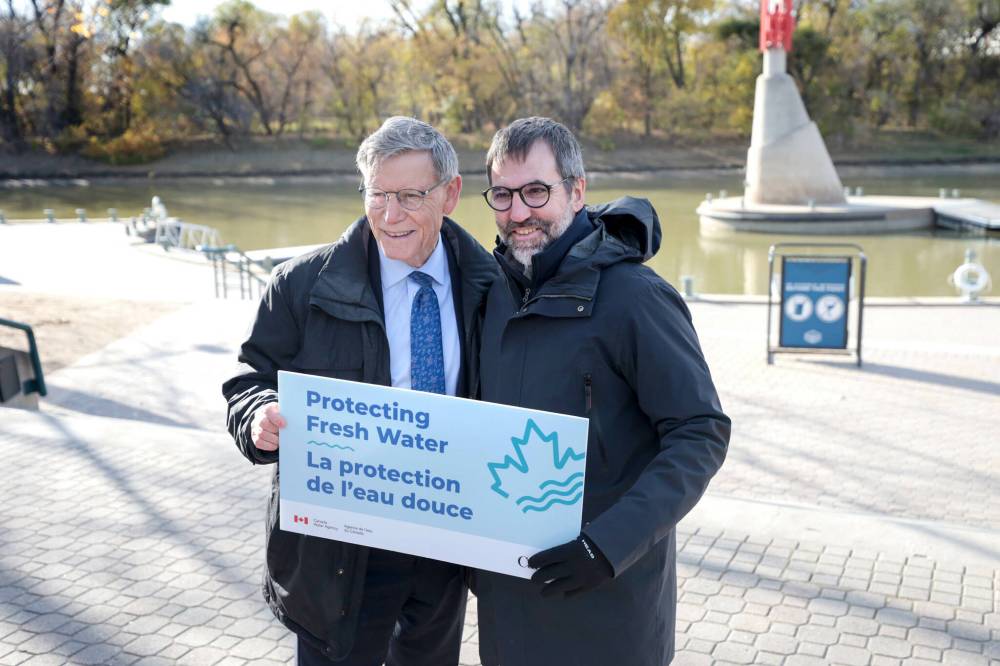
Ruth Bonneville / Free Press files
Steven Guilbeault, Minister of Environment and Climate Change, right, with Winnipeg MP Terry Duguid at the launch of Canada Water Agency at The Forks in October 2024.
The federal budget contains one line that says $3.8 million in cuts over four years has been earmarked and there’s $1.2 million in “ongoing” pruning. It doesn’t mention which aspects of the program will be affected. The agency had a budget of $52.1 million in the last fiscal year, including for staff positions, operations and grant programs.
“In the interim, the agency remains fully committed to delivering on its mandate to improve freshwater management in Canada,” the emailed statement said.
The union that represents scientists and other staff at the agency said the budget is silent on funding for federal science departments and research laboratories.
“Vague language in the budget leaves room for concern in most science-based departments and agencies, and many non-science based ones. We need more information,” Professional Institute of the Public Service of Canada president Sean O’Reilly said in an email.
The national water agency celebrated its one-year anniversary in mid-October and announced $1.6 million for projects and organizations that support the health of Lake Winnipeg.
Several organizations that received the recent funding did not respond to requests for comment about the hit to the budget.
At the Oct. 18 news conference, Winnipeg Liberal MP Terry Duguid, who was instrumental in establishing the water agency, told reporters he had been advocating to keep it well-funded and that “nothing is more important than fresh water.”
On Wednesday Duguid called the cuts a “minor reduction” and said he isn’t worried about the long-term future of the program.
“Vague language in the budget leaves room for concern in most science-based departments.”
“I think the agency did well in the budget given the context (of its age),” Duguid told the Free Press. Duguid served as parliamentary secretary to the prime minister, under Justin Trudeau, and special adviser on water at the time the agency was launched.
“I’m pleased that the agency has been left more or less intact and will be able to do its good work this year and into the future,” he said.
O’Reilly said the federal budget has significant gaps when evaluated against federal science capacity and called the government’s plan to reduce the public service to save money a “major red flag.”
The budget proposes cuts amounting to about 16,000 jobs by next year and 40,000 by 2028-29 to create a “sustainable” workforce.
“While the budget frames this as a government-wide savings effort, there are no explicit protections for science positions. This raises serious risks of science staffing cuts and departmental budget reallocations away from core research functions,” he said.
Manitoba Environment Minister Mike Moyes said he’s been in talks with his federal counterpart about the budget and will have further discussions about the implications for Manitobans.

In 2023, the federal government announced its intention to fund the water agency to the tune of $85.1-million over five years.
“I think the agency did well in the budget given the context (of its age).”
The agency guides water policy and administers funding to programs that protect, rehabilitate and respond to emerging issues in eight major watersheds: Lake Winnipeg, Lake of the Woods, the Great Lakes, Lake Simcoe, and the Mackenzie, Fraser, Saint John and St. Lawrence rivers.
The agency headquarters is located in downtown Winnipeg and, at the time of its announcement, was due to open regional offices in Quebec, Ontario and British Columbia. The department employs more than 200 staff, about half of whom are in Winnipeg.
In 2024, the federal government said the agency would distribute $64.5 million over 10 years to protect Lake Winnipeg and its watershed.
nicole.buffie@freepress.mb.ca

Nicole Buffie
Multimedia producer
Nicole Buffie is a reporter for the Free Press city desk. Born and bred in Winnipeg, Nicole graduated from Red River College’s Creative Communications program in 2020 and worked as a reporter throughout Manitoba before joining the Free Press newsroom as a multimedia producer in 2023. Read more about Nicole.
Every piece of reporting Nicole produces is reviewed by an editing team before it is posted online or published in print — part of the Free Press‘s tradition, since 1872, of producing reliable independent journalism. Read more about Free Press’s history and mandate, and learn how our newsroom operates.
Our newsroom depends on a growing audience of readers to power our journalism. If you are not a paid reader, please consider becoming a subscriber.
Our newsroom depends on its audience of readers to power our journalism. Thank you for your support.
Related Articles
‘Nothing is more important than fresh water’: $1.6 million to fund research, outreach projects