

Canada responsible for ensuring safe First Nations housing, Federal Court rules in $5-B class-action suit

Advertisement
Read this article for free:
or
Already have an account? Log in here »
To continue reading, please subscribe:

Digital Subscription
One year of digital access for only $205*
- Enjoy unlimited reading on winnipegfreepress.com
- Read the E-Edition, our digital replica newspaper
- Access News Break, our award-winning app
- Play interactive puzzles
*First annual payment billed as $205.00 + GST for one year. This annual subscription will automatically renew at $233.00 + GST every 52 weeks (10% off the regular annual price of $259.35). Offer available to new and qualified returning subscribers only. Cancel any time.
To continue reading, please subscribe:
Add Free Press access to your Brandon Sun subscription for only an additional
$1 for the first 4 weeks*
- Enjoy unlimited reading on winnipegfreepress.com
- Read the E-Edition, our digital replica newspaper
- Access News Break, our award-winning app
- Play interactive puzzles
*Your next Brandon Sun subscription payment will increase by $1.00 and you will be charged $17.95 plus GST for four weeks. After four weeks, your payment will increase to $24.95 plus GST every four weeks.
Read unlimited articles for free today:
or
Already have an account? Log in here »
Hey there, time traveller!
This article was published 11/12/2025 (286 days ago), so information in it may no longer be current.
A Federal Court judge has recognized Canada is responsible for ensuring safe housing on First Nations in a $5-billion class-action lawsuit filed on behalf of two reserves in Manitoba and Ontario.
Chiefs of St. Theresa Point Asinininew Nation in northern Manitoba and Sandy Lake First Nation in northwestern Ontario filed the lawsuit in 2023, claiming that Canada had violated the rights of their people by “creating and failing to remedy the lack of access to adequate housing on First Nation lands” and sought $5 billion in damages.
In his ruling Dec. 5, Justice Paul Favel said Canada had a duty to First Nations, noting a “structural deficit has been created, and it has been virtually impossible to keep up with the housing needs of First Nations.”
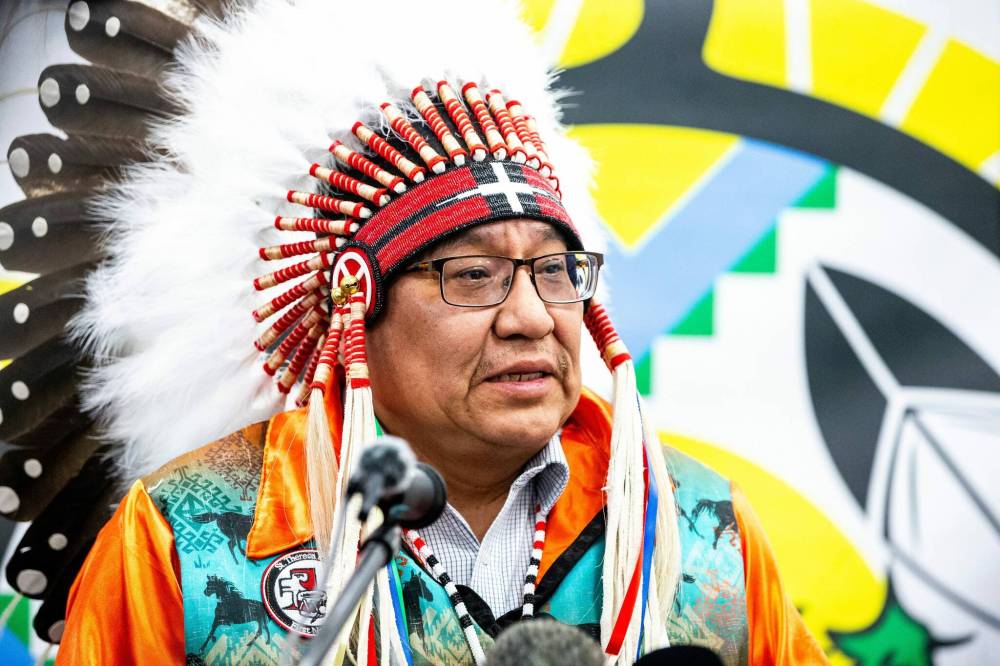
MIKAELA MACKENZIE / FREE PRESS FILES
St. Theresa Point chief Raymond Flett: “The court made it clear that Canada cannot maintain the status quo.”
St. Theresa Point chief Raymond Flett described the ruling as “emotional” Thursday.
“Our community came together to build this case against the federal government, we opened the doors to our homes, our townhouses, our shacks, our tents, to tell our story… the court made it clear that Canada cannot maintain the status quo,” he said at a news conference.
The ruling considered a number of incidents that occurred, in part, because of unstable housing in both First Nations, including one in St. Theresa Point in 2023 when two 14-year-old girls froze to death.

Canada has 30 days to appeal the court’s decision. If it does not, the court will move toward determining the extent of Canada’s failure to provide support and possible compensation, said Michael Rosenberg, a lawyer with McCarthy Tétrault LLP, one of two law firms representing the First Nations.
“It’s no longer open to the federal government to expect the most vulnerable First Nations to make ends meet, to close infrastructure gaps on their reserves and to do so without the partnership of Canada,” he said.
Assembly of Manitoba Chiefs Grand Chief Kyra Wilson called the ruling an opportunity for Canada to work with First Nations communities in good faith.
“We need dedicated funding and recognizing that First Nations must lead the design and delivery of housing solutions in their own communities,” she said.
malak.abas@freepress.mb.ca
Malak Abas is a city reporter at the Free Press. Born and raised in Winnipeg’s North End, she led the campus paper at the University of Manitoba before joining the Free Press in 2020. Read more about Malak.
Every piece of reporting Malak produces is reviewed by an editing team before it is posted online or published in print — part of the Free Press‘s tradition, since 1872, of producing reliable independent journalism. Read more about Free Press’s history and mandate, and learn how our newsroom operates.
Our newsroom depends on a growing audience of readers to power our journalism. If you are not a paid reader, please consider becoming a subscriber.
Our newsroom depends on its audience of readers to power our journalism. Thank you for your support.
Malak Abas is a city reporter at the Free Press. Born and raised in Winnipeg’s North End, she led the campus paper at the University of Manitoba before joining the Free Press in 2020. Read more about Malak.
Every piece of reporting Malak produces is reviewed by an editing team before it is posted online or published in print — part of the Free Press‘s tradition, since 1872, of producing reliable independent journalism. Read more about Free Press’s history and mandate, and learn how our newsroom operates.
Our newsroom depends on a growing audience of readers to power our journalism. If you are not a paid reader, please consider becoming a subscriber.
Our newsroom depends on its audience of readers to power our journalism. Thank you for your support.
Advertisement Advertise With Us
Advertisement Advertise With Us