Manitoba Museum eager to showcase Hudson Bay Co. royal charter after court approves sale ‘Foundational document for Canada’ to be shared by four entities after Thomson-Weston purchase
Read this article for free:
or
Already have an account? Log in here »
To continue reading, please subscribe:

Digital Subscription
One year of digital access for only $205*
- Enjoy unlimited reading on winnipegfreepress.com
- Read the E-Edition, our digital replica newspaper
- Access News Break, our award-winning app
- Play interactive puzzles
*First annual payment billed as $205.00 + GST for one year. This annual subscription will automatically renew at $233.00 + GST every 52 weeks (10% off the regular annual price of $259.35). Offer available to new and qualified returning subscribers only. Cancel any time.
To continue reading, please subscribe:
Add Free Press access to your Brandon Sun subscription for only an additional
$1 for the first 4 weeks*
- Enjoy unlimited reading on winnipegfreepress.com
- Read the E-Edition, our digital replica newspaper
- Access News Break, our award-winning app
- Play interactive puzzles
*Your next Brandon Sun subscription payment will increase by $1.00 and you will be charged $17.95 plus GST for four weeks. After four weeks, your payment will increase to $24.95 plus GST every four weeks.
Read unlimited articles for free today:
or
Already have an account? Log in here »
Hey there, time traveller!
This article was published 11/12/2025 (298 days ago), so information in it may no longer be current.
The Manitoba homecoming for the royal charter that created the Hudson Bay Co. cleared its final hurdle Thursday after a court approved the $18-million sale of the 355-year-old document.
With the blessing of two of the country’s richest families who made the purchase, the historic parchment will soon find a semi-permanent home at the Manitoba Museum.
“This is the best possible outcome. It’s really exciting for all the possibilities,” said Amelia Fay, director of research, collections and exhibitions at the Manitoba Museum and the curator of its HBC collection.

Ruth Bonneville / Free Press
Amelia Fay, director of research, collections and exhibitions at the Manitoba Museum and the curator of its HBC collection, inside a reproduction of HBC’s head office in London England with a portrait of Prince Rupert.
“This royal charter is incredibly significant for all Canadians… It’s almost like a foundational document for Canada.”
King Charles II issued the five-page vellum document on May 2, 1670, allowing for the creation of the fur trading business. It granted the company control over one-third of modern-day Canada, centuries before Confederation.
Although Europeans were trading and interacting with Indigenous people, the charter marked the moment when the Crown formally laid claim to the land. It continues to affect land rights to this day, Fay said.
The charter went up for auction after Hudson’s Bay filed for creditor protection in March. The defunct company closed all of its stores and has been selling off its trove of 4,400 pieces of art and artifacts to pay back those owed money.
Holding companies belonging to the Weston and Thomson families spent months negotiating a deal to purchase the charter for $18 million.
They plan to immediately and permanently donate it to the Archives of Manitoba, the Manitoba Museum, the Canadian Museum of History in Gatineau, Que., and the Royal Ontario Museum on Toronto.
Kathleen Epp, keeper of the HBC collection at the Archives of Manitoba, said the court finalizing the sale ends a saga that has kept her in suspense for months.
She called the donation by the Weston and Thomson families a “contribution to the preservation of heritage in Canada.”
“It’s an incredible outcome and an unprecedented outcome, and we’re just pleased to be a part of it,” she said.
“I do think there will be national interest in it and that’s been demonstrated already.”
“This royal charter is incredibly significant for all Canadians… It’s almost like a foundational document for Canada.”
The Thomsons, who made their money in the media business, and the Westons, who are giants in the grocery and retail world, placed the only bid in the charter auction, but a court had to approve their joint purchase before it could take place.
HBC lawyers and financial advisers initially planned to sell the document at auction, but Weston firm Wittington Investments Ltd. stepped forward in July with a $12.5-million offer to buy and donate it to the Canadian Museum of History.
HBC was prepared to accept the offer, but David Thomson’s firm DKRT Family Corp. argued it had been waiting for an auction to make its own $15-million starting bid. It wanted the Archives of Manitoba to own the charter.
HBC decided to revert to the auction plan and let Thomson make the opening bid until both families teamed up to make the winning bid.

Reflect Advisors, HBC’s financial advisers, reached out to 150 people or companies to see if they would top the bid. HBC said no one was willing, making the Thomsons and Westons the de facto winner.
Asad Moten, a lawyer for the attorney general of Canada, said the charter has remained in a protective box in storage since the creditor protection case began. Before that, it was in a private office.
The Canadian Conservation Institute will examine it to assess its condition and make recommendations on next steps before it is moved anywhere, Moten said.
It must be stored and displayed in an environment with controlled temperature, humidity and lighting to preserve the ink and parchment upon which it was written, Fay said.
The Thomsons and Westons have said the four institutions to be donated the charter will be designated “custodians” and will share the document equally. However, the families would like it to first go on display in Winnipeg, where HBC opened its first department store in 1881.
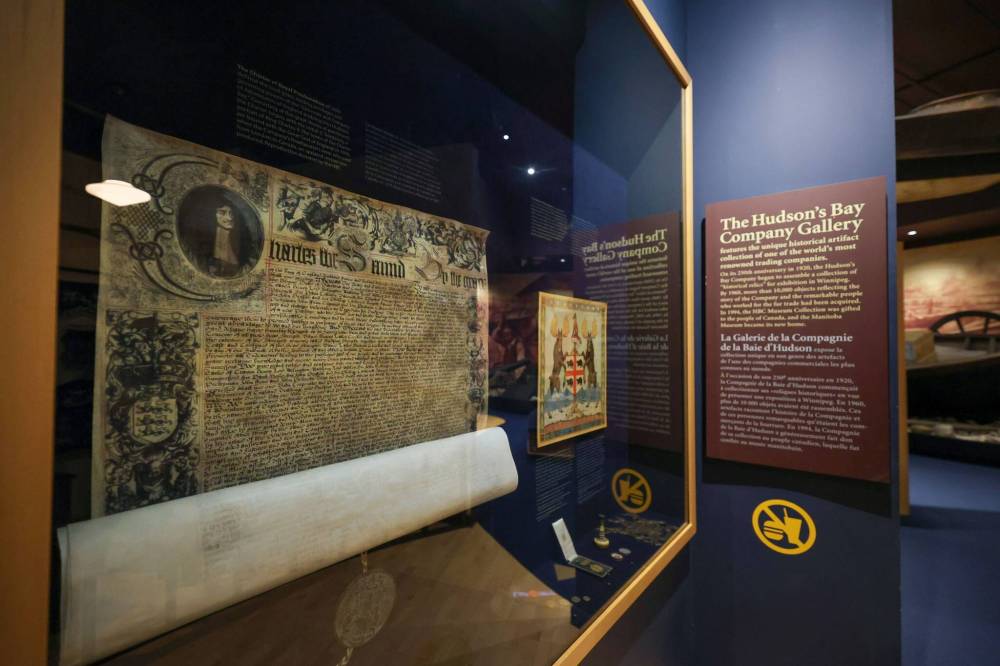
Ruth Bonneville / Free Press
A replica of the original HBC charter that is on display at the HBC exhibit at the Manitoba Museum.
Tasking custodians to care for the charter will prevent it from falling into a private collection and allow the document to be viewed by the public for generations, Fay said.
Details on how, when and where the document will first be displayed remain unknown, she said.
The Tompson and Weston families have requested a consultation process with Indigenous groups, museums, universities, archives, subject matter experts and the public to determine how the charter should be shared.
A term sheet — filed with the Ontario Superior Court and signed by the donors and recipients — outlines a possible arrangement in which each institution cares for the charter for rotating multi-year periods on a mutually agreed-upon schedule.
When the document arrives at the Manitoba Museum, it will join roughly 28,000 HBC artifacts stored there, Fay said.
Her role as curator will include helping to determine which other artifacts and information should be arranged nearby. Providing historical context about the company’s relationships to Indigenous and Métis people will be critical.
The Manitoba Museum temporarily hosted the charter in 2020, but the number of people able to view it was limited by the COVID-19 pandemic.
At that time, it was included in a display that featured material recovered from HBC’s London office — the company’s last U.K. boardroom before shifting their headquarters to Canada, Fay said
When the charter isn’t on exhibit at one of the four custodian institutions, the term sheet said they could perhaps display high-quality replicas of the artifact.
Manitoba Métis Federation president David Chartrand said he would like the opportunity to display the document at the Red River Métis National Heritage Centre, which is under development at 355 Main St. and will likely open by spring 2027.
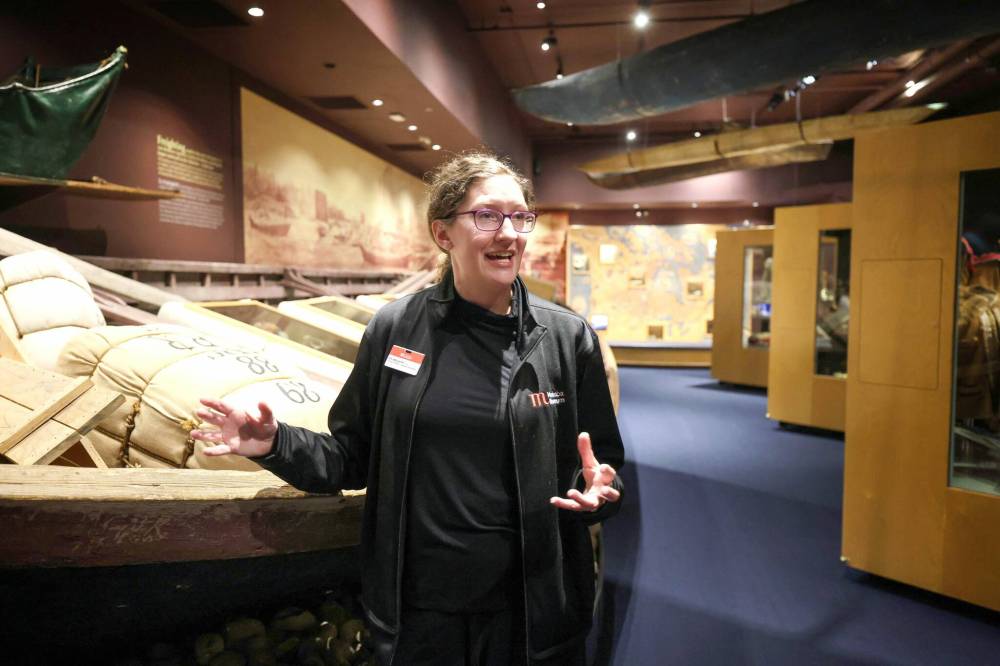
Ruth Bonneville / Free Press
Amelia Fay, curator of the HBC Museum Collection.
“We’d like to.. tell the story of the charter and its conflicting position with the Métis,” Chartrand said. “We were… economically driven by the fur trade ourselves before the Hudson’s Bay Co. decided to control everything.”
The Métis president said the federation bid $50,000 on several different Hudon’s Bay Co. artworks recently put up for auction, but was “blown out of the water” by competing bids.
The term sheet also contemplates a website being created to showcase the charter and digital renderings of other artifacts.
The Thomsons and Westons have agreed to donate $5 million to help fund these efforts. Future support has also been promised by the Desmarais family and Power Corp. of Canada, along with the Hennick Family Foundation.
The Desmarais family is behind Power Corp., which has a controlling stake in insurer GreatWest Lifeco and IGM Financial. The Hennick family founded real estate firm Colliers International.
—With files from The Canadian Press
tyler.searle@freepress.mb.ca

Tyler Searle is a multimedia producer who writes for the Free Press’s city desk. A graduate of Red River College Polytechnic’s creative communications program, he wrote for the Stonewall Teulon Tribune, Selkirk Record and Express Weekly News before joining the paper in 2022. Read more about Tyler.
Every piece of reporting Tyler produces is reviewed by an editing team before it is posted online or published in print — part of the Free Press‘s tradition, since 1872, of producing reliable independent journalism. Read more about Free Press’s history and mandate, and learn how our newsroom operates.
Our newsroom depends on a growing audience of readers to power our journalism. If you are not a paid reader, please consider becoming a subscriber.
Our newsroom depends on its audience of readers to power our journalism. Thank you for your support.
Related Articles
Manitoba Museum, Archives of Manitoba in group of four institutions to share 1670 royal charter creating Hudson’s Bay Co.