The back-to-class battle Inner-city outreach workers take on truancy one student at a time
Read this article for free:
or
Already have an account? Log in here »
To continue reading, please subscribe:
Digital Subscription
One year of digital access for only $1.44 a week*
- Enjoy unlimited reading on winnipegfreepress.com
- Read the E-Edition, our digital replica newspaper
- Access News Break, our award-winning app
- Play interactive puzzles
*Billed as $5.77 plus GST every four weeks. After 52 weeks, price increases to the regular rate of $19.95 plus GST every four weeks. Offer available to new and qualified returning subscribers only. Cancel any time.
To continue reading, please subscribe:
Add Free Press access to your Brandon Sun subscription for only an additional
$1 for the first 4 weeks*
- Enjoy unlimited reading on winnipegfreepress.com
- Read the E-Edition, our digital replica newspaper
- Access News Break, our award-winning app
- Play interactive puzzles
*Your next Brandon Sun subscription payment will increase by $1.00 and you will be charged $17.95 plus GST for four weeks. After four weeks, your payment will increase to $24.95 plus GST every four weeks.
Read unlimited articles for free today:
or
Already have an account? Log in here »
Hey there, time traveller!
This article was published 19/12/2025 (310 days ago), so information in it may no longer be current.
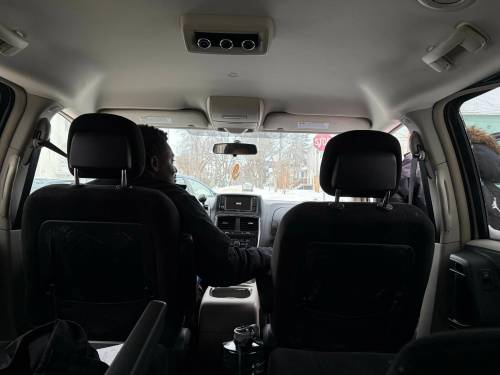
It’s shortly after 10 a.m. on a recent Monday morning, and Sam Ayigbe is navigating North End streets in a minivan, heat on full blast.
The van’s dashboard reads -10 C, but it feels far colder with the wind chill.
On Powers Street, a familiar face prompts him to pump the brakes and roll down the passenger window.
“Donnie! Donnie! Donnie!” Ayigbe calls out to a teenage boy who is underdressed for the weather. “Hey, brother! How are you? You coming to school today?”
The 13 year old answers by shaking his head, before shrugging and gesturing towards a younger sibling, who is in tow. The teen delivers a one-liner about being busy with family stuff.
The brief interaction does not end the way Ayigbe wanted — with Donnie hopping aboard and getting a ride to school.
Still, Ayigbe considers it a victory.
“A win is a win. He’s alive — I hadn’t seen his face for a month,” said Ayigbe, who is one of three education outreach workers on the Inner City Youth Alive school re-entry team.
“A win is a win. He’s alive… I hadn’t seen his face for a month.”
Ayigbe had a few other wins that cold December day, finding and dropping off three teens — each of whom would not have made it to school if not for him and his grey Dodge Caravan.
Looking at his list of students, Ayigbe’s success rate for the day is below 50 per cent.
As for the remaining kids? He would try again tomorrow.
Inner City Youth Alive expanded its school-reintegration unit at the start of the school year. Ayigbe is now the third full-time staffer dedicated to providing holistic support to students who have never attended school or disengaged from it.
Disheartened by how many students roam the streets during the day and a perceived lack of urgency on the part of government and division leaders, the non-profit organization’s managers have spent the last decade advocating for change.
That’s why Engage Education was born. It’s a secular initiative run by the faith-based, youth-serving organization that operates out of 418 Aberdeen Ave.
Sara Traver, now the manager of youth programs, created it from scratch five years ago.
Traver’s flexible, multi-step template to re-engage students — or, in some cases, register youth who’ve never attended class — is tailored to each family.
Her team relies on word-of-mouth at the Inner City Youth Alive drop-in centre and referrals from neighbours, relatives or school employees concerned about a child’s well-being.
Sam Ayigbe returns to the Inner City Youth Alive minivan after knocking on the doors and windows of a student’s home. There was no answer but Ayigbe vows to return the next day. (Maggie Macintosh / Free Press)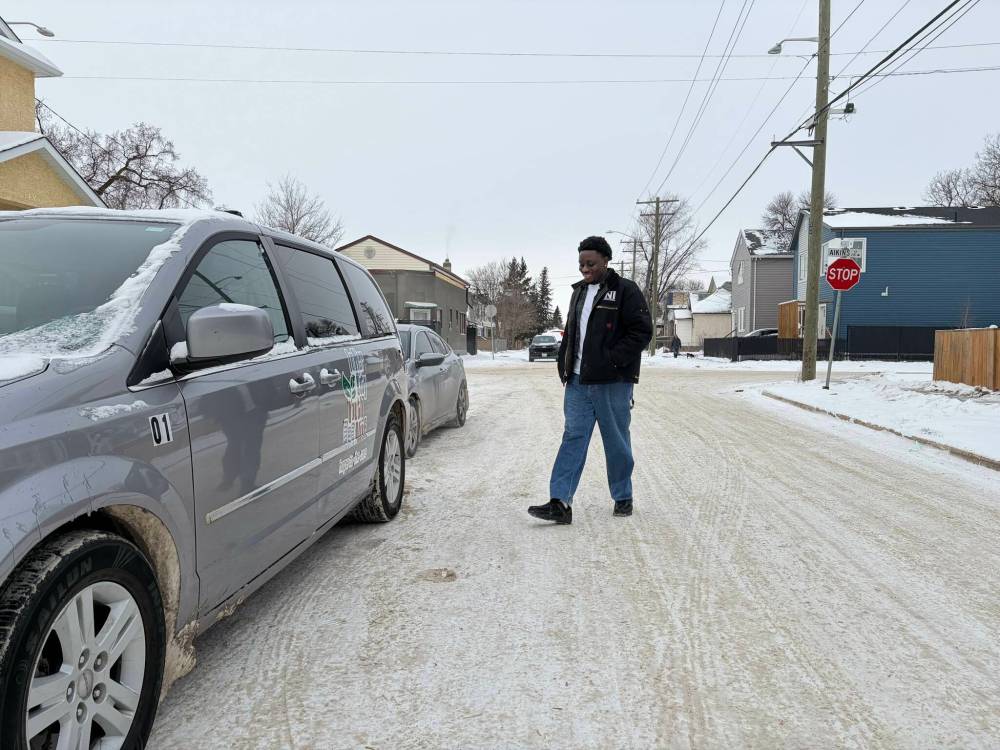
Traver reaches out to a guardian in a household and sets up a casual meeting. She visits every family to get to know them, usually over tea, and hands out her cell number.
She’ll then meet with every student one-on-one at a later date to get to know them and their interests, as well as their goals.
Traver wants to know what they need to succeed in life and work with them to brainstorm how to achieve it.
Whether that’s a driver’s licence, status card, dentist appointment or counselling services, Engage Education can help with all of the above, she said.
“Kids are actually willing to go to school. You’ve just got to have a relationship with them, not give up on them, encourage them and be there for all the things, no judgment,” Traver said.
“Kids are actually willing to go to school.”
Education outreach workers have two shuttle vans to get kindergarten to Grade 12 students from their doorsteps to school.
They frequent student residences and drop-off zones outside Norquay, William Whyte and Strathcona, along with secondary schools in the area, such as Sisler, St. John’s and R.B. Russell Vocational.
The re-entry plans that Traver co-designs usually begin with students easing back into school. While the non-profit is dedicated to helping children become full-time students, workers are also realistic.
They are tackling symptoms of poverty, housing insecurity and mental health crises rooted in intergenerational trauma that cannot be solved with a friendly greeting, granola bar and safe ride to school.
All of the 52 youth in the academic re-entry program are Indigenous.
Inner City Youth Alive managers are aware there is widespread distrust in public schools, as well as religious organizations of all kinds, in connection to residential schools and other historic and modern-day forms of discrimination against First Nations, Métis and Inuit people.
A third of all Engage Education students in 2024-25 had resolved their chronic absenteeism issues by the end of June.
Seven students withdrew from the program before this school year, citing their newfound independence and ability to get to class on their own.
Murmurs about the program’s early successes caught the ear of philanthropist Walter Schroeder, known for his motto “education over poverty,” in late 2023.
Schroeder has taken a special interest in the inner-city division he attended as a child in recent years. He’s pledged $250,000 annually for Engage Education over five years, ending in 2029.
Alex Vaccari, executive director of the Schroeder Foundation, said the organization wants to help students spend more time in school, even if it’s only on a part-time basis.
“This is not a quick-fix endeavour and we recognize that,” Vaccari said. “If we can move the needle just a little bit and help to make students’ lives a bit better, that’s our goal.”
“If we can move the needle just a little bit and help to make students’ lives a bit better, that’s our goal.”
Ninety-per cent of the 52 participants have phase-in plans as of the last week of classes before winter break.
The Winnipeg School Division’s latest attendance data shows roughly 500 high schoolers missed 20 or more days of a core class between the first day of the school year and Nov. 14.
The division stopped paying truancy officers to knock on the doors of missing students shortly after Matt Henderson became its chief superintendent in August 2023.
Henderson suggested it would have been irresponsible to continue spending public dollars on a program that did not have a high success rate.
Principals, vice-principals and both intercultural support and community support workers currently go into communities to do outreach on behalf of the division.
“Schools do tremendous work, but they can’t do everything,” Henderson said. “And right now, public education is really trying to keep the city together.”
Outreach worker Sam Ayigbe says he must practise patience, above all else, because “consistency” is ultimately what is required to increase attendance rates. (Maggie Macintosh / Free Press)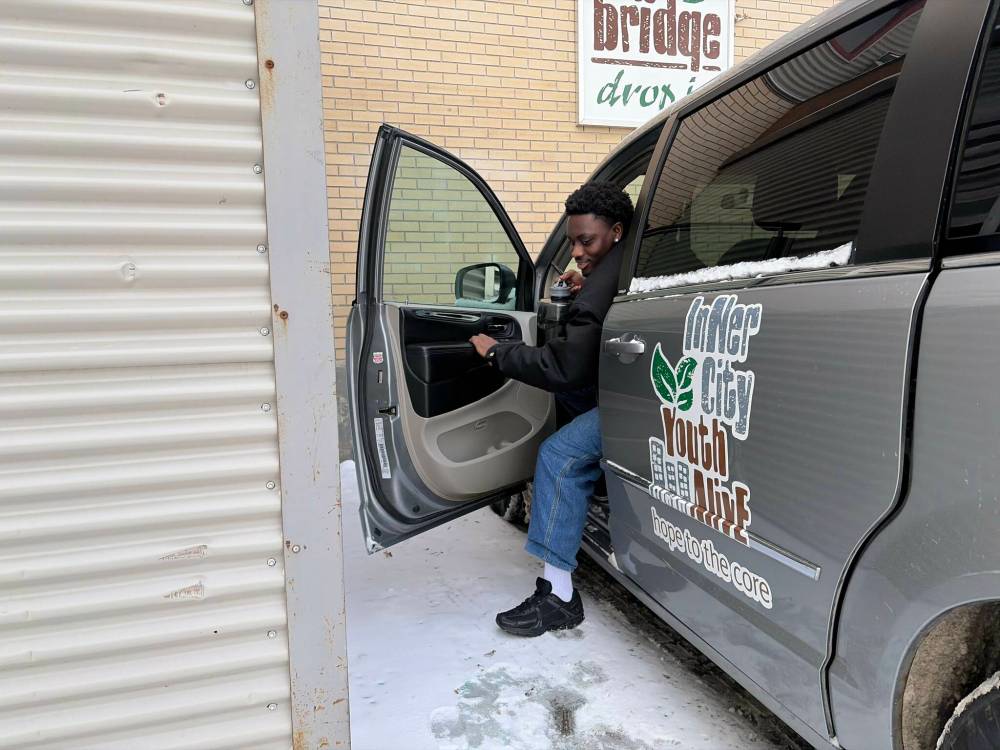
The chief superintendent publicly criticized Inner City Youth Alive’s recently released documentary, Absent, on chronic absenteeism in the North End.
He stood by that criticism in an interview this week, saying the documentary, which can be seen on YouTube, exposes a serious issue but it contains “misleading” information. Henderson declined to expand.
He noted the division has a working relationship with many community organizations, ranging from Bear Clan Patrol to Peaceful Village.
Inner City Youth Alive’s publicly stated mission gives him pause to expand their existing partnership, he said.
The charity’s website describes its emphasis on relationship building and providing at-risk youth with “hope, inspiration, mentorship and a strong sense of the Heavenly Father’s desire to be in relationship with us.”
Executive director Kent Dueck indicated the only ties Engage Education has to religion is that it is motivated by Christian values, such as compassion, generosity and humility.
The Kinew government has hinted at plans to introduce new legislation aimed at better tracking and supporting missing students in the new year.
In last month’s throne speech, Premier Wab Kinew said school engagement initiative “Reach Out, Reach Up” would be a priority this session.
Inner City Youth Alive wants to see more opportunities for youth to re-enter the school system via alternative education models such as theirs.
Mallory Pledger, who oversees all of the group’s programs, is looking to the future.
“We’ve been hoping and dreaming and wishing that somewhere there could be a re-integration classroom of some sort,” Pledger said.
She said the organization plans to create in-house classrooms next year so staffers can meet with students in a flexible setting.
For Henderson, there is a critical need for more collaboration among sectors to address wider factors, such as organized crime. He is a proponent of universal basic income.
As Ayigbe takes his key out of the ignition in the Inner City Youth Alive parking lot on a recent Monday, he pauses to consider what is needed most to address the disproportionately high rates of absenteeism in the neighbourhood he calls home.
The 24-year-old may only have started his role four months ago, but he’s already had countless conversations with students.
Inner City Youth Alive education outreach worker Sam Ayigbe picks up a high school student in the North End to drive her to class. He helps three students get to class that day. (Maggie Macintosh / Free Press)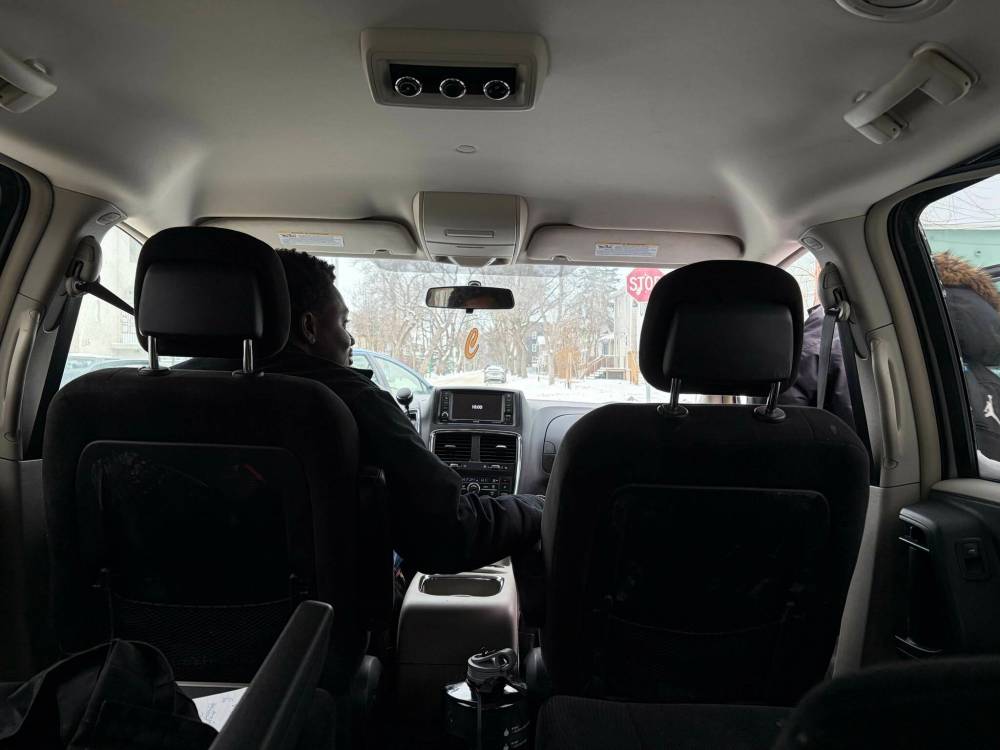
Sometimes, they want to vent about relationship troubles during the commute. Or disclose how exhausted they are because they were up all night playing video games.
Ayigbe said he must practise patience, above all else, because “consistency” is ultimately what is required to increase attendance rates.
While noting he cannot change the often-complex family lives and responsibilities of students, Ayigbe can show up with a smile on his face and a persistent knock on the door.
Every day he goes to work to fulfill “every single hat imaginable,” from chauffeur to therapist, and his goal is “to get as many kids out of their house as possible and see some sunlight,” he said.
He repeatedly knocked on the front door and windows of a residence on Magnus Avenue. No one answered.
It’s disheartening because the students who live there have “really good stretches,” he said.
Ayigbe said the reality is that so many of the kids he works with have a ton of responsibilities. Donnie, for example, is often in charge of caregiving.
Henderson also noted he recently met a student who is in charge of taking his aunt to get dialysis treatment every other day.
“These kids have a lot of weight on their shoulders that’s not theirs to bear… Or they’re main characters, but they’re not treated like it,” Ayigbe said.
That’s why Ayigbe always asks kids about “their story.” Because he wants to know — just as much as he wants to get them to school.
maggie.macintosh@freepress.mb.ca

Maggie Macintosh
Education reporter
Maggie Macintosh reports on education for the Free Press. Originally from Hamilton, Ont., she first reported for the Free Press in 2017. Read more about Maggie.
Funding for the Free Press education reporter comes from the Government of Canada through the Local Journalism Initiative.
Every piece of reporting Maggie produces is reviewed by an editing team before it is posted online or published in print — part of the Free Press‘s tradition, since 1872, of producing reliable independent journalism. Read more about Free Press’s history and mandate, and learn how our newsroom operates.
Our newsroom depends on a growing audience of readers to power our journalism. If you are not a paid reader, please consider becoming a subscriber.
Our newsroom depends on its audience of readers to power our journalism. Thank you for your support.