Truth, justice and the AI way Artificial intelligence is slowly finding its way into law offices and courtrooms; jurists trying to keep up with the technology are demanding full disclosure
Read this article for free:
or
Already have an account? Log in here »
To continue reading, please subscribe:

Digital Subscription
One year of digital access for only $205*
- Enjoy unlimited reading on winnipegfreepress.com
- Read the E-Edition, our digital replica newspaper
- Access News Break, our award-winning app
- Play interactive puzzles
*First annual payment billed as $205.00 + GST for one year. This annual subscription will automatically renew at $233.00 + GST every 52 weeks (10% off the regular annual price of $259.35). Offer available to new and qualified returning subscribers only. Cancel any time.
To continue reading, please subscribe:
Add Free Press access to your Brandon Sun subscription for only an additional
$1 for the first 4 weeks*
- Enjoy unlimited reading on winnipegfreepress.com
- Read the E-Edition, our digital replica newspaper
- Access News Break, our award-winning app
- Play interactive puzzles
*Your next Brandon Sun subscription payment will increase by $1.00 and you will be charged $17.95 plus GST for four weeks. After four weeks, your payment will increase to $24.95 plus GST every four weeks.
Read unlimited articles for free today:
or
Already have an account? Log in here »
Hey there, time traveller!
This article was published 26/12/2025 (253 days ago), so information in it may no longer be current.
At first glance, it was shaping up to be an unremarkable deportation case in front of the Federal Court in Ottawa.
A lawyer seeking a judicial review of an immigration tribunal ruling for his clients filed a motion to admit new evidence and obtain a time extension.
But Associate Judge Catharine Moore had a problem. She could not find some of the cases the lawyer referenced in the court filings and sounded the alarm.
It turns out the cases had been “hallucinated,” with the lawyer admitting he neglected to check the work of an artificial intelligence tool used by Canadian immigration lawyers.
Instead of seeking the court’s forgiveness, he doubled down, arguing his undeclared and unverified use of AI did not substantially impact his legal argument. But Moore wasn’t buying it, particularly since the Federal Court, along with many other judiciaries across Canada, have ordered that all uses of artificial intelligence be properly referenced by lawyers appearing in their courtrooms.
“The use of generative artificial intelligence is increasingly common and a perfectly valid tool for counsel to use; however, in this Court, its use must be declared and as a matter of both practice, good sense and professionalism, its output must be verified by a human,” Moore wrote in an April decision.
The lawyer’s undisclosed use of AI amounted to an attempt to mislead the court, she said, and potentially warranted a penalty.
The case serves as a cautionary tale, as the use of AI tools — some purpose-built for the law profession — proliferates.
The Law Society of Manitoba, the regulatory body overseeing the profession in the province, is advising its members to be smart about their use of the technology and have issued guidelines dictating how to use it responsibly.
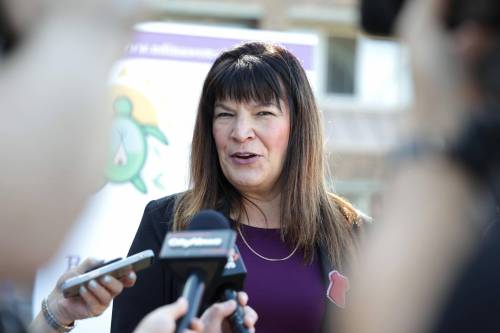
Alissa Schacter, the society’s director of policy and strategic initiatives, said the overarching message is lawyers are ultimately responsible for their work — including any generated by AI.
“The same way, you know, if you have an articling student or a junior associate that you’re supervising, you wouldn’t submit their work without checking it. Well, it’s no different with AI,” she said.
Alissa Schacter, the Law Society of Manitoba’s director of policy and strategic initiatives (Mikaela MacKenzie / Free Press)
Manitoba lawyers have been slow to turn to the technology, the Free Press has found, despite an order from Court of King’s bench Chief Justice Glenn Joyal in June 2023 that all uses of AI in submissions prepared for the King’s Bench be disclosed.
“Based on feedback from the bench, there have been very few, if any,” said Elissa Neville, executive legal officer for Manitoba Courts.
“At the time the practice direction was issued, the Court of King’s Bench was becoming increasingly aware of the potential use of AI in submissions. It wanted to let both parties and the legal profession know that the court was giving attention to the issue,” she said.
“It also wanted to provide a mechanism through which the court could be alerted to the use of AI in order to conduct its own verifications and assessments, if necessary, as to the reliability and credibility of the materials being filed.”
Neither the provincial court nor the Manitoba Court of Appeal have yet to issue guidelines for the use of AI.
Much of the law society’s guidelines align with obligations lawyers already have under their professional code of conduct, Schacter said.
“Lawyers have an obligation to be technologically competent… and obviously what that means evolves as technology evolves, which is very rapidly these days,” Schacter said.
“So if you’re going to use AI, it means you have a duty to understand how the particular tool works. What it’s doing with your information.… Is there the potential for privileged information or confidential client information to be compromised? … Educate yourself about how the tool works.”
The potential for fake cases and inaccuracies must be top of mind, Schacter said, as AI can often produce results that seem credible, lulling users into a sense of complacency.
Schacter said she’s heard mixed reports, with some lawyers using AI tools for specific tasks, such as editing emails or as dictation software, while others have found it too inaccurate to be useful.
“My sense is overall that the legal community in Manitoba and, again, broadly speaking is, to varying degrees, testing it out in different ways,” she said. “But I certainly don’t think it’s revolutionized practice here yet.”
Glenn Joyal, Chief Justice of the Court of King’s Bench of Manitoba (Mike Deal / Free Press files)
The Manitoba Bar Association has found its members being careful with using AI.
“I think our members are generally interested in the new technology and the opportunities that it provides,” said Jason Gisser, a lawyer and the chair of the association’s joint committee on the study of artificial intelligence in the Manitoba legal profession.
“But I think they’re approaching it cautiously, in order to ensure that it can be used responsibly.”
The committee — made up of representatives from the bar association, the University of Manitoba’s law school, court officials, the law students’ association and various law firms — was struck to study, monitor and discuss the evolution of AI and its impact, as well as the potential challenges and opportunities it presents. The bar association also conducted a survey over the summer on the subject.
“What we found was a variety of opinions on AI, like you might find in any profession that’s trying to grapple with this new technology… there were a variety of levels of AI utilization at this point,” Gisser said.
“Different uses that were mentioned in the survey results were things like assistance with drafting, review of documents, translating documents, legal research, as well as things like… assistance with marketing.”
Gisser said the survey also found there’s an expectation that as the technology continues to rapidly evolve, it will likely become commonplace in the profession, much like email and the internet have over the years.
“They may be expected to use it for the benefit of their clients. And so, that comes with the responsibility to learn how to use the technology,” said Gisser.
Katie Szilagyi, an assistant professor in the faculty of law at the U of M, focused on AI in the justice system for her doctoral thesis.
She said the Canadian administrative state has already begun to adopt the technology, via more traditional forms of artificial intelligence: risk-assessment instruments, advanced actuarial methodologies and algorithmic measures meant to replace things that used to be done by people.
“The administrative state, although it isn’t one of the sexier areas of law, tends to be the area that most people interact with when they interact with our legal system,” said Szilagyi, citing tribunals for employment insurance, the Canada Revenue Agency and immigration as examples.
“This does tend to be an area that is primed for some degrees of automation due to high volume, repetitive transactions that people are beginning to simplify through automation, where possible… But seeing the creep of automated systems in different parts of government is definitely something that we want to be aware of.”
“…seeing the creep of automated systems in different parts of government is definitely something that we want to be aware of.”
Generative AI tools such as ChatGPT becoming widely available in recent years, however, is the other side of the equation, as it continues to produce language “that is statistically generated in order to mimic what human language looks like,” Szilagyi said.
“And because lawyers’ stock and trade is in words, it is often something that people are excited about using to increase efficiencies in the legal workplace.”
There is worry among some in the profession that generative artificial intelligence may supplant the work traditionally done by junior staffers, limiting opportunity.
“I think people are of two minds about that. To some degree, there is concern that this work will be displaced in terms of the entry-level tasks that were traditionally available,” said Szilagyi.
“But at the same time, we see the workplace change and grow significantly every time a new technology is introduced. And I think students who are fairly savvy users and consumers of technology do understand that transformation sometimes creates new opportunities.”
She said it’s possible there will be new jobs for young lawyers in the future that have not yet been conceptualized, as a result of AI.
“I don’t think AI is going away anytime soon. I also don’t think it’s the panacea that some people think it is. It’s not going to completely transform the world and change things, but it is here to stay,” she said.
“And so, how do we understand how to work with it? How do we understand its limitations?”
erik.pindera@freepress.mb.ca

Erik Pindera is a reporter for the Free Press, mostly focusing on crime and justice. The born-and-bred Winnipegger attended Red River College Polytechnic, wrote for the community newspaper in Kenora, Ont. and reported on television and radio in Winnipeg before joining the Free Press in 2020. Read more about Erik.
Every piece of reporting Erik produces is reviewed by an editing team before it is posted online or published in print — part of the Free Press‘s tradition, since 1872, of producing reliable independent journalism. Read more about Free Press’s history and mandate, and learn how our newsroom operates.
Our newsroom depends on a growing audience of readers to power our journalism. If you are not a paid reader, please consider becoming a subscriber.
Our newsroom depends on its audience of readers to power our journalism. Thank you for your support.
Related Articles
Premier uses software to make homemade Ojibwa translator; cautiously optimistic about technology’s benefits