Billboard evangelism may look outdated but group says it’s effective

Advertisement
Read this article for free:
or
Already have an account? Log in here »
To continue reading, please subscribe:

Digital Subscription
One year of digital access for only $205*
- Enjoy unlimited reading on winnipegfreepress.com
- Read the E-Edition, our digital replica newspaper
- Access News Break, our award-winning app
- Play interactive puzzles
*First annual payment billed as $205.00 + GST for one year. This annual subscription will automatically renew at $233.00 + GST every 52 weeks (10% off the regular annual price of $259.35). Offer available to new and qualified returning subscribers only. Cancel any time.
To continue reading, please subscribe:
Add Free Press access to your Brandon Sun subscription for only an additional
$1 for the first 4 weeks*
- Enjoy unlimited reading on winnipegfreepress.com
- Read the E-Edition, our digital replica newspaper
- Access News Break, our award-winning app
- Play interactive puzzles
*Your next Brandon Sun subscription payment will increase by $1.00 and you will be charged $17.95 plus GST for four weeks. After four weeks, your payment will increase to $24.95 plus GST every four weeks.
Read unlimited articles for free today:
or
Already have an account? Log in here »
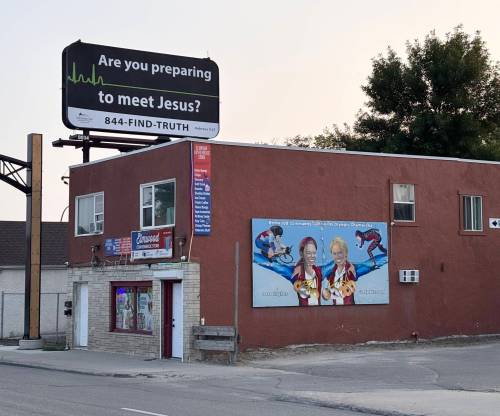
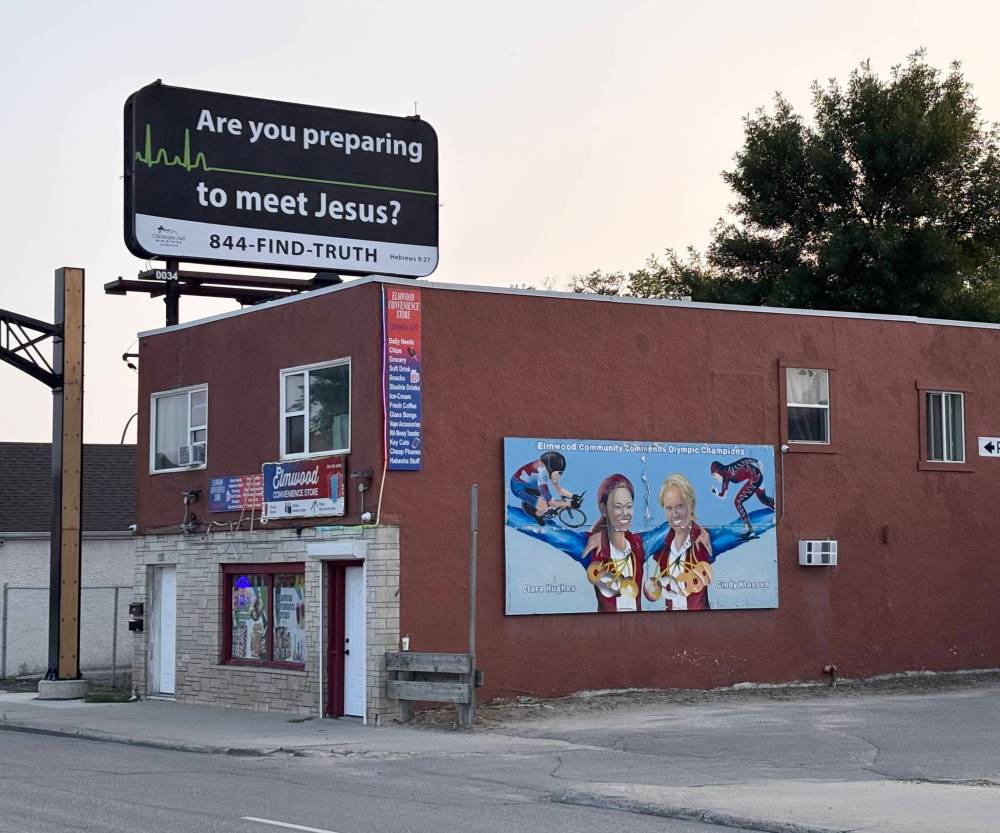
Maybe you’ve seen them in Winnipeg — billboards that say things like: “Jesus is alive!” “Are you prepared to meet Jesus?” “After you die, you will meet God.” They include a phone number to call: 844-FIND-TRUTH.
There are two billboards in Winnipeg. One is on Henderson Highway in Elmwood. The other is on Balmoral Street, by Cumberland.
Have you ever wondered who is behind them, and why they do it?
John Longhurst photo
The billboard promoting Christianity on Henderson Highway is created and sponsored by an Amish/Mennonite organization called Christian Aid Ministries.
You might be surprised to learn they are created and sponsored by an Amish/Mennonite organization called Christian Aid Ministries (CAM). Based in rural Ontario, the group is funded by Amish and some conservative Mennonite denominations and individuals.
In Canada, CAM has been putting up these billboards since 2015. Their counterparts in the U.S. have been doing it since 2007.
Currently, they have about 50 billboards spread across Canada, located in every province except Quebec. In the U.S., their American counterpart has put up more than 1,700 billboards.
It costs CAM over $900,000 a year for the Canadian billboards, says Ryan Martin, who does public relations for the organization. The money to pay for them is donated by people who contribute to what the organization calls its “billboard evangelism” program.
Why do they do it? To reach people with the Christian message. “We’re discovering that there are just a lot of questions, and our billboard messages are designed to reach people with the questions and the issues that are plaguing them,” he says.
But why billboards? Isn’t that an outdated way to reach people? Wouldn’t social media be better? CAM says no. That’s because it views Canadian culture as “a society on wheels.”
In its promotional material on its website, CAM notes that many Canadians spend an hour or two each weekday going back and forth from work by car or bus. That means commuters may pass by their billboards millions of times each year. For Martin, that is a prime opportunity to “plant the seed of truth into the hearts of people.”
Some might question the effectiveness. After all, Canadians see hundreds of messages, ads and signs each day. Why does CAM think this strategy will work?
Martin thinks this approach is effective because their messages are different from what people are apt to see every day.
The messages stand out because they “connect with the soul, and a message that connects with the soul has a much greater impact,” he says. “The messages are not neutral. They regard truth.”
As for the phone number people can call, Martin says over 175 people call the number each day in the U.S. Here in Canada, they average about four calls per day. Callers can choose to listen to a recorded message or speak with someone in person. Half of Canadians who call choose to talk with one of about 30 volunteers who answer the calls.
The volunteers listen to callers, answer any questions they might have, and pray with them, Martin says. If callers want, they can be connected with conservative Mennonite or Anabaptist churches in their communities for follow-up.

But billboards aren’t the only way CAM seeks to engage Canadians. It also sends volunteers to respond to natural disasters across the country. Last summer, for example, they sent volunteers to do clean up after the wildfires in Lac du Bonnet. This year, they mucked out flooded basements in Swan River. CAM volunteers are also responding after the flooding in the Niagara region of Ontario and the wildfires in Clinton, B.C.
In a story on the CAM website, the organization shares how families often feel overwhelmed following a disaster, feeling alone as often do clean up by themselves. “Having a group of cheerful volunteers arrive at their door, not asking for payment, but simply wanting to serve in Christ’s name, often brought encouragement long before the physical work was finished,” CAM says.
For Martin, the disaster response work is part of what it means for them to be Christians.
“It’s a practical way to show the love of God,” Martin said. “We see that over and over again from people who were not interested in the Gospel because they believe that church members are just people who are just doing their religious duty. But to see this outpouring of love and support, it makes people reconsider their faith. And that is really exciting to see.”
Jdl562000@yahoo.com
The Free Press is committed to covering faith in Manitoba through our Religion in the News project. This reporting continues because readers like you step forward to fund it.
Donate now to support our reporting on religion.
Your donation is eligible for a charitable tax receipt.
BECOME A FAITH JOURNALISM SUPPORTER
Our newsroom depends on a growing audience of readers to power our journalism. If you are not a paid reader, please consider becoming a subscriber.
Our newsroom depends on its audience of readers to power our journalism. Thank you for your support.
The Free Press is committed to covering faith in Manitoba through our Religion in the News project. This reporting continues because readers like you step forward to fund it.
Donate now to support our reporting on religion.
Your donation is eligible for a charitable tax receipt.
BECOME A FAITH JOURNALISM SUPPORTER
Our newsroom depends on a growing audience of readers to power our journalism. If you are not a paid reader, please consider becoming a subscriber.
Our newsroom depends on its audience of readers to power our journalism. Thank you for your support.
Advertisement Advertise With Us
Advertisement Advertise With Us
The Free Press acknowledges the financial support it receives from members of the city’s faith community, which makes our coverage of religion possible.