

What’s in a name?
Calling child exploitation what it really is matters, protection advocates argue

Advertisement
Read this article for free:
or
Already have an account? Log in here »
To continue reading, please subscribe:

Digital Subscription
One year of digital access for only $205*
- Enjoy unlimited reading on winnipegfreepress.com
- Read the E-Edition, our digital replica newspaper
- Access News Break, our award-winning app
- Play interactive puzzles
*First annual payment billed as $205.00 + GST for one year. This annual subscription will automatically renew at $233.00 + GST every 52 weeks (10% off the regular annual price of $259.35). Offer available to new and qualified returning subscribers only. Cancel any time.
To continue reading, please subscribe:
Add Free Press access to your Brandon Sun subscription for only an additional
$1 for the first 4 weeks*
- Enjoy unlimited reading on winnipegfreepress.com
- Read the E-Edition, our digital replica newspaper
- Access News Break, our award-winning app
- Play interactive puzzles
*Your next Brandon Sun subscription payment will increase by $1.00 and you will be charged $17.95 plus GST for four weeks. After four weeks, your payment will increase to $24.95 plus GST every four weeks.
Read unlimited articles for free today:
or
Already have an account? Log in here »
Hey there, time traveller!
This article was published 30/12/2025 (274 days ago), so information in it may no longer be current.
More than 30 years after “child pornography” was specifically criminalized in Canada, the terminology has been eliminated from federal laws in favour of the phrase “child sexual abuse and exploitation material.”
The change, which took effect on Oct. 10, is meant to emphasize that the material depicts abuse — not entertainment.
The result of a private member’s bill, all federal laws that once referred to “child pornography” now say “child sexual abuse and exploitation material,” in a swap that will also change the language used in police news releases, courtroom discussions, judges’ decisions and beyond.
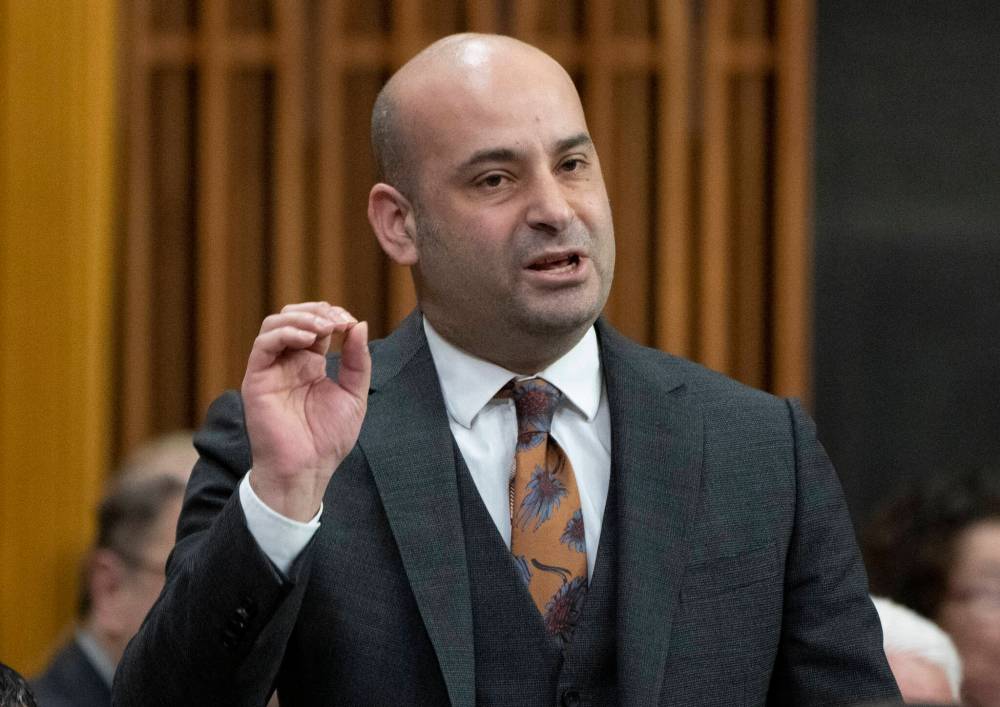
ADRIAN WYLD / THE CANADIAN PRESS FILES
Conservative MP Frank Caputo, a former prosecutor, drafted the bill to update the terminology.
Advocates, including the Winnipeg-based Canadian Centre for Child Protection, had long called for the change, which doesn’t alter the scope of criminal charges or the legal consequences.
The updated terminology was evident in a recent release from the Winnipeg Police Service, which described the arrest of a 31-year-old man after “a series of photographs and videos depicting child sexual abuse and exploitation were uploaded to a social media platform.” Among the accused’s three charges was: “possession of child sexual abuse and exploitation material.”
Bill C-291 was introduced in 2022 by B.C. Conservative MP Mel Arnold and drafted by fellow B.C. Conservative MP Frank Caputo, a former prosecutor who focused on cases of child sexual abuse. The bill received royal assent on Oct. 10, 2024, but did not come into force until this year.
“The term ‘child pornography’ disgusted me,” Caputo told the House of Commons this fall. “Children cannot consent. Pornography depicts consenting adults.”
In recent decades, the Internet has facilitated an explosion of child sexual abuse and exploitation material, including through peer-to-peer networks, software known as Tor that allows for anonymous web browsing and end-to-end encryption on messaging platforms.
“The term ‘child pornography’ disgusted me… Children cannot consent. Pornography depicts consenting adults.”
Between 2018 and 2022, Project Arachnid, a set of technological tools operated by the centre for child protection, sent more than 38 million notices to online service providers to remove child sexual abuse material or other harmful material, says the centre’s 2024 report.
The centre operates Cybertip.ca, Canada’s tip line for reporting online child sexual abuse and exploitation, which processed nearly 30,000 reports from the public in 2024.
The harms of this kind of abuse are well-documented. In a community impact statement, the Phoenix 11, a group of survivors of child sexual abuse who were brought together by the centre, wrote that “the images and videos of our child sexual abuse are permanent markers of the most painful and traumatic experiences of our lives.”
Group members stated they worried about being recognized in public from the online abuse; lived in “a perpetual state of vigilance and fear” and had developed health issues as a result, including complex PTSD, panic attacks and insomnia.
For years, the centre championed for the removal of the term “child pornography” from Canada’s laws.
Kalyn Danco, the centre’s associate general counsel, said the term “pornography” should only be used to describe material involving consenting adults, who have agreed to its public distribution.
“One thing that many survivors have said is that they find it hard to live with the knowledge that people watch their (child sexual abuse) material for sick entertainment purposes, and the word pornography has that connotation,” she said. “With this change at the legal level — and if media follows suit — we end that implication that this could somehow be entertainment.”
“Words matter. They do affect how we think about problems, the weight we give those problems, our policy responses. So as this issue has only continued to rise over the years, I think having the right terminology in place has become increasingly important,” she said.
In a statement, the Winnipeg police internet child exploitation unit also highlighted the importance of choosing words intentionally.
“Words matter. They do affect how we think about problems, the weight we give those problems, our policy responses.”
“The word pornography can often suggest consent. There is absolutely nothing consensual about children being sexually assaulted and exploited and the abuse being digitally captured, essentially ensuring the victim is revictimized every single time the image/video is viewed,” the statement said.
The hope now, Danco added, is that provinces and territories take similar action to update their own laws and regulations. In Manitoba, several laws make reference to “child pornography,” including the Child and Family Services Act.
Asked if the term “child pornography” will be removed from provincial legislation, Emily Coutts, Premier Wab Kinew’s principal secretary, said the government plans to consult with its legislative team to determine which laws would need to be amended and how that could best be done.
With slight variations, the phrase “child sexual abuse and exploitation material” has been in use for years by advocates, international organizations and certain police agencies, including the RCMP.

On its website, the Mounties state the term “child pornography” evokes children “being provocative, rather than suffering horrific sexual abuse” and can actually help offenders to “justify and normalize” their crimes.
In 2016, ECPAT International, a global consortium focused on ending child sexual exploitation, led the creation of the “Luxembourg Guidelines,” which set out unified terminology for referring to different kinds of child sexual exploitation and abuse.
The guidelines note the term “child sexual abuse material” could potentially construe a narrower set of acts than “child pornography.” Because of this, the term “exploitation” is particularly important, the document notes, as “it encompasses material that sexualises and is exploitative to the child although it is not explicitly depicting the sexual abuse of a child,” such as images of children in sexualized nude or semi-nude poses.
For this reason, the term “exploitation” was added to the Canadian wording during the committee review of Bill C-291. It was intended to ensure the new term encompassed depictions already criminalized under the mantle of “child pornography,” including fictional or AI-generated material.
marsha.mcleod@freepress.mb.ca
Marsha McLeod
Investigative reporter
Signal
Marsha McLeod is an investigative reporter at the Free Press. She joined the Free Press in 2023. Read more about Marsha.
Every piece of reporting Marsha produces is reviewed by an editing team before it is posted online or published in print — part of the Free Press‘s tradition, since 1872, of producing reliable independent journalism. Read more about Free Press’s history and mandate, and learn how our newsroom operates.
Our newsroom depends on a growing audience of readers to power our journalism. If you are not a paid reader, please consider becoming a subscriber.
Our newsroom depends on its audience of readers to power our journalism. Thank you for your support.
Marsha McLeod
Investigative reporter
Signal
Marsha McLeod is an investigative reporter at the Free Press. She joined the Free Press in 2023. Read more about Marsha.
Every piece of reporting Marsha produces is reviewed by an editing team before it is posted online or published in print — part of the Free Press‘s tradition, since 1872, of producing reliable independent journalism. Read more about Free Press’s history and mandate, and learn how our newsroom operates.
Our newsroom depends on a growing audience of readers to power our journalism. If you are not a paid reader, please consider becoming a subscriber.
Our newsroom depends on its audience of readers to power our journalism. Thank you for your support.
Related Articles
Premier’s words got people to pay attention; maybe that was the point



Advertisement Advertise With Us
Advertisement Advertise With Us