

Giving pedestrians a head start on vehicles improves safety, has no effect on traffic, city finds

Advertisement
Read this article for free:
or
Already have an account? Log in here »
To continue reading, please subscribe:

Digital Subscription
One year of digital access for only $205*
- Enjoy unlimited reading on winnipegfreepress.com
- Read the E-Edition, our digital replica newspaper
- Access News Break, our award-winning app
- Play interactive puzzles
*First annual payment billed as $205.00 + GST for one year. This annual subscription will automatically renew at $233.00 + GST every 52 weeks (10% off the regular annual price of $259.35). Offer available to new and qualified returning subscribers only. Cancel any time.
To continue reading, please subscribe:
Add Free Press access to your Brandon Sun subscription for only an additional
$1 for the first 4 weeks*
- Enjoy unlimited reading on winnipegfreepress.com
- Read the E-Edition, our digital replica newspaper
- Access News Break, our award-winning app
- Play interactive puzzles
*Your next Brandon Sun subscription payment will increase by $1.00 and you will be charged $17.95 plus GST for four weeks. After four weeks, your payment will increase to $24.95 plus GST every four weeks.
Read unlimited articles for free today:
or
Already have an account? Log in here »
Hey there, time traveller!
This article was published 02/01/2026 (281 days ago), so information in it may no longer be current.
City staff are giving pedestrian head starts at downtown intersections the green light, and are working to expand the safety measure to locations further from the core.
The four- to six-second delay for vehicles waiting at red lights — referred to as leading pedestrian intervals — were installed at 91 of downtown’s 111 intersections in March; 65 per cent at all four corners and the rest at two.
In a report that will be presented to city council’s public works committee Thursday, David Patman, the city’s manager of transportation planning, said analyzing video taken at 10 of the intersections, both before and after the interval was implemented, found a “reduction in conflict rate” between pedestrians and drivers.
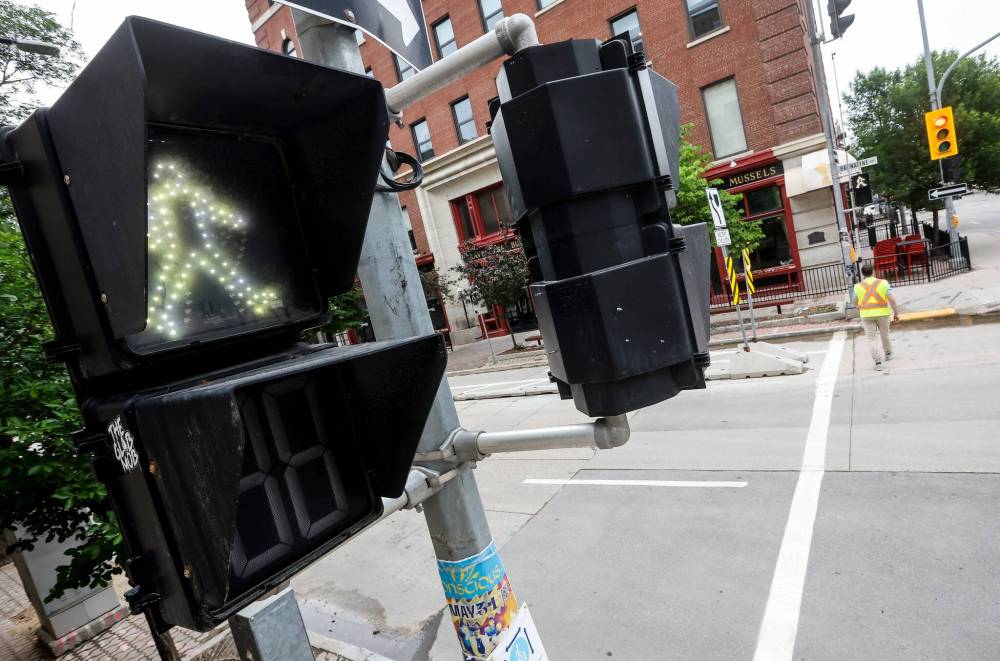
City staff are in the process of deciding how many of Winnipeg’s approximately 560 signals outside of downtown should have the leading pedestrian interval installed. (John Woods / Free Press files)
“This lead time allowed pedestrians to establish themselves in the intersection and become more visible to drivers,” Patman wrote in the report, which was published online Friday. “It resulted in an increased time gap between conflicting vehicles and crossing pedestrians.”
The initiative also found “no significant changes” to traffic congestion downtown as a result of the short delay.
City staff are in the process of deciding how many of Winnipeg’s approximately 560 signals outside of downtown should have the interval installed.
Patman said they are considering the level of risk and possible safety improvements, using factors, including the volume of crossings by people on foot, and the the proximity to schools, hospitals, senior facilities and major transit stops, among others.
“Candidate locations should be carefully selected to ensure that safety benefits can be achieved without adding unnecessary delay to high-volume Winnipeg roads,” said Patman.
Public works chair Janice Lukes said expanding the project is a no-brainer.
“I love it, because it’s virtually no cost other than the staff figuring out where to do it, and then we just change the timing of the lights in the central station,” she said Friday.
Lukes said it’s important for historically dangerous streets for pedestrians be prioritized.
“When you look at the map that is in the transportation master plan, streets like McPhillips (have) all these dots of collisions,” she said.
The report said staff will consider safety studies, pedestrian volume and area with higher rates of poverty when deciding which streets to prioritize.
Some signals, like those on Goulet and Marion streets, have upcoming reviews already planned, and will receive the new timing during those reviews.
There is no added cost to implement leading pedestrian intervals and takes about 90 minutes per signal using existing staff. The project will be carried out over the next five years, with 60-75 new leading pedestrian intervals installed yearly.
Approximately 275 pedestrians were involved in vehicle accidents downtown, including 13 that resulted in major injuries and eight in fatalities from 2015 to 2022. The Winnipeg Police Service said nine pedestrians died last year after being hit by vehicles. In total, there were 17 fatal crashes.

Hillary Rosentreter, an advocate for safety improvements on Winnipeg streets, said she’s noticed a significant difference when walking or cycling across downtown since the leading pedestrian intervals were introduced.
“You’re able to get yourself into a position where you’re most of the way through the intersection, or at the very least, extremely visible before drivers are even meant to start moving,” she said. “Visibility is a big factor in safety.”
She’d like the expansion of the project reach as many streets as possible.
“It’s been nice to see… I think they benefit most (in) obviously heavily pedestrianized areas, but would be valuable everywhere that people walk, so anywhere that there’s a sidewalk, basically,” she said.
malak.abas@freepress.mb.ca
Malak Abas is a city reporter at the Free Press. Born and raised in Winnipeg’s North End, she led the campus paper at the University of Manitoba before joining the Free Press in 2020. Read more about Malak.
Every piece of reporting Malak produces is reviewed by an editing team before it is posted online or published in print — part of the Free Press‘s tradition, since 1872, of producing reliable independent journalism. Read more about Free Press’s history and mandate, and learn how our newsroom operates.
Our newsroom depends on a growing audience of readers to power our journalism. If you are not a paid reader, please consider becoming a subscriber.
Our newsroom depends on its audience of readers to power our journalism. Thank you for your support.
Malak Abas is a city reporter at the Free Press. Born and raised in Winnipeg’s North End, she led the campus paper at the University of Manitoba before joining the Free Press in 2020. Read more about Malak.
Every piece of reporting Malak produces is reviewed by an editing team before it is posted online or published in print — part of the Free Press‘s tradition, since 1872, of producing reliable independent journalism. Read more about Free Press’s history and mandate, and learn how our newsroom operates.
Our newsroom depends on a growing audience of readers to power our journalism. If you are not a paid reader, please consider becoming a subscriber.
Our newsroom depends on its audience of readers to power our journalism. Thank you for your support.
Related Articles
City streets see fewer collisions, injuries: report


Advertisement Advertise With Us
Advertisement Advertise With Us