

First Nation says Hydro misuse of river diversion destroying sturgeon population

Advertisement
Read this article for free:
or
Already have an account? Log in here »
To continue reading, please subscribe:
Digital Subscription
One year of digital access for only $1.44 a week*
- Enjoy unlimited reading on winnipegfreepress.com
- Read the E-Edition, our digital replica newspaper
- Access News Break, our award-winning app
- Play interactive puzzles
*Billed as $5.77 plus GST every four weeks. After 52 weeks, price increases to the regular rate of $19.95 plus GST every four weeks. Offer available to new and qualified returning subscribers only. Cancel any time.
To continue reading, please subscribe:
Add Free Press access to your Brandon Sun subscription for only an additional
$1 for the first 4 weeks*
- Enjoy unlimited reading on winnipegfreepress.com
- Read the E-Edition, our digital replica newspaper
- Access News Break, our award-winning app
- Play interactive puzzles
*Your next Brandon Sun subscription payment will increase by $1.00 and you will be charged $17.95 plus GST for four weeks. After four weeks, your payment will increase to $24.95 plus GST every four weeks.
Read unlimited articles for free today:
or
Already have an account? Log in here »
Hey there, time traveller!
This article was published 22/01/2026 (276 days ago), so information in it may no longer be current.
A northern First Nation is calling on Manitoba Hydro to alter its use of the Churchill River diversion to protect a lake sturgeon population allegedly decimated by hydroelectric operations.
Tataskweyak Cree Nation Chief Doreen Spence said the culturally significant species is facing extinction on the river system without immediate intervention, 50 years after Manitoba built the diversion to send water to large power generating stations.
“The diversion has artificially altered the flow of the water… so much that the river is barely able to sustain life as it once did,” Spence told reporters in Winnipeg Thursday.
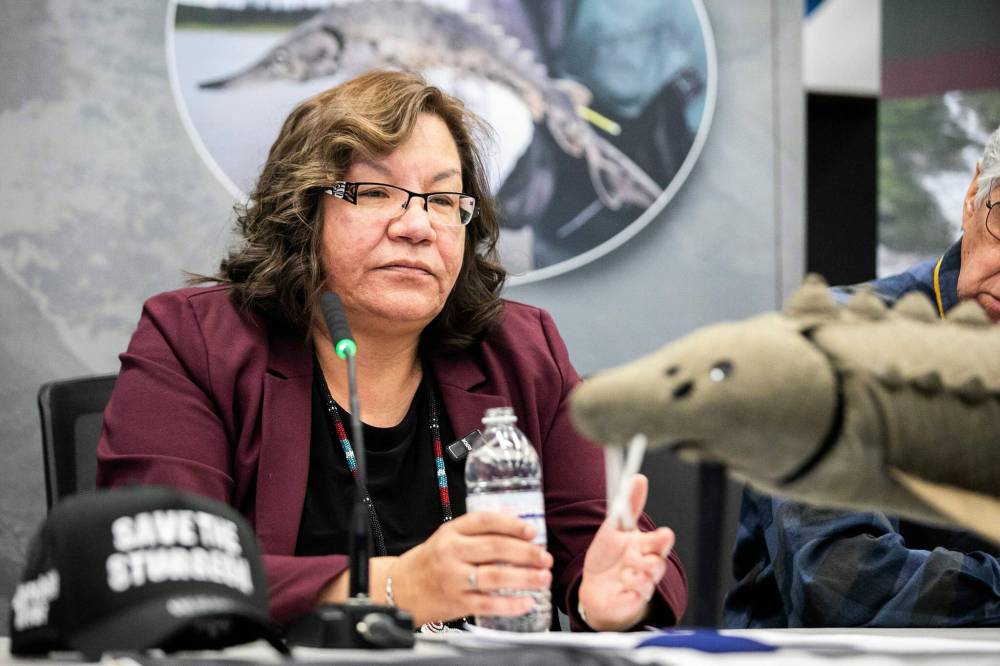
MIKAELA MACKENZIE / FREE PRESS
Tataskweyak Cree Nation Chief Doreen Spence
“Manitoba Hydro must operate the diversion in sync with the natural flow regime of the river for the sturgeon to survive.”
Tataskweyak, located about 700 kilometres north of Winnipeg, commissioned a study in 2018 to determine if Hydro operations contributed to sturgeon population decline. The research was led by AAE Tech Services Inc. and Halket Environmental Consultants Inc.
Researchers said the diversion caused the collapse of the sturgeon population primarily by diverting more than 90 per cent of the river’s natural flow for long periods of time, drastically reducing habitat availability; and creating a non-natural and unpredictable flow regime that undermines the ecosystem’s stability and ability to survive.
Hydraulic modelling shows current conditions do not support lake sturgeon, researchers said.
“This research we have done shows Hydro can still produce electricity and ensure the health of the river inhabitants,” Spence said.
“All animals have a rhythm. The river has a rhythm. The diversion operates in opposition to that rhythm.”
The diversion can send up to 98.5 per cent of the Churchill’s flow into the Nelson River, which means the Churchill, most of the time, is significantly lower than than it was before the diversion started operating in 1976, researchers said.
They said historically low water is punctuated by short bursts of historically high flows. Spence said any regeneration is destroyed by the flood of water.
Hydro received Tataskweyak’s technical reports Thursday and was not yet prepared to comment on the findings or recommendations.
“We look forward to ongoing discussions with Tataskweyak Cree Nation about Churchill River lake sturgeon populations,” spokesman Peter Chura wrote in an email.
He said Hydro has always operated the diversion in full compliance with its licence conditions.
“The Churchill River diversion is an integral component of Manitoba Hydro’s overall system and operating decisions must balance a range of factors, including energy security and affordability for all Manitobans,” Chura wrote.
Caedmon Malowany, a spokesman for Natural Resources and Indigenous Futures Minister Ian Bushie, said the current water power licence for the diversion includes conditions that address many of the environmental impacts from legacy power developments.
“We anticipate discussing this further as we review their study in context with the previous studies on the sturgeon population and examine the ongoing environmental impacts of legacy water power developments.”
Tataskweyak said lake sturgeon (“namao” in Cree) were once abundantly harvested, but only one population remains where the lower Churchill and Little Churchill rivers meet.
Robert Spence, a knowledge keeper and advocate, said about 2,000 sturgeon remain. The fish are limited to a 20-kilometre area during low-flow conditions in winter, researchers said.
They said lake sturgeon used the entire 450-km stretch of the lower Churchill before the diversion was built.
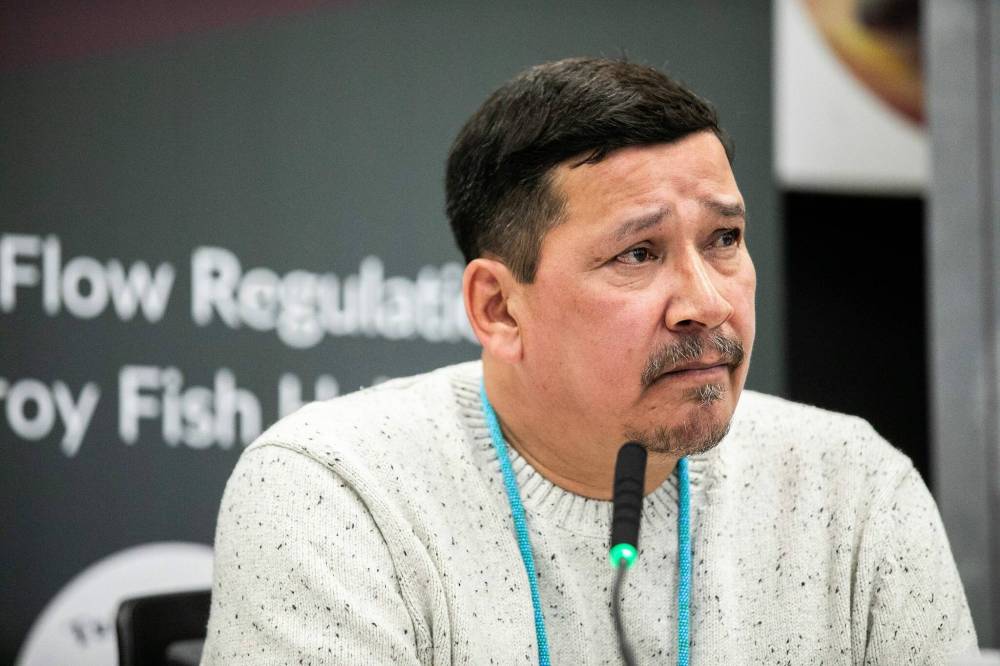
MIKAELA MACKENZIE / FREE PRESS
‘We knew that if we kept harvesting, we would be hurting the sturgeon, as well,’ says knowledge keeper and advocate Robert Spence.
Tataskweyak placed a moratorium on sturgeon fishing in 2010.
“We knew that if we kept harvesting, we would be hurting the sturgeon, as well,” Robert Spence said.
Chura said Hydro has worked with Tataskweyak since 2011 to study lake sturgeon populations, providing $1.5 million since 2018 for the First Nation to conduct its own population research.
“TCN’s research, like that previously undertaken by Manitoba Hydro, indicates there is a stable lake sturgeon population at the confluence of the Churchill and Little Churchill rivers,” Chura wrote.
Tataskweyak wants a say in how the diversion in managed and in government and Crown corporation decisions that affect the First Nation and its natural resources.
“Let’s do this together in a way that protects nature,’” Doreen Spence said. “Let’s share the water, consistent with the treaty relationship. We need to work on this in the spirit of reconciliation, and coexist together.”
She said Tataskweyak is prepared to go to court, if needed.
Hydro’s licence for the diversion expires in September. Spence called on the province to conduct a “proper” environmental assessment and to consider Tataskweyak’s findings before the licence is renewed.
The First Nation’s recommendations include efforts to reintroduce sturgeon upstream, a fish passage at Missi Falls, long-term monitoring of fish populations, and a five-year review of recovery measures.

Tataskweyak also wants Fisheries and Oceans Canada to get involved to protect sturgeon and their habitat.
A spokesperson said the federal department is aware of the studies and the request.
“(The department) is committed to fulfilling its mandate to protect fish and fish habitat in collaboration with partners, including Indigenous communities,” the spokesperson said in a statement.
Tataskweyak shared the findings amid tensions over the investigation into the cause of a days-long power outage that led to a water crisis in Pimicikamak Cree Nation.
chris.kitching@freepress.mb.ca
Chris Kitching is a general assignment reporter at the Free Press. He began his newspaper career in 2001, with stops in Winnipeg, Toronto and London, England, along the way. After returning to Winnipeg, he joined the Free Press in 2021, and now covers a little bit of everything for the newspaper. Read more about Chris.
Every piece of reporting Chris produces is reviewed by an editing team before it is posted online or published in print — part of the Free Press‘s tradition, since 1872, of producing reliable independent journalism. Read more about Free Press’s history and mandate, and learn how our newsroom operates.
Our newsroom depends on a growing audience of readers to power our journalism. If you are not a paid reader, please consider becoming a subscriber.
Our newsroom depends on its audience of readers to power our journalism. Thank you for your support.
Chris Kitching is a general assignment reporter at the Free Press. He began his newspaper career in 2001, with stops in Winnipeg, Toronto and London, England, along the way. After returning to Winnipeg, he joined the Free Press in 2021, and now covers a little bit of everything for the newspaper. Read more about Chris.
Every piece of reporting Chris produces is reviewed by an editing team before it is posted online or published in print — part of the Free Press‘s tradition, since 1872, of producing reliable independent journalism. Read more about Free Press’s history and mandate, and learn how our newsroom operates.
Our newsroom depends on a growing audience of readers to power our journalism. If you are not a paid reader, please consider becoming a subscriber.
Our newsroom depends on its audience of readers to power our journalism. Thank you for your support.
Related Articles
Arctic Gateway Group marks steady progress on ramping up Churchill operations



Advertisement Advertise With Us
Advertisement Advertise With Us
History
Updated on Thursday, January 22, 2026 6:14 PM CST: Adds comments.
Updated on Thursday, January 22, 2026 6:56 PM CST: Adds federal comments