

Prairies Premier League kicks off come spring
Pro-am expansion serves as bridge for Northern Super, Canadian Premier leagues

Advertisement
Read this article for free:
or
Already have an account? Log in here »
To continue reading, please subscribe:

Digital Subscription
One year of digital access for only $205*
- Enjoy unlimited reading on winnipegfreepress.com
- Read the E-Edition, our digital replica newspaper
- Access News Break, our award-winning app
- Play interactive puzzles
*First annual payment billed as $205.00 + GST for one year. This annual subscription will automatically renew at $233.00 + GST every 52 weeks (10% off the regular annual price of $259.35). Offer available to new and qualified returning subscribers only. Cancel any time.
To continue reading, please subscribe:
Add Free Press access to your Brandon Sun subscription for only an additional
$1 for the first 4 weeks*
- Enjoy unlimited reading on winnipegfreepress.com
- Read the E-Edition, our digital replica newspaper
- Access News Break, our award-winning app
- Play interactive puzzles
*Your next Brandon Sun subscription payment will increase by $1.00 and you will be charged $17.95 plus GST for four weeks. After four weeks, your payment will increase to $24.95 plus GST every four weeks.
Read unlimited articles for free today:
or
Already have an account? Log in here »
Hey there, time traveller!
This article was published 27/01/2026 (259 days ago), so information in it may no longer be current.
Manitoba’s footprint on the soccer pitch is expanding.
On Tuesday, the Manitoba Soccer Association (MSA) and Saskatchewan Soccer Association announced an agreement to launch the Prairies Premier League (PPL) this spring.
The PPL will represent the highest level of professional-amateur competition for men and women in Manitoba and Saskatchewan and, as MSA executive director Héctor Vergara explained, fill a crucial gap that exists between the amateur level in each province and the highest level of soccer in the country — the Canadian Premier League for men and the Northern Super League for women.
SPENCER COLBY / THE CANADIAN PRESS FILES Ottawa Rapid midfielder and Winnipeg’s own Desiree Scott (centre right) vie for the ball against the Vancouver Rise’s Jessica De Filippo during the Northern Super League semifinal in Ottawa last November. The Prairies Premier League will help Manitobans launch a bid for a pro league career.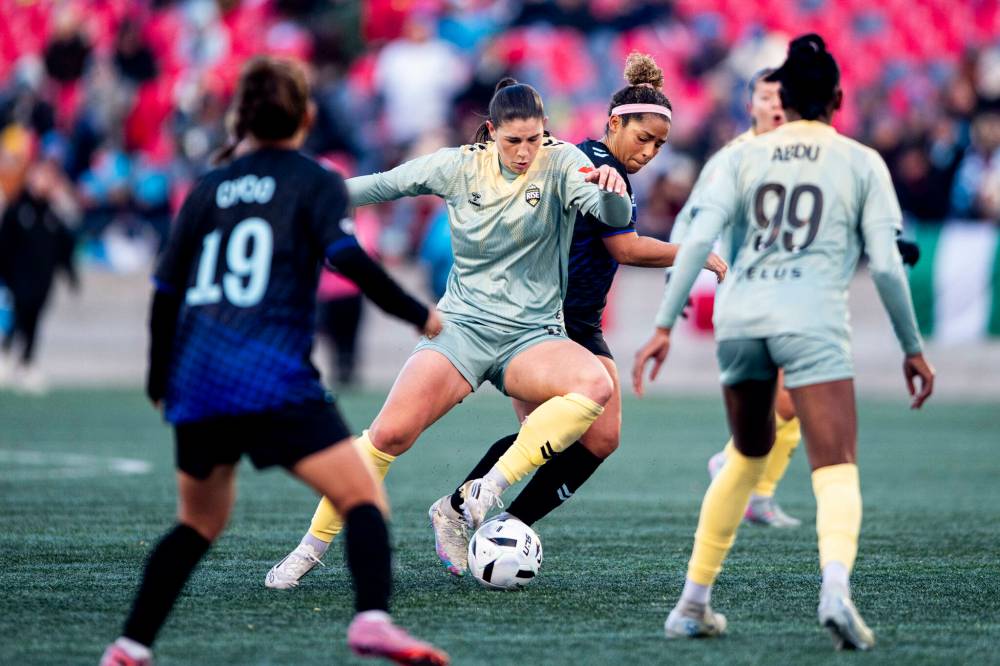
“It’s been needed in both of our provinces,” Vergara said.
“It’s a very important day in the sense that we’re moving down another path here, adding a path to the system — the player pathway — and, hopefully, now that we have two men’s and three women’s teams playing, these players now can move into that pathway and fill that gap and look into the future for their careers.”
Opportunities for Manitoban players searching for consistent, high-level competition beyond the amateur level are limited.
The Winnipeg-based FC Manitoba or Northern Ontario’s Thunder Bay Chill are the most popular clubs for local athletes.
Both clubs were members of USL League Two (formerly the Premier Development League), a U.S.-based semi-professional league, but FC Manitoba has not participated since 2023, while the Chill left the league after the 2024 season.
“It’s been needed in both of our provinces.”
Saskatchewan did not have a team that belonged to the USL League Two.
“This allows us to have a little bit of an opportunity to create more possibilities for more players in the province to play,” Vergara said.
The PPL will exist under the Premier Soccer Leagues Canada (known as League1 Canada before Tuesday) umbrella, which includes the Ontario Premier League, Alberta Premier League, British Columbia Premier League and Ligue1 Québec.
The inaugural season will feature seven clubs spanning Manitoba, Saskatchewan and Northern Ontario: FC Manitoba, the Bonivital Flames, Lucania FC (women’s only), Saskatchewan’s EXCEL Program, Forza Soccer Academy, QC United and the Thunder Bay Chill.
The league will run from early May through mid-July. A full competition schedule will be announced in the coming months.
“This allows us to have a little bit of an opportunity to create more possibilities for more players in the province to play.”
Talks of a league in the prairies had been going on for more than two years. Quebec and Ontario have had semi-professional leagues for more than a decade, while B.C. (2022) and Alberta (2024) have formed leagues more recently.
“It’s not easy, because the criteria to be a pro-am club is obviously higher than what we normally see in an amateur competition in the province,” Vergara said.
“This requires teams to start moving in the direction of professional environments. Criteria will be higher. Expectations will be higher. And… they’re incrementally going to kind of increase in the next two to three years in order for us to be able to have this league also be able to participate in a competition that leads to a national championship.”
Currently, the winners of regional men’s leagues earn a berth to the Canadian Championship the following season, which includes eight sides in the CPL and three in Major League Soccer. The Prairies Premier League will have a representative in the Canadian Championship in the coming years, but not in 2026.
SUPPLIED The Prairies Premier League will fill a crucial gap that exists between the amateur and professional levels.
The hope, for now, is that the PPL can serve as a bridge for more Manitoban talent to reach the CPL and NSL.
“Those players who are more serious about their careers and who want to play, to try and make a career out of it… will probably push into this Prairie Premier League,” Vergara said, “and then players who are simply just want to play for the enjoyment of the game… will play in the amateur level.”
winnipegfreepress.com/joshuafreysam

Josh Frey-Sam reports on sports and business at the Free Press. Josh got his start at the paper in 2022, just weeks after graduating from the Creative Communications program at Red River College. He reports primarily on amateur teams and athletes in sports. Read more about Josh.
Every piece of reporting Josh produces is reviewed by an editing team before it is posted online or published in print — part of the Free Press‘s tradition, since 1872, of producing reliable independent journalism. Read more about Free Press’s history and mandate, and learn how our newsroom operates.
Our newsroom depends on a growing audience of readers to power our journalism. If you are not a paid reader, please consider becoming a subscriber.
Our newsroom depends on its audience of readers to power our journalism. Thank you for your support.
Josh Frey-Sam reports on sports and business at the Free Press. Josh got his start at the paper in 2022, just weeks after graduating from the Creative Communications program at Red River College. He reports primarily on amateur teams and athletes in sports. Read more about Josh.
Every piece of reporting Josh produces is reviewed by an editing team before it is posted online or published in print — part of the Free Press‘s tradition, since 1872, of producing reliable independent journalism. Read more about Free Press’s history and mandate, and learn how our newsroom operates.
Our newsroom depends on a growing audience of readers to power our journalism. If you are not a paid reader, please consider becoming a subscriber.
Our newsroom depends on its audience of readers to power our journalism. Thank you for your support.
Related Articles
San Jose Earthquakes acquire Timo Werner from Red Bull Leipzig in major move for MLS club











Advertisement Advertise With Us
Advertisement Advertise With Us
History
Updated on Tuesday, January 27, 2026 7:43 PM CST: updates photo