

Canadian women crushed by U.S. squad
Most lopsided loss for Canada ever at a Winter Olympics

Advertisement
Read this article for free:
or
Already have an account? Log in here »
To continue reading, please subscribe:

Digital Subscription
One year of digital access for only $205*
- Enjoy unlimited reading on winnipegfreepress.com
- Read the E-Edition, our digital replica newspaper
- Access News Break, our award-winning app
- Play interactive puzzles
*First annual payment billed as $205.00 + GST for one year. This annual subscription will automatically renew at $233.00 + GST every 52 weeks (10% off the regular annual price of $259.35). Offer available to new and qualified returning subscribers only. Cancel any time.
To continue reading, please subscribe:
Add Free Press access to your Brandon Sun subscription for only an additional
$1 for the first 4 weeks*
- Enjoy unlimited reading on winnipegfreepress.com
- Read the E-Edition, our digital replica newspaper
- Access News Break, our award-winning app
- Play interactive puzzles
*Your next Brandon Sun subscription payment will increase by $1.00 and you will be charged $17.95 plus GST for four weeks. After four weeks, your payment will increase to $24.95 plus GST every four weeks.
Read unlimited articles for free today:
or
Already have an account? Log in here »
Hey there, time traveller!
This article was published 10/02/2026 (223 days ago), so information in it may no longer be current.
MILAN — At what point does a wake-up call become a national hockey nightmare?
We may have reached that stunning stage Tuesday in Milan, where the Canadian women’s team was steamrolled 5-0 by a younger, faster and more skilled American squad that appears very much to be inside Canada’s head.
It was the most lopsided loss Canada has ever suffered at a Winter Olympics. It marked the first time the program has ever been shut out on the sport’s biggest stage. And it poured gasoline on a growing — and increasingly uncomfortable — narrative: that Canada has been passed in women’s hockey by its neighbours to the south.
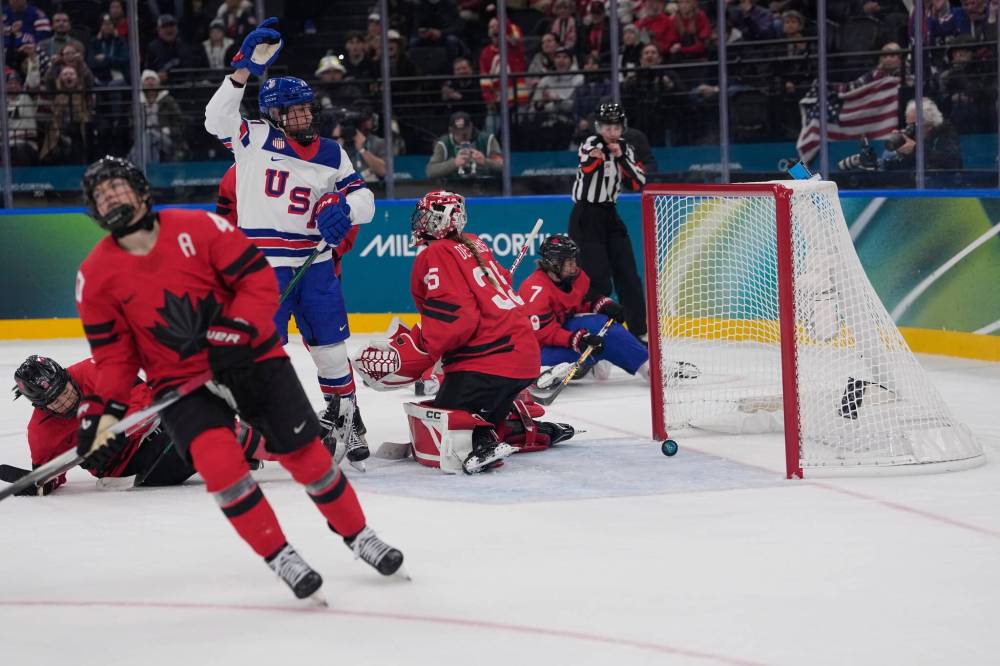
Petr David Josek / The Associated Press
United States’ Hannah Bilka, not seen in the frame, scores her side’s fourth goal during a preliminary round match of women’s ice hockey between USA and Canada at the 2026 Winter Olympics, in Milan, Tuesday.
“We just didn’t play very well at all. Irresponsible with the puck, like just poor puck management. And it’s not that there’s not confidence, but we played like we didn’t have confidence with the puck,” a very candid head coach Troy Ryan said following the game.
“We rushed a lot of decisions. You just look at the amount of offsides we had, the amount of icings we had — it’s just uncharacteristic. It’s not just us. I think the pace of that game speed, tempo, pace was definitely an upgrade compared to the first two games that we had and we were probably forced to make some decisions that we didn’t want to make.”
Alarm bells began ringing earlier this winter, when the U.S. swept a four-game exhibition series by a combined score of 24-7. Canada said all the right things afterward — then essentially ran back the same roster for Milano Cortina 2026.
Perhaps that wasn’t the best idea.
The Americans scored twice in the first period, added another pair in the middle frame and then put things on cruise control, outshooting Canada 33-20. Ste. Anne’s Jocelyne Larocque played 21:53 on the blue-line and was a minus-two while taking one of five minor penalties for her team — four of them drawn by American Abbey Murphy, who also had three assists.
Winnipegger Kati Tabin skated for just 8:17 as the seventh defender and wasn’t on the ice for a goal against.
It certainly didn’t help that Canadian captain and undisputed leader Marie-Philip Poulin was a spectator, the result of a lower-body injury she suffered one night earlier in a 5-1 victory over Czechia. She’s the heart and soul of this group, which looked dazed and confused for most of the night.
“She’s irreplaceable,” said Ryan.
“It changes a lot of things. I don’t think that’s the reason why we had the performance that we had, but you just miss her everywhere. Your power play’s a little less lethal, your penalty kill even at times and then just having the faceoff (prowess), winning those puck-possession plays. She’s just very valuable to have, so you notice her in all aspects of the game.”
You know when players rally around an injured teammate and all give a bit more? This was the opposite of that.
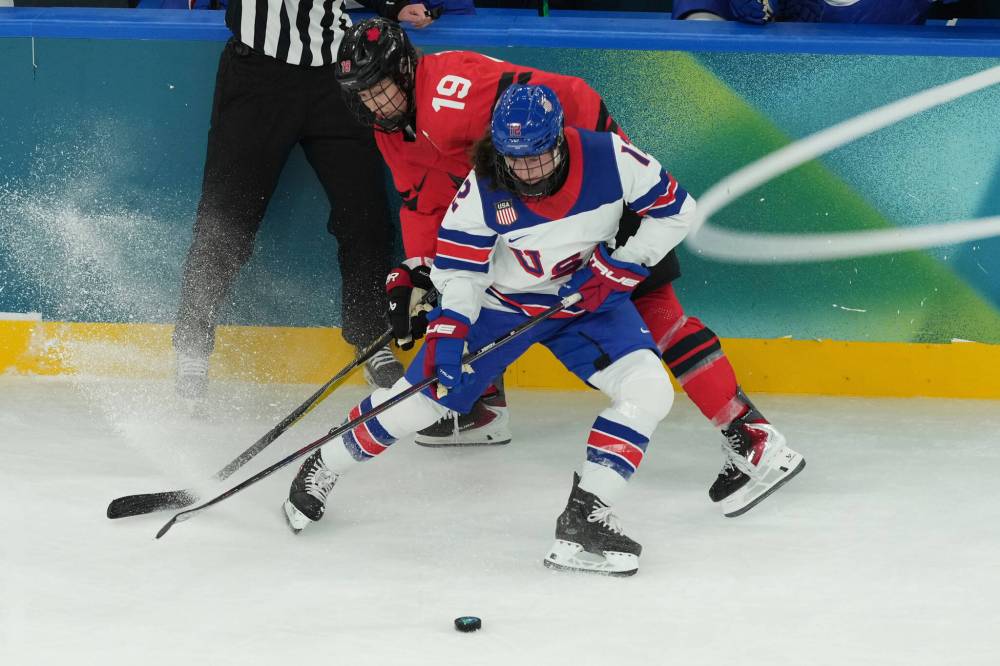
Antonio Calanni / The Associated Press
Canada’s Brianne Jenner (left) battles for the puck with United States’ Kelly Pannek.
“We really wanted to push through and win that game for her. It sucks that we didn’t have the performance that we wanted,” said forward Julia Gosling.
“I wasn’t expecting that from our group, honestly. I think we should have had that confidence after the last two games (wins over Switzerland and Czechia). I guess the pressure got to us a little.”
Nor did it likely help the cause that the Canadians were playing for a second straight night, while the Americans had an extra 24 hours of rest.
But those are likely just excuses that overlook a much bigger issue: This team might be, at best, second-best. Ryan said one of his biggest concerns was what he described as poor body language from his group once they fell behind.
“The big message for me is there just seemed to be a bit of a shoulder drop. The group got down a little bit. Honestly, I have no time for it. We’re at the Olympic games,” he said.
“It’s a bit of a cliche, but you’ve got to either have success in those games or you learn from them. You learn a little bit about yourself. You learn a little bit about the opposition. But there’s just no time for dropping the shoulders and hanging the heads. How you handle that game is going to determine how things go in other games.”
Which brings us to at least one silver lining: This embarrassing loss came in pool play rather than a gold-medal game. Still, it’s difficult to find much reason to believe the outcome would be any different should the rivals meet again for all the marbles next Thursday — as just about everyone expects.
“I don’t think you read too much into it. I think sometimes games like that happen. It’s hard to put a finger on what it was, but I don’t think we’re lacking any confidence or confidence in each other,” said Canadian forward Brianne Jenner.
“I think we are as hungry as it gets. We want to do everything we can to learn from this.”
Another consolation is the fact that Poulin’s injury is not expected to be tournament ending.
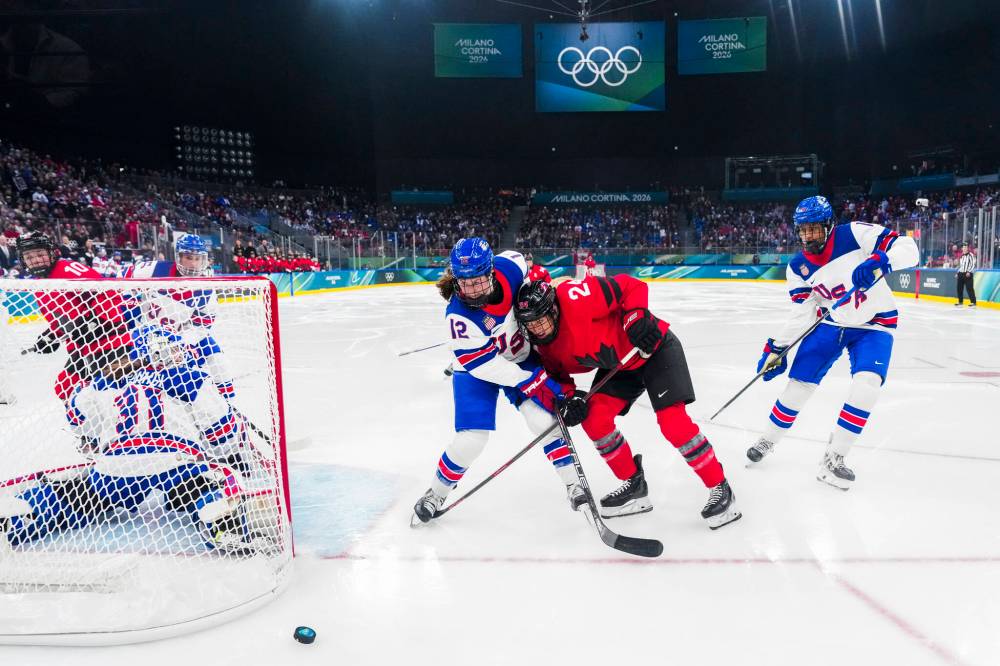
Leah Hennel / COC
Team Canada’s Natalie Spooner (24) tries to get aroung United States’ Kelly Pannek (12) during the third period.
“I think it’d be doubtful that she’d be (available) for our next one, but we’re optimistic that she will return during these Olympics,” said Ryan.
“All I’ve really been told from medical is that (it is) not as bad as they originally thought, so we’re definitely optimistic that she’ll be back.”

Canada closes out pool play on Thursday against Finland. A victory would mean a quarterfinal matchup against Germany, while a loss — in addition to being a massive upset — would mean facing Switzerland, who they beat 4-0 in the opening game. The Americans will face host Italy in the quarters on the other side of the bracket.
“We’ll watch some video,” Ryan said of how to go about fixing this on the fly.
“Right now, obviously if you make decisions now, you’re probably making the wrong decisions, but the good thing about not playing (Wednesday) is you get to sit back and watch some video and discuss it as a staff.”
“But there’s probably some little tweaks that we need to make, for sure.”
www.winnipegfreepress.com/mikemcintyre
Mike McIntyre is a sports reporter whose primary role is covering the Winnipeg Jets. After graduating from the Creative Communications program at Red River College in 1995, he spent two years gaining experience at the Winnipeg Sun before joining the Free Press in 1997, where he served on the crime and justice beat until 2016. Read more about Mike.
Every piece of reporting Mike produces is reviewed by an editing team before it is posted online or published in print — part of the Free Press‘s tradition, since 1872, of producing reliable independent journalism. Read more about Free Press’s history and mandate, and learn how our newsroom operates.
Our newsroom depends on a growing audience of readers to power our journalism. If you are not a paid reader, please consider becoming a subscriber.
Our newsroom depends on its audience of readers to power our journalism. Thank you for your support.
Mike McIntyre is a sports reporter whose primary role is covering the Winnipeg Jets. After graduating from the Creative Communications program at Red River College in 1995, he spent two years gaining experience at the Winnipeg Sun before joining the Free Press in 1997, where he served on the crime and justice beat until 2016. Read more about Mike.
Every piece of reporting Mike produces is reviewed by an editing team before it is posted online or published in print — part of the Free Press‘s tradition, since 1872, of producing reliable independent journalism. Read more about Free Press’s history and mandate, and learn how our newsroom operates.
Our newsroom depends on a growing audience of readers to power our journalism. If you are not a paid reader, please consider becoming a subscriber.
Our newsroom depends on its audience of readers to power our journalism. Thank you for your support.
Related Articles
Carman holds special place in Swiss head coach Fischer’s heart




Advertisement Advertise With Us
Advertisement Advertise With Us