

U of M partners with firm behind proposed sand mine to study Manitoba groundwater

Advertisement
Read this article for free:
or
Already have an account? Log in here »
To continue reading, please subscribe:

Digital Subscription
One year of digital access for only $205*
- Enjoy unlimited reading on winnipegfreepress.com
- Read the E-Edition, our digital replica newspaper
- Access News Break, our award-winning app
- Play interactive puzzles
*First annual payment billed as $205.00 + GST for one year. This annual subscription will automatically renew at $233.00 + GST every 52 weeks (10% off the regular annual price of $259.35). Offer available to new and qualified returning subscribers only. Cancel any time.
To continue reading, please subscribe:
Add Free Press access to your Brandon Sun subscription for only an additional
$1 for the first 4 weeks*
- Enjoy unlimited reading on winnipegfreepress.com
- Read the E-Edition, our digital replica newspaper
- Access News Break, our award-winning app
- Play interactive puzzles
*Your next Brandon Sun subscription payment will increase by $1.00 and you will be charged $17.95 plus GST for four weeks. After four weeks, your payment will increase to $24.95 plus GST every four weeks.
Read unlimited articles for free today:
or
Already have an account? Log in here »
Hey there, time traveller!
This article was published 13/02/2026 (245 days ago), so information in it may no longer be current.
University of Manitoba researchers will soon have a new, non-invasive tool to study the province’s vast groundwater resources after inking a partnership with Alberta-based mining company Sio Silica.
“If the technology works … it’s going to provide a mechanism to do real-time monitoring of changes in groundwater,” Ricardo Mantilla, an associate professor in the university’s civil engineering department and lead researcher for the project, said in an interview.
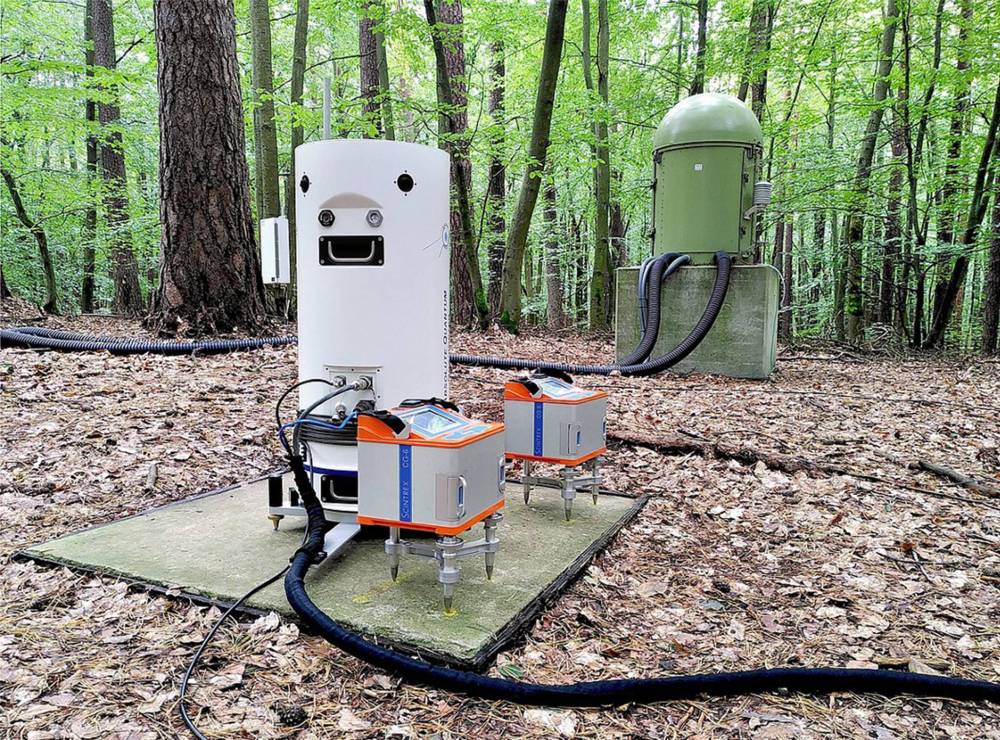
The emerging technology — called absolute quantum gravimetry — can measure changes in gravity caused by changes in groundwater levels, allowing researchers to better understand the flow and storage of underground water resources without the need for “expensive and disruptive” drilling, he said.

SUPPLIED
Ricardo Mantilla, associate professor in the university of Manitoba’s civil engineering department and lead researcher
“That obviously has applications for (Sio Silica), but it can have very important implications for how we understand groundwater in aquifers in our province.”
Sio Silica president Carla Devlin said the partnership demonstrates the company’s support for “independent research and transparent monitoring … (that) strengthens accountability and builds trust” as it continues its push to build a sand mine in Manitoba.
Sio Silica is in the process of seeking an environmental licence for a mine that proposes airlifting silica sand from a drinking water aquifer in southeastern Manitoba. It’s the company’s second attempt to secure a licence; Manitoba’s environment minister rejected an initial proposal in early 2024 following a hearing by the province’s Clean Environment Commission.
The company believes the aquifer, located 60 metres below the communities of Vivian, Anola, Springfield and others, contains high-purity silica sand that can be transformed into silicon metal — a critical mineral used for high-tech applications such as computer chips and lithium-ion batteries. Silica sand is also used in manufacturing, solar panel production and hydraulic fracturing, or fracking.
Residents have pushed back against the mining operation, concerned it could damage a drinking water source that serves more than 120,000 households.
The company initially proposed to drill more than 7,000 wells over 25 years and extract more than one million tonnes of sand annually. The environment commission stressed the project’s “experimental” technique has never been used for a large-scale mine before. It urged caution and additional testing in its report.
In October, Sio Silica submitted a revised application to the environmental assessment branch that proposes fewer wells, smaller sand quantities and a more gradual approach.
Devlin said supporting groundwater monitoring research at Manitoba’s largest university shows the company is “really focused on water safety.”
“The work is designed to safeguard groundwater, and it will confirm that our operations will not put Manitoba’s water at risk. By monitoring and sharing data, we are helping ensure clean, safe water for communities now and into the future,” she added.
While the technology to monitor changes in the gravitational field caused by water movement is already used in satellites, Mantilla said this new machinery — effectively a “very sophisticated refrigerator” that cools atoms to a temperature where changes in gravity become measurable — can be loaded into a truck and carted around the province, allowing for a much more localized understanding of water systems.
Mantilla said the company’s mine site could become “a good experimental test” of the new technology, but his team has a much broader focus.
“Groundwater is everything in Manitoba,” he said.
SUPPLIED
An example of the ‘absolute quantum gravimetry’ equipment.
The province, famed for its 100,000 lakes, its web of rivers and its connection to the Arctic, is a “perfect laboratory” for water research, Mantilla said, adding the research will also have implications for one of the province’s largest industries — agriculture.
“A lot of people in the province rely on groundwater, and we want to make sure that resource is being used in a sustainable way,” Mantilla said. “This technology is well beyond any particular industrial application.”
Mantilla said his team has been researching this method of groundwater monitoring for more than a year, and was seeking funders to help purchase the specialized machinery, which “runs in the million-dollar type of investment.”
He connected with Sio Silica when the company visited several research groups in the university’s engineering department and took an interest in his project, later agreeing to sponsor the research.

Hans-Joachim Wieden, the university’s associate vice-president for partnership, knowledge mobilization and innovation, said these kinds of industry partnerships are critical to maximize the impact of the institution’s research. Support from the private sector helps fill gaps in federal research funding, gives students valuable job experience and provides a pathway for research to make a tangible impact in communities.
“We, as the university, are interested in doing industry collaboration … for the benefits it holds for the students, for the researchers and for the communities we are in,” Wieden said.
On top of its financial contribution, Sio Silica plans to share groundwater monitoring data from its mine site with the university to help model and understand the aquifer as a complete system. Devlin noted the company envisions a long-term partnership that could include helping build out the university’s hydrology department.
“The work is not a localized mitigation exercise, it’s a foundational reset in how aquifers are understood,” she said of Mantilla’s research.
julia-simone.rutgers@freepress.mb.ca
Julia-Simone Rutgers is an investigative reporter who joined the Free Press in 2020. Read more about Julia-Simone.
Every piece of reporting Julia-Simone produces is reviewed by an editing team before it is posted online or published in print — part of the Free Press‘s tradition, since 1872, of producing reliable independent journalism. Read more about Free Press’s history and mandate, and learn how our newsroom operates.
Our newsroom depends on a growing audience of readers to power our journalism. If you are not a paid reader, please consider becoming a subscriber.
Our newsroom depends on its audience of readers to power our journalism. Thank you for your support.
Julia-Simone Rutgers is an investigative reporter who joined the Free Press in 2020. Read more about Julia-Simone.
Every piece of reporting Julia-Simone produces is reviewed by an editing team before it is posted online or published in print — part of the Free Press‘s tradition, since 1872, of producing reliable independent journalism. Read more about Free Press’s history and mandate, and learn how our newsroom operates.
Our newsroom depends on a growing audience of readers to power our journalism. If you are not a paid reader, please consider becoming a subscriber.
Our newsroom depends on its audience of readers to power our journalism. Thank you for your support.
Related Articles
Carney’s support for controversial sand mine sparks criticism
Advertisement Advertise With Us
Advertisement Advertise With Us
History
Updated on Friday, February 13, 2026 1:41 PM CST: Adds email address