

Norway House files suit against Hydro, governments over Lake Winnipeg

Advertisement
Read this article for free:
or
Already have an account? Log in here »
To continue reading, please subscribe:

Digital Subscription
One year of digital access for only $205*
- Enjoy unlimited reading on winnipegfreepress.com
- Read the E-Edition, our digital replica newspaper
- Access News Break, our award-winning app
- Play interactive puzzles
*First annual payment billed as $205.00 + GST for one year. This annual subscription will automatically renew at $233.00 + GST every 52 weeks (10% off the regular annual price of $259.35). Offer available to new and qualified returning subscribers only. Cancel any time.
To continue reading, please subscribe:
Add Free Press access to your Brandon Sun subscription for only an additional
$1 for the first 4 weeks*
- Enjoy unlimited reading on winnipegfreepress.com
- Read the E-Edition, our digital replica newspaper
- Access News Break, our award-winning app
- Play interactive puzzles
*Your next Brandon Sun subscription payment will increase by $1.00 and you will be charged $17.95 plus GST for four weeks. After four weeks, your payment will increase to $24.95 plus GST every four weeks.
Read unlimited articles for free today:
or
Already have an account? Log in here »
Hey there, time traveller!
This article was published 20/02/2026 (218 days ago), so information in it may no longer be current.
Norway House Cree Nation is suing Manitoba Hydro and the provincial and federal governments over how the public utility manipulates the level of Lake Winnipeg.
It’s the latest litigation launched by a First Nation in relation to Hydro’s regulation of the outflow of the lake into the Nelson River, which it has done since the mid-1970s.
Norway House filed its claim in the Court of King’s Bench on Thursday. It alleges Hydro and the Manitoba government have misrepresented the severity and scope of the adverse effects to the community caused by the regulation operation and the construction of a channel from Lake Winnipeg to Playgreen Lake.
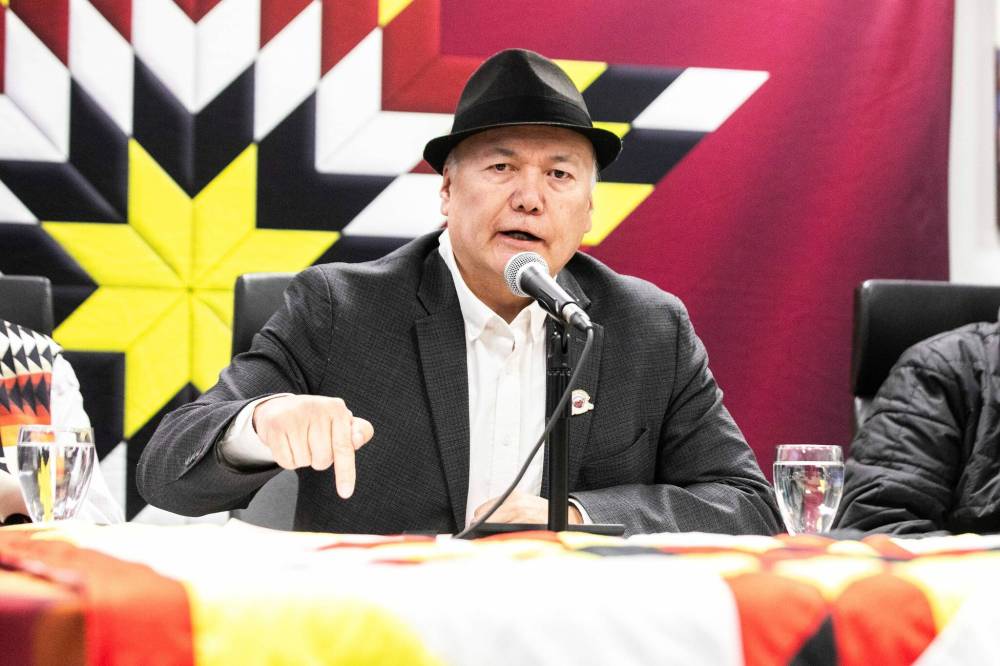
MIKAELA MACKENZIE / FREE PRESS
‘I am bound and determined to get what is rightfully ours, and this has nothing to do with money,’ said Norway House Chief Larson Anderson.
The community, which is about 460 kilometres north of Winnipeg, near the northern shore of Lake Winnipeg, hired engineering firm DHI Water and Environments Inc. to conduct a scientific assessment of the effects of the regulation project.
“That assessment, received in June 2025, revealed that the damage caused by the project was significantly more severe than Manitoba Hydro had consistently represented and that the impacts are continuing to worsen,” reads the claim.
The study found that the majority of the sediment and debris that flows into Playgreen Lake comes through the constructed “2-mile” channel with Lake Winnipeg. That sediment, the community argues, has devastated the fish habitat of Playgreen Lake. As a result most commercial fishers from the community have chosen to harvest from Lake Winnipeg instead.
“I am bound and determined to get what is rightfully ours, and this has nothing to do with money,” Norway House Chief Larson Anderson said on Friday.
The chief said the goal of the lawsuit is to force the governments and Hydro to armour the shorelines of the channel and of the lakes to prevent erosion and to remove millions of tonnes of sediment that have flowed into Playgreen Lake since the regulation project began, “so we can continue to fish on our lakes and so we can continue to live off our resources.”
If that’s done, Anderson said, “we’ll leave everybody alone.”
There are no plans to reach a settlement agreement.
“The plan is to push this to trial… We have fresh evidence,” said Norway House lawyer, Dustin Seguin, who’s a member of the Cree Nation. “We have enough to show the misconduct of Mantoba Hydro, based on agreements where their conduct was unforeseen.”
The claim alleges the project and the channel have caused “significant harm” to the community’s way of life and have infringed upon its Aboriginal and Treaty rights.
The federal government, it argues, failed to exercise its obligations to safeguard Norway House’s interests from those harms, particularly following the construction of the channel.
The regulation project has fundamentally altered Playgreen Lake and other waterways and land used by Norway House, the claim alleges. That has resulted in progressively worsening effects on fishing, hunting, trapping, drinking water, travel and cultural uses of the natural environment.
The project was approved and put into operation before the development of modern Indigenous rights and environment laws and legal theory, but, the claim argues, the law now requires meaningful consideration of Norway House’s rights for the project to continue to operate and be regulated.
The lawsuit asks the court to declare that the community’s rights have been infringed upon, that the community be consulted on the project for licensing and decision-making purposes, and that Hydro and the province install monitoring technology and conduct studies on the effects of the project.
The chief said an agreement in relation to flood damages was negotiated with Hydro and the provincial and federal governments in 1997, but the problems have continued unabated.
“We are still facing even more damage, even more issues, and they’re 100 per cent the fault of Manitoba Hydro,” the chief said.
“We’ve seen the destruction of our fish, which we… relied on for our survival. You know, we northern people, we don’t get the kind of money that many southern communities and cities receive. So we rely on our wild food, in particular, our fish, (for) our livelihood.”

Hydro spokesman Peter Chura said the regulation of Lake Winnipeg is fundamental to reliably supplying affordable electricity to the province.
“Manitoba Hydro conducts all its operations within the requirements of its licenses, permits, and the legal and regulatory regimes within which Manitoba Hydro operates,” Chura said on Friday.
The spokesman said the Crown corporation takes Norway House’s claim “very seriously and will participate fully in the legal proceedings,” but declined to comment on the specifics of the lawsuit.
Licences for the regulation project come up for renewal in August and several First Nations have filed court claims over alleged damages. Hydro and the governments have denied wrongdoing in response to some of the claims.
erik.pindera@freepress.mb.ca
Erik Pindera is a reporter for the Free Press, mostly focusing on crime and justice. The born-and-bred Winnipegger attended Red River College Polytechnic, wrote for the community newspaper in Kenora, Ont. and reported on television and radio in Winnipeg before joining the Free Press in 2020. Read more about Erik.
Every piece of reporting Erik produces is reviewed by an editing team before it is posted online or published in print — part of the Free Press‘s tradition, since 1872, of producing reliable independent journalism. Read more about Free Press’s history and mandate, and learn how our newsroom operates.
Our newsroom depends on a growing audience of readers to power our journalism. If you are not a paid reader, please consider becoming a subscriber.
Our newsroom depends on its audience of readers to power our journalism. Thank you for your support.
Erik Pindera is a reporter for the Free Press, mostly focusing on crime and justice. The born-and-bred Winnipegger attended Red River College Polytechnic, wrote for the community newspaper in Kenora, Ont. and reported on television and radio in Winnipeg before joining the Free Press in 2020. Read more about Erik.
Every piece of reporting Erik produces is reviewed by an editing team before it is posted online or published in print — part of the Free Press‘s tradition, since 1872, of producing reliable independent journalism. Read more about Free Press’s history and mandate, and learn how our newsroom operates.
Our newsroom depends on a growing audience of readers to power our journalism. If you are not a paid reader, please consider becoming a subscriber.
Our newsroom depends on its audience of readers to power our journalism. Thank you for your support.
Related Articles
First Nations hopeful as Hydro’s first Indigenous chair eyes reversing years of enmity


Advertisement Advertise With Us
Advertisement Advertise With Us
History
Updated on Saturday, February 21, 2026 9:42 AM CST: Corrects spelling of name to Dustin Seguin