

Police warn about AI use in sophisticated scam calls
‘Just Hang Up’ campaign launches in Manitoba to protect seniors

Advertisement
Read this article for free:
or
Already have an account? Log in here »
To continue reading, please subscribe:

Digital Subscription
One year of digital access for only $205*
- Enjoy unlimited reading on winnipegfreepress.com
- Read the E-Edition, our digital replica newspaper
- Access News Break, our award-winning app
- Play interactive puzzles
*First annual payment billed as $205.00 + GST for one year. This annual subscription will automatically renew at $233.00 + GST every 52 weeks (10% off the regular annual price of $259.35). Offer available to new and qualified returning subscribers only. Cancel any time.
To continue reading, please subscribe:
Add Free Press access to your Brandon Sun subscription for only an additional
$1 for the first 4 weeks*
- Enjoy unlimited reading on winnipegfreepress.com
- Read the E-Edition, our digital replica newspaper
- Access News Break, our award-winning app
- Play interactive puzzles
*Your next Brandon Sun subscription payment will increase by $1.00 and you will be charged $17.95 plus GST for four weeks. After four weeks, your payment will increase to $24.95 plus GST every four weeks.
Read unlimited articles for free today:
or
Already have an account? Log in here »
Hey there, time traveller!
This article was published 24/02/2026 (207 days ago), so information in it may no longer be current.
Police warned Manitobans about the rising use of artificial intelligence to clone voices for use in phone scams, while launching a campaign Tuesday to protect seniors from fraud.
The six-month “Just Hang Up” campaign will alert seniors, their children and their caregivers about grandparent or emergency scams that have become prevalent and increasingly sophisticated.
“These scams are designed to be high pressure. They prey on the ones we love the most — our grandparents, the ones we know who are going to help us in the time of need,” Winnipeg Police Service Insp. Jennifer McKinnon said at a news conference.
Manitobans aged 60 and older reported losing almost $350,000 to grandparent or emergency scams in 2024, as reported by the Canadian Anti-Fraud Centre. The actual total is likely much higher because scams are vastly underreported.
Police believe only five to 10 per cent of incidents are reported, McKinnon said.
Fraudsters collect potential victims’ personal details from public phone listings, social media, data breaches or other sources.
They typically phone a senior and pose as a grandchild or loved one, claiming money is urgently needed for bail or an emergency. Some fraudsters may pose as police or a lawyer.
Victims are pressured to send money or give cash to a courier, while being told to keep it a secret.
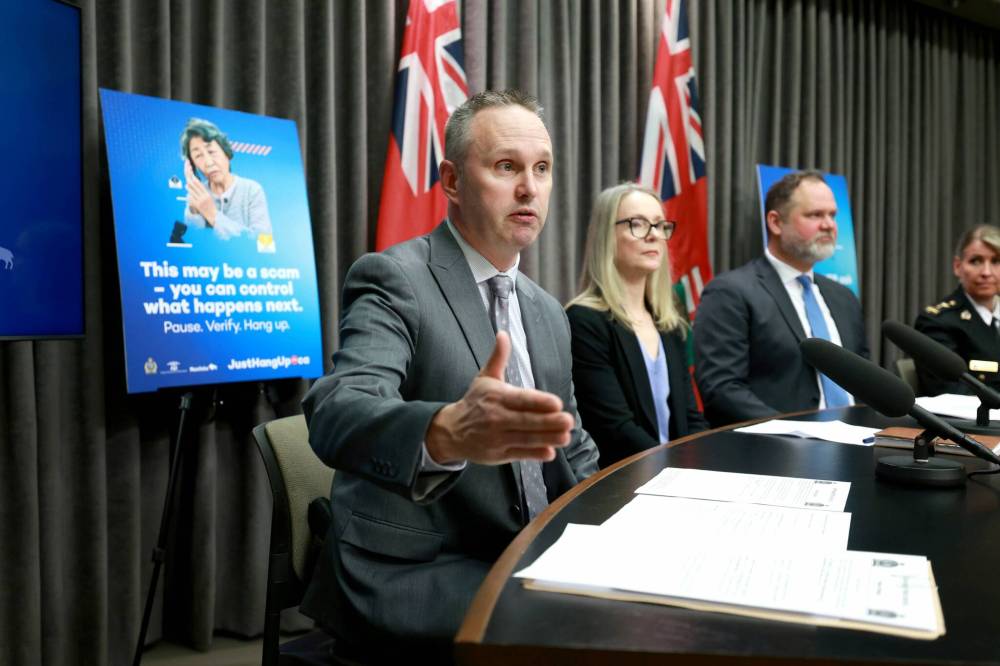
Ruth Bonneville / Free Press
Winnipeg police Sgt. Trevor Thompson, of the Financial Crimes Division, warns victims rarely get their money back.
Artificial intelligence has been used to clone voices from audio or video recordings.
“There is just really no chance that grandparents, maybe even your own parents, would be able to distinguish the difference,” police Const. Dani McKinnon said.
Phone numbers that appear on a call display can be spoofed to make the scam appear legitimate.
People who receive a call should pause, hang up and speak to family members to find out if the emergency is real, police advised. They shouldn’t give out personal or banking information, or money without verifying the info, police said.
The campaign is funded with $134,000 from the Manitoba government’s criminal property forfeiture fund.
“These scams are designed to be high pressure. They prey on the ones we love the most… our grandparents, the ones we know who are going to help us in the time of need.”
The message will be advertised on TV and radio stations, in newspapers and magazines, online and on roadside billboards.
Police will deliver presentations in seniors centres and other locations.
Amanda Macrae, CEO of A&O: Support Services for Older Adults, which partnered with police for the campaign, has spoken to some victims or their families.
“They are devastated,” she said. “They feel like maybe they should have done something earlier.”

Justice Minister Matt Wiebe shared a story about a family member who received a scam phone call with a sense of urgency.
“There is just really no chance that grandparents, maybe even your own parents, would be able to distinguish the difference.”
“The only thing that sort of got the person to recognize that this might be a scam was when they reached out to another family member to say, ‘What’s going on here?’” he said. “The advice that we were able to give was just hang up.”
Sgt. Trevor Thompson, of the police services’ financial crimes unit, said it’s uncommon for victims to recover their money, which often ends up in scammers’ accounts via a cryptocurrency ATM.
Scammers could be anywhere in the world. Fraud proceeds could be used to fund organized crime, terrorism or some foreign governments, Thompson said.
chris.kitching@freepress.mb.ca
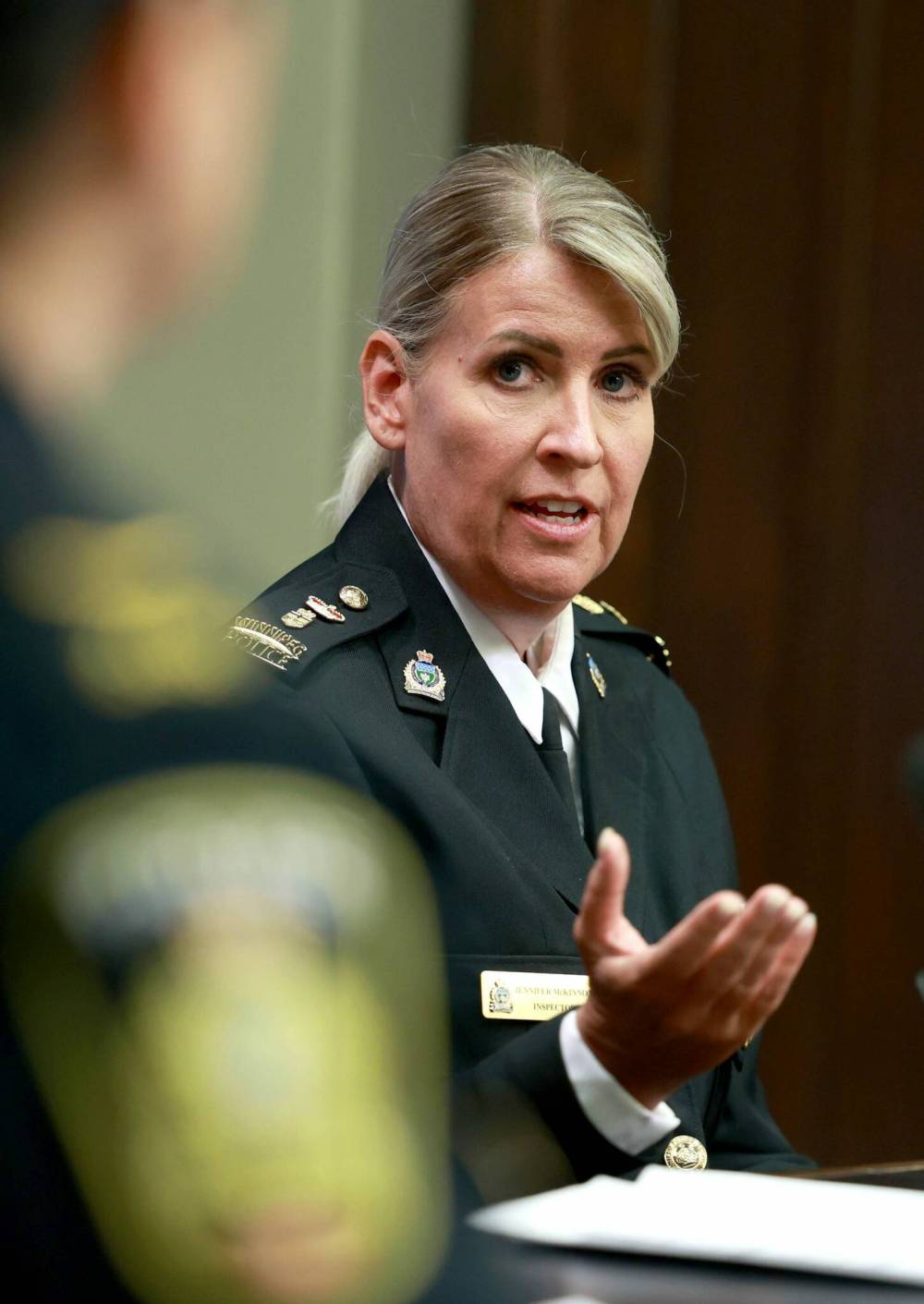
Ruth Bonneville / Free Press
Winnipeg police Insp. Jennifer McKinnon says grandparents, who are likely to jump at the chance to help a family member, are a favourite of scammers.
Chris Kitching is a general assignment reporter at the Free Press. He began his newspaper career in 2001, with stops in Winnipeg, Toronto and London, England, along the way. After returning to Winnipeg, he joined the Free Press in 2021, and now covers a little bit of everything for the newspaper. Read more about Chris.
Every piece of reporting Chris produces is reviewed by an editing team before it is posted online or published in print — part of the Free Press‘s tradition, since 1872, of producing reliable independent journalism. Read more about Free Press’s history and mandate, and learn how our newsroom operates.
Our newsroom depends on a growing audience of readers to power our journalism. If you are not a paid reader, please consider becoming a subscriber.
Our newsroom depends on its audience of readers to power our journalism. Thank you for your support.
Chris Kitching is a general assignment reporter at the Free Press. He began his newspaper career in 2001, with stops in Winnipeg, Toronto and London, England, along the way. After returning to Winnipeg, he joined the Free Press in 2021, and now covers a little bit of everything for the newspaper. Read more about Chris.
Every piece of reporting Chris produces is reviewed by an editing team before it is posted online or published in print — part of the Free Press‘s tradition, since 1872, of producing reliable independent journalism. Read more about Free Press’s history and mandate, and learn how our newsroom operates.
Our newsroom depends on a growing audience of readers to power our journalism. If you are not a paid reader, please consider becoming a subscriber.
Our newsroom depends on its audience of readers to power our journalism. Thank you for your support.
Related Articles
MPI reveals year’s ‘top five’ foiled frauds from nearly $17M in thwarted scams







Advertisement Advertise With Us
Advertisement Advertise With Us
History
Updated on Wednesday, February 25, 2026 7:45 AM CST: Adds photos