Time to poll Manitobans on changing clocks: premier Consensus on permanent standard or daylight time expected to be elusive
Read this article for free:
or
Already have an account? Log in here »
To continue reading, please subscribe:
Digital Subscription
One year of digital access for only $1.44 a week*
- Enjoy unlimited reading on winnipegfreepress.com
- Read the E-Edition, our digital replica newspaper
- Access News Break, our award-winning app
- Play interactive puzzles
*Billed as $5.77 plus GST every four weeks. After 52 weeks, price increases to the regular rate of $19.95 plus GST every four weeks. Offer available to new and qualified returning subscribers only. Cancel any time.
To continue reading, please subscribe:
Add Free Press access to your Brandon Sun subscription for only an additional
$1 for the first 4 weeks*
- Enjoy unlimited reading on winnipegfreepress.com
- Read the E-Edition, our digital replica newspaper
- Access News Break, our award-winning app
- Play interactive puzzles
*Your next Brandon Sun subscription payment will increase by $1.00 and you will be charged $17.95 plus GST for four weeks. After four weeks, your payment will increase to $24.95 plus GST every four weeks.
Read unlimited articles for free today:
or
Already have an account? Log in here »
Hey there, time traveller!
This article was published 13/03/2026 (221 days ago), so information in it may no longer be current.
The province will survey Manitobans about whether to end twice-annual time changes, after B.C. decided to move to year-round daylight time, Premier Wab Kinew announced Friday.
Kinew revealed plans to seek public opinion 10 days after he said his government wasn’t looking to follow B.C. right now because it had other priorities to focus on.
“I understand what B.C. did. Going to that extra hour of evening daylight in the summer is popular,” he told reporters at an unrelated event Friday.
“The reason why I’m not rushing to that is I want us to carefully consider kids going to school in the dark in winter time, and I want us to carefully consider reducing obesity and stroke in our society.”
MIKAELA MACKENZIE / FREE PRESS Premier Wab Kinew revealed plans on Friday to poll Manitobans on whether to end twice-annual time changes.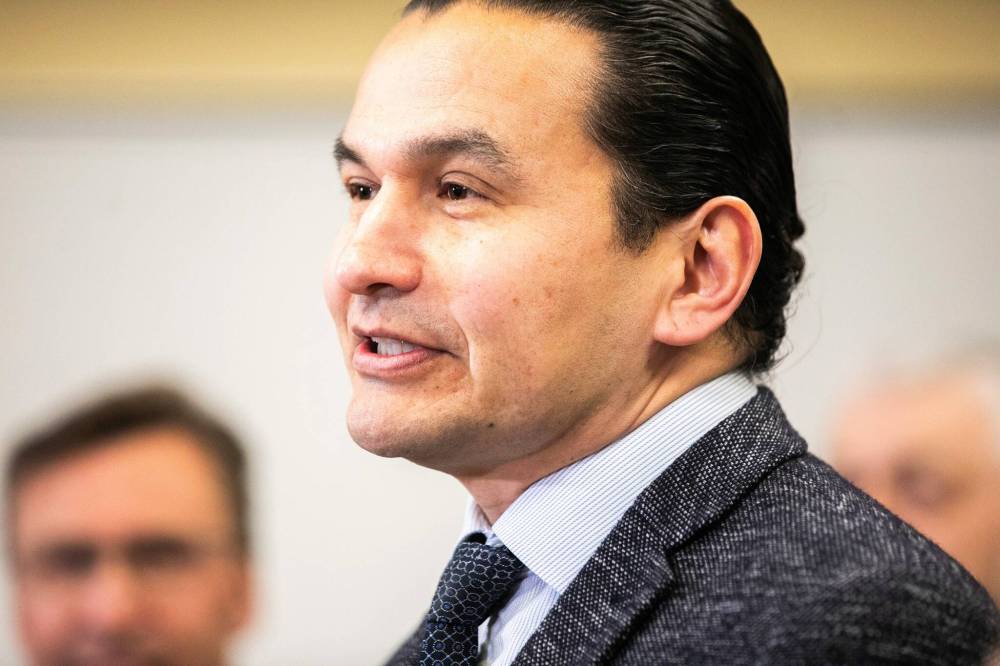
Kinew said Manitobans flooded MLAs’ email inboxes this month with opinions. He agreed time is winding down on biannual clock changes, and it would be a matter of choosing permanent standard or daylight time if Manitoba makes a change.
Kinew, a father of three, attended a hockey practice at 8:30 a.m. last Sunday after clocks moved forward one hour at 2 a.m. for daylight time.
“I was looking at the other parents and I was thinking, ‘Why are we doing this?’” he said. “It doesn’t really make sense any more, so I do think we’re coming to the end of doing this time change twice a year.”
He said his wife, Dr. Lisa Monkman, a family physician, told him changing the clocks twice annually is “stupid.”
Kinew referenced a 2025 study by researchers at California’s Stanford University, which concluded that staying in either standard or daylight time is better for human health than changing clocks twice a year.
Permanent standard time would bring the most health benefits and reduce obesity and stroke at higher rates than permanent daylight time, according to the study, which explored how time changes affect the body’s circadian rhythm, or natural internal clock, which regulates many physiological processes.
Related Articles
Clock change marks progress for some Canadians, but is a pain for others







Kinew isn’t sure Manitobans would prefer year-round standard time, which prioritizes morning light and is more aligned with human circadian rhythm, over daylight time, which brings the extra hour of evening daylight.
“We’re talking about prevalence of stroke, prevalence of obesity in the society coming down significantly if we move to that permanent winter time,” he said. “I just don’t know if the general public in Manitoba is there. I just want to take some time to talk to Manitobans and see if we can build a consensus.”
The province is looking at putting a survey on its website. The NDP, while in opposition, held public consultations in 2019.
No one would design the current system if they were starting from scratch, Kinew said, but trying to transition from a “sleep destroying structure” to one that is more sustainable and healthy in the long run will be a challenge.
“We live in Winnipeg. Winter defines a big chunk of our existence, so I think getting the daylight question right in winter time is pretty important,” he said.
“It doesn’t really make sense any more, so I do think we’re coming to the end of doing this time change twice a year.”
Starbuck canola farmer Chuck Fossay finds the time change useful. The sunny evening hours help during the bulk of growing season.
“During harvest, it’s a lot easier to keep on working when the sun is shining,” he said.
Daylight time was inconsistently used throughout Manitoba in the 1960s, Fossay said. It was confusing, he added — easy to miss appointments in another town or city.
“Whatever happens, I hope it stays at the set time and everybody follows the same rules,” Fossay said.
It’s worth considering how national and international businesses will be affected by a change, the leads of both the Winnipeg and Manitoba chambers of commerce said.
“It’s not saying don’t do it. We just… really need to do our due diligence in understanding what the impact will be,” said Loren Remillard, the Winnipeg Chamber of Commerce’s president.
“You’re never going to make everybody happy.”
Businesses using the stock market, which opens in the east, could see a challenge, he noted. He’s warned against a patchwork of daylight time use across the continent, which could lead to headaches for businesses.
Chuck Davidson, president of the Manitoba Chambers of Commerce, forecasts a lack of consensus on a change within the private sector.
“You’re never going to make everybody happy,” Davidson said. “(But) I think we’re always open to having conversations about pros and cons.”
Brianna Solberg, the Canadian Federation of Independent Business’ director for Manitoba, said any switch must involve proper consultation and co-ordination with various sectors tied to cross-border schedules, including small business, transportation, agriculture and manufacturing, as well as neighbouring trading partners such as Ontario, Saskatchewan and U.S. states.
A patchwork of time zones would be tough to navigate, especially if shipping or delivery windows have to shift, or shopping hours don’t align, she said.
CFIB members in B.C. said that province’s switch was rushed and its consultation process was limited.

Solberg said a survey of CFIB members in Manitoba found 83 per cent are in favour of moving to one permanent time, although they are split on whether it should be standard or daylight.
“Our focus isn’t on picking which clock wins,” she said. “It’s on ensuring any change is co-ordinated, predictable and doesn’t create any new red tape for small businesses.”
Dr. Lorrie Kirshenbaum, director of the Institute of Cardiovascular Sciences at St. Boniface Hospital, told the Free Press last week that the time change affects sleeping and eating cues, and heart health and depression for some people.
Saskatchewan keeps its clocks on central standard time year-round. Yukon and parts of Nunavut also do not change their clocks.
On March 3, prior to the time change, Kinew told reporters “not right now” while discussing whether Manitoba would follow B.C.
“Everybody’s got an opinion on it, but we only have so many hours in a day, and we’re going to spend those hours on health care and lowering your cost of living,” he said.
Clocks in Manitoba will fall back to standard time Nov. 1, at 2 a.m.
fpcity@freepress.mb.ca

As a general assignment reporter, Chris covers a little bit of everything for the Free Press.

Gabby is a big fan of people, writing and learning. She joined the Free Press business beat in 2021.
Our newsroom depends on a growing audience of readers to power our journalism. If you are not a paid reader, please consider becoming a subscriber.
Our newsroom depends on its audience of readers to power our journalism. Thank you for your support.