

Changes to security personnel training needed, forum told
Indigenous leaders call for 20-year-old curriculum to be updated

Advertisement
Read this article for free:
or
Already have an account? Log in here »
To continue reading, please subscribe:
Digital Subscription
One year of digital access for only $75*
- Enjoy unlimited reading on winnipegfreepress.com
- Read the E-Edition, our digital replica newspaper
- Access News Break, our award-winning app
- Play interactive puzzles
*Billed as $5.77 plus GST every four weeks. After 52 weeks, price increases to the regular rate of $19.95 plus GST every four weeks. Offer available to new and qualified returning subscribers only. Cancel any time.
Monthly Digital Subscription
$4.99/week*
- Enjoy unlimited reading on winnipegfreepress.com
- Read the E-Edition, our digital replica newspaper
- Access News Break, our award-winning app
- Play interactive puzzles
*Billed as $19.95 plus GST every four weeks. Cancel any time.
To continue reading, please subscribe:
Add Free Press access to your Brandon Sun subscription for only an additional
$1 for the first 4 weeks*
- Enjoy unlimited reading on winnipegfreepress.com
- Read the E-Edition, our digital replica newspaper
- Access News Break, our award-winning app
- Play interactive puzzles
*Your next Brandon Sun subscription payment will increase by $1.00 and you will be charged $17.95 plus GST for four weeks. After four weeks, your payment will increase to $24.95 plus GST every four weeks.
Read unlimited articles for free today:
or
Already have an account? Log in here »
The grandfather of an Indigenous teen who was evicted along with his family from their hotel room while seeking medical care at Health Sciences Centre spoke through tears about the experience during a public forum on security guards on Saturday.
Raymond Robinson is the grandfather of 16-year-old Nicholas Robinson. Nicholas and his mother, Jodie, were kicked out of their Canad Inns hotel room at HSC on Tuesday despite being in the process of extending their stay.
“There are better ways of handling things than the way the were handled,” Raymond said at Saturday’s event held at Canad Inns Polo Park.
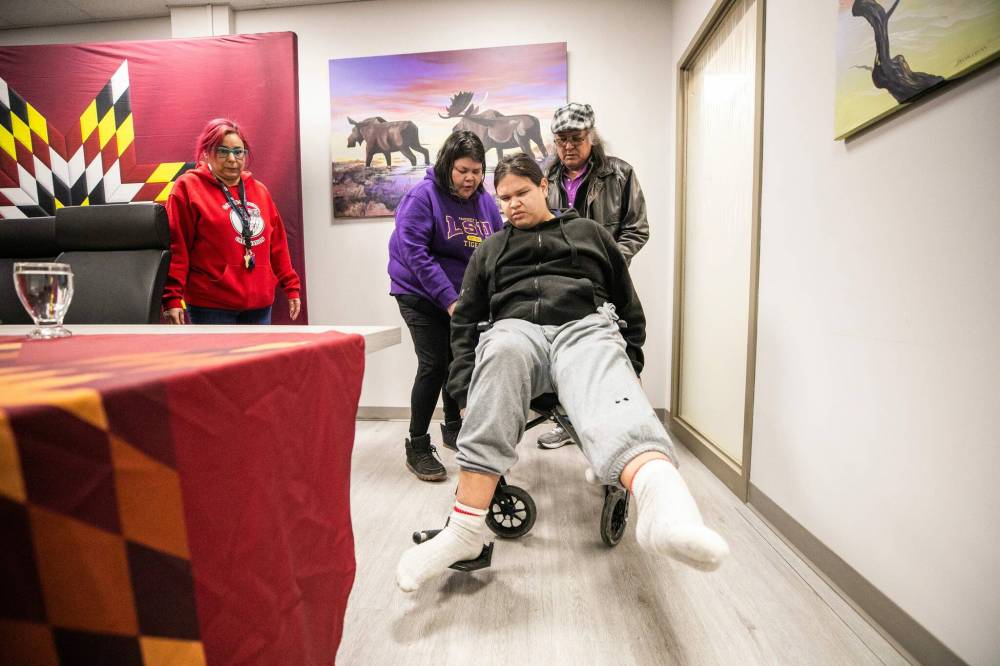
MIKAELA MACKENZIE / FREE PRESS
Nicholas Robinson, 16, is pushed into a press conference by his mother, Jodie Robinson, on Wednesday.
The event, hosted by the Indigenous Peoples Alliance of Manitoba, brought together community members, representatives of security companies, and government officials for an open dialogue on improving relationships, accountability, and respectful treatment in Winnipeg’s retail and public spaces.
It comes after several recent incidents, including one involving a security guard at a downtown Dollarama, who allegedly beat an Indigenous man with brass knuckles during an altercation two weeks ago. The assault was caught on video.
The 23-year-old guard is facing several charges, including assault with a weapon and unauthorized possession of a prohibited or restricted weapon.
Raymond said his grandson was recovering from knee surgery four days earlier and was staying at the hotel through accommodations provided by Indigenous Services Canada’s First Nations and Inuit Health Branch
They were in the process of having their stay extended last Tuesday while awaiting a follow-up medical appointment when an employee and security staff showed up and the family was evicted from their room. The eviction was captured on a 50-second video.
In the days since, Canad Inns has apologized to the teen and his family, and the local hotel chain fired the employee involved.
Despite that, Raymond said he plans to pursue legal action, arguing the apology from Canad Inns isn’t enough and that his grandson’s story is not an isolated incident, saying a similar situation happened to another Indigenous woman later the same day his grandson was kicked out.
Raymond also spoke about his own experiences while staying in hotels for medical reasons.
“When I say I want a (hotel) room, (they) respect me right away,” he said. “When I say it’s on medical, the tone changes.
“I’ve had enough.”
IPAM board member Eric Robinson, Manitoba’s former deputy premier under the Greg Selinger government, said he hopes Saturday’s forum brings security companies to the table with Indigenous leaders to develop a work plan that honours and upholds respectful relations.
“We’ve done similar work in the past with the taxicab industry and we’ve met some success there, so I hope we can do the same thing with the security guard companies.”
“We’ve done similar work in the past with the taxicab industry and we’ve met some success there, so I hope we can do the same thing with the security guard companies,” Robinson said.
Robinson added that whoever provides the training needs to be more mindful and respectful of the presence of Indigenous people.
“We happen to be the Indigenous capital of Canada here in the city of Winnipeg, and that’s a reality,” he said. “We’re not going anywhere very quick. We’re here, as a result of certain circumstances, we have been here a long time, and we do respect people, and anybody that says contrary is absolutely wrong. So we expect to be treated respectfully, just as the way we’ve been treating respectfully.”
Robinson said he hopes the forum will spark changes in training policies and in how security personnel interact with Indigenous people.
Several security companies were on hand, including Paladin, AC Security, and Commissionaires – Winnipeg.
Coleen Rajotte, an IPAM board member, said an invitation sent to Impact Security Group received no response, and security services at the University of Manitoba backed out of the forum on Friday.
“We need to be part of the talk. We want to be part of the solution,” said Derek Jones, security sales specialist with AC Security. “We want to bring everybody together as a community and try to break down some of the walls.”
He said there its “lots” of stereotyping, from both sides, and said just like there are good and bad people, there are good and bad security guards, the latter of which he said are difficult to weed out.
“And I think that is part of the main issue that needs to be rectified,” he said.
Several people spoke during a story-sharing session, including Vivian Ketchum, a digital storyteller who said she tries to document as many run-ins with security guards as possible.
Manitoba Justice Minister Matt Wiebe attended the four-hour forum.
“We need to be part of the talk. We want to be part of the solution. We want to bring everybody together as a community and try to break down some of the walls.”
“These are difficult stories,” the minister said, noting his government met with IPAM just over a year ago and heard similar concerns then, and that more incidents have since occurred in the community.
“We also know that these stories are not unique to the people who are sharing here today. We’ve heard from a lot of folks, they’re speaking on behalf of community, so this is real,” he said.

“My message is that we’re listening to these voices, we’re listening to these concerns. And by bringing people in and bringing them to the table, that’s how we’re going to get the education correct and get the training right to make sure that security guards are interacting with the public in a respectful way.”
The province’s Private Investigator and Security Guard program is currently working on modernizing its training program. The updated program is expected to roll out later this year and will include a newly developed code of conduct, Indigenous awareness units created in collaboration with the province’s Indigenous liaison team in the justice department, and a “train the trainer” program for instructors to support consistent, high-quality training delivery across Manitoba.
“Ensuring that cultural sensitivity, that indigenous experience and that trauma informed training is more of my conversation,” Wiebe said. “The curriculum is over 20 years old, so there’s a lot missing.”
The training program was last updated in 2005.
scott.billeck@freepress.mb.ca
Scott Billeck is a general assignment reporter for the Free Press. A Creative Communications graduate from Red River College, Scott has more than a decade’s worth of experience covering hockey, football and global pandemics. He joined the Free Press in 2024. Read more about Scott.
Every piece of reporting Scott produces is reviewed by an editing team before it is posted online or published in print — part of the Free Press‘s tradition, since 1872, of producing reliable independent journalism. Read more about Free Press’s history and mandate, and learn how our newsroom operates.
Our newsroom depends on a growing audience of readers to power our journalism. If you are not a paid reader, please consider becoming a subscriber.
Our newsroom depends on its audience of readers to power our journalism. Thank you for your support.
Scott Billeck is a general assignment reporter for the Free Press. A Creative Communications graduate from Red River College, Scott has more than a decade’s worth of experience covering hockey, football and global pandemics. He joined the Free Press in 2024. Read more about Scott.
Every piece of reporting Scott produces is reviewed by an editing team before it is posted online or published in print — part of the Free Press‘s tradition, since 1872, of producing reliable independent journalism. Read more about Free Press’s history and mandate, and learn how our newsroom operates.
Our newsroom depends on a growing audience of readers to power our journalism. If you are not a paid reader, please consider becoming a subscriber.
Our newsroom depends on its audience of readers to power our journalism. Thank you for your support.
Advertisement Advertise With Us
Advertisement Advertise With Us