

Environmental groups give NDP budget a ‘near failing grade’

Advertisement
Read this article for free:
or
Already have an account? Log in here »
To continue reading, please subscribe:
Digital Subscription
One year of digital access for only $1.44 a week*
- Enjoy unlimited reading on winnipegfreepress.com
- Read the E-Edition, our digital replica newspaper
- Access News Break, our award-winning app
- Play interactive puzzles
*Billed as $5.77 plus GST every four weeks. After 52 weeks, price increases to the regular rate of $19.95 plus GST every four weeks. Offer available to new and qualified returning subscribers only. Cancel any time.
To continue reading, please subscribe:
Add Free Press access to your Brandon Sun subscription for only an additional
$1 for the first 4 weeks*
- Enjoy unlimited reading on winnipegfreepress.com
- Read the E-Edition, our digital replica newspaper
- Access News Break, our award-winning app
- Play interactive puzzles
*Your next Brandon Sun subscription payment will increase by $1.00 and you will be charged $17.95 plus GST for four weeks. After four weeks, your payment will increase to $24.95 plus GST every four weeks.
Read unlimited articles for free today:
or
Already have an account? Log in here »
Hey there, time traveller!
This article was published 27/03/2026 (212 days ago), so information in it may no longer be current.
The Manitoba government has made big promises to protect and prioritize the environment as it works to boost economic development and become a “have province.”
But climate groups say the latest provincial budget, released Tuesday, has failed to deliver.
A coalition of environmental organizations including the Canadian Parks and Wilderness Society, Manitoba Eco-Network and Climate Action Team Manitoba gave the province “a near failing grade for its lack of meaningful investment in climate action and environmental protection,” according to a Friday release.
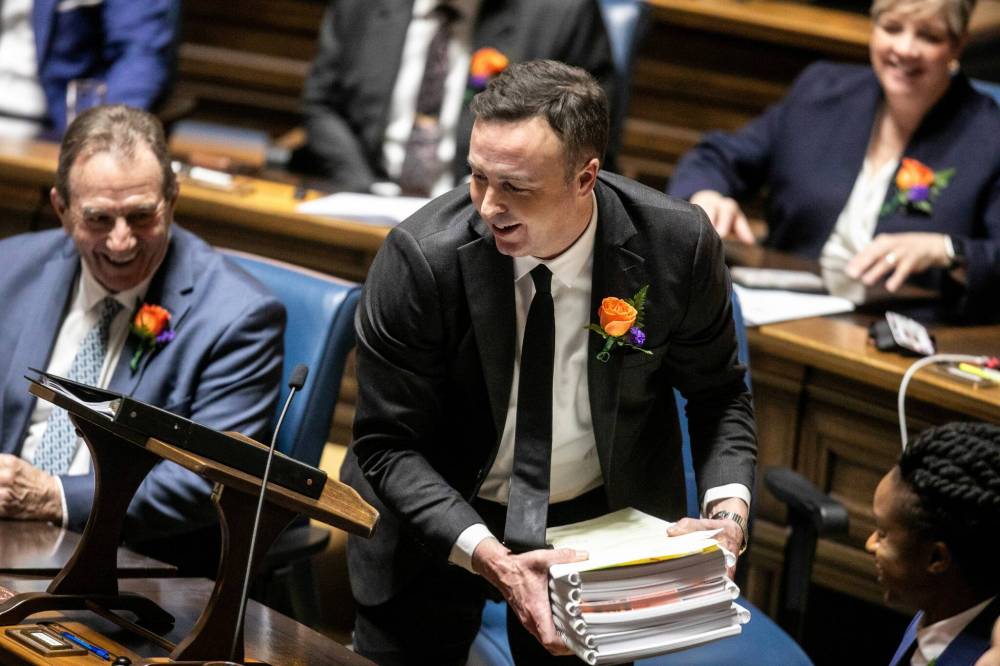
MIKAELA MACKENZIE / FREE PRESS FILES
Climate groups say Finance Minister Adrien Sala’s budget lacks “meaningful investment in climate action and environmental protection.”
“Manitoba’s 2026 budget and the past two budgets before it have been extremely disappointing for climate and nature,” Ron Thiessen, executive director of CPAWS Manitoba, said in an interview.
“The accelerating rate of extreme wildfires that have been choking our airways show we can’t wait to reduce emissions and protect the lands that remove carbon from the air. We feel quite strongly that without very strong provincial investment in climate and environment, our well-being suffers and health-care costs will continue to rise.”
In late January, the organizations were among more than two dozen local climate, business and labour groups that presented a letter to government calling for increased investment in energy-efficiency initiatives, public and active transportation and land and water protection in this year’s budget.
While Manitoba’s Environment and Climate Change Department got an 11 per cent funding increase, the money is predominantly earmarked for existing initiatives, including $10 million in ongoing funding for Efficiency Manitoba’s home energy retrofit program and extending the electric vehicle rebate, which has helped more than 5,000 Manitobans switch to electric or plug-in hybrid vehicles since July 2024.
It also includes a pledge to work with the City of Winnipeg and other municipalities to make transit free for children and youth, acknowledging “public transit is a key component in our path to net zero.”
Environment and Climate Change Minister Mike Moyes said the fare-free program will cost approximately $10 million, and discussions are currently underway with municipalities including Flin Flon, Selkirk, Brandon and Winnipeg about its implementation.
“It’s something I’m hearing lots about in the community and that lots of parents are excited about, both in terms of saving money for bus passes and bus tickets, but it’s also building out the next generation of bus riders,” Moyes said in an interview.
On conservation, the budget reiterated Manitoba’s $250,000 contribution to study the feasibility of a marine conservation in Hudson Bay as part of the Port of Churchill expansion and announced a modest increase to the parks and trails budget, including $1 million to “fully staff our park,” capital funds for upgrades at five provincial parks and disaster relief funding to rebuild wildfire-damaged campgrounds at Nopiming Provincial Park.
Environmental organizations say those investments “fall short across the board.”
“The choice to double down on balancing the budget while further cutting taxes is pushing greater climate costs and devastation onto the next generation, while missing myriad opportunities to grow low-carbon industries and jobs,” Laura Cameron, director of Climate Action Team Manitoba, said in Friday’s release.
“A climate plan without investment is simply a wish list.”
Thiessen said he applauds the province’s conservation efforts and its commitment to 30-by-30 targets — a national commitment to conserve at least 30 per cent of its land, inland waters and marine areas by 2030 to combat biodiversity loss and climate change — but a “revolutionary investment” is needed to meet that ambitious goal, including a funded plan to support Indigenous communities identifying and planning new protected areas, and support for new parks and campgrounds within a 200-kilometre radius of Winnipeg.
“We’re seeing serious and accelerated new investments in development, which is much needed, however, we’re not seeing the investments in climate and conservation to balance those outcomes,” Thiessen said.

While the report card called the free youth transit program “a positive step, and a great affordability measure,” climate action groups and transit unions have been calling for the province to increase operational funding for Winnipeg Transit, and ultimately restore the 50-50 funding partnership with the municipality.
“Public transit is one of the most effective tools we have to reduce emissions and improve affordability, yet the government continues to under-invest in the services Manitobans rely on every day,” Cameron said in the release.
Asked to respond to the failing grade from environmental groups, Moyes said the province is “incredibly proud” of its climate record thus far.
“We recognize that we’ve achieved a lot, but that there’s more to do,” he said.
julia-simone.rutgers@freepress.mb.ca
Julia-Simone Rutgers is an investigative reporter who joined the Free Press in 2020. Read more about Julia-Simone.
Every piece of reporting Julia-Simone produces is reviewed by an editing team before it is posted online or published in print — part of the Free Press‘s tradition, since 1872, of producing reliable independent journalism. Read more about Free Press’s history and mandate, and learn how our newsroom operates.
Our newsroom depends on a growing audience of readers to power our journalism. If you are not a paid reader, please consider becoming a subscriber.
Our newsroom depends on its audience of readers to power our journalism. Thank you for your support.
Julia-Simone Rutgers is an investigative reporter who joined the Free Press in 2020. Read more about Julia-Simone.
Every piece of reporting Julia-Simone produces is reviewed by an editing team before it is posted online or published in print — part of the Free Press‘s tradition, since 1872, of producing reliable independent journalism. Read more about Free Press’s history and mandate, and learn how our newsroom operates.
Our newsroom depends on a growing audience of readers to power our journalism. If you are not a paid reader, please consider becoming a subscriber.
Our newsroom depends on its audience of readers to power our journalism. Thank you for your support.
Advertisement Advertise With Us
Advertisement Advertise With Us
History
Updated on Friday, March 27, 2026 8:07 PM CDT: Fixes day of budget