

Home care assessment wait times stagnate
Lack of staff means assessments can’t keep pace with demand, says union

Advertisement
Read this article for free:
or
Already have an account? Log in here »
To continue reading, please subscribe:
Digital Subscription
One year of digital access for only $1.44 a week*
- Enjoy unlimited reading on winnipegfreepress.com
- Read the E-Edition, our digital replica newspaper
- Access News Break, our award-winning app
- Play interactive puzzles
*Billed as $5.77 plus GST every four weeks. After 52 weeks, price increases to the regular rate of $19.95 plus GST every four weeks. Offer available to new and qualified returning subscribers only. Cancel any time.
To continue reading, please subscribe:
Add Free Press access to your Brandon Sun subscription for only an additional
$1 for the first 4 weeks*
- Enjoy unlimited reading on winnipegfreepress.com
- Read the E-Edition, our digital replica newspaper
- Access News Break, our award-winning app
- Play interactive puzzles
*Your next Brandon Sun subscription payment will increase by $1.00 and you will be charged $17.95 plus GST for four weeks. After four weeks, your payment will increase to $24.95 plus GST every four weeks.
Read unlimited articles for free today:
or
Already have an account? Log in here »
Hey there, time traveller!
This article was published 01/04/2026 (207 days ago), so information in it may no longer be current.
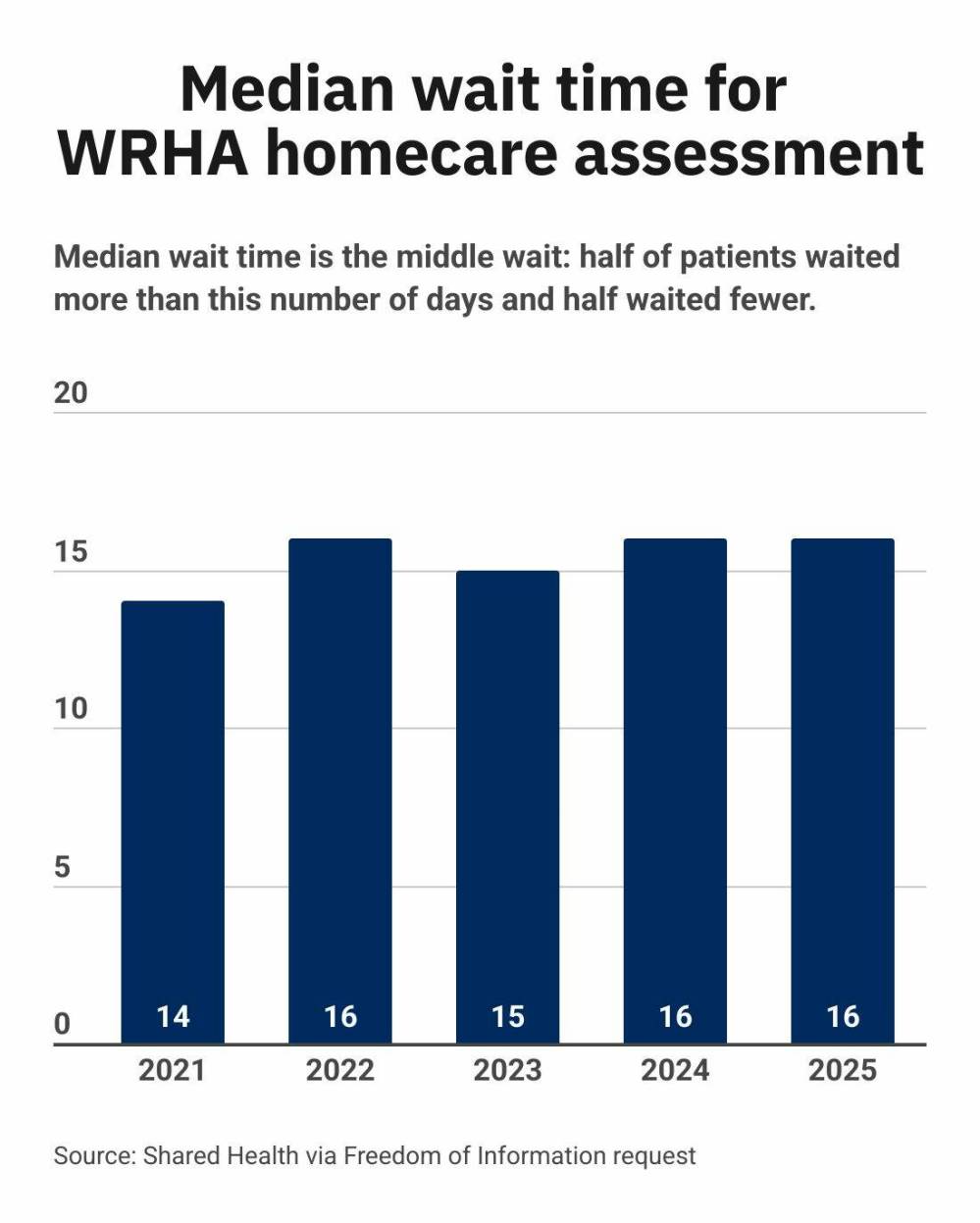
Wait times to be assessed for home care in Winnipeg haven’t improved in five years, including since the pandemic, when services were stretched to the limit.
In addition, as the population ages, hiring key home-care staff hasn’t kept pace, unions say.
Roughly half of people seeking home care through the Winnipeg Regional Health Authority waited 16 days or longer in 2025.

MIKAELA MACKENZIE / FREE PRESS FILES
‘That tells me nothing has been changing,’ says Eric De Schepper, whose partner, Katherine Ellis, died while waiting for home care.
In 2021, that number — the midway point between the longest and shortest wait times — was 14 days, data obtained via a freedom of information request show.
“It tells me that nothing has been changing,” said Eric De Schepper.
His dying wife didn’t receive the proper home care services she needed in 2023. Since then, he’s advocated for a better system.
De Schepper encouraged Manitobans to speak up about their waits — it “may make a difference,” he said.
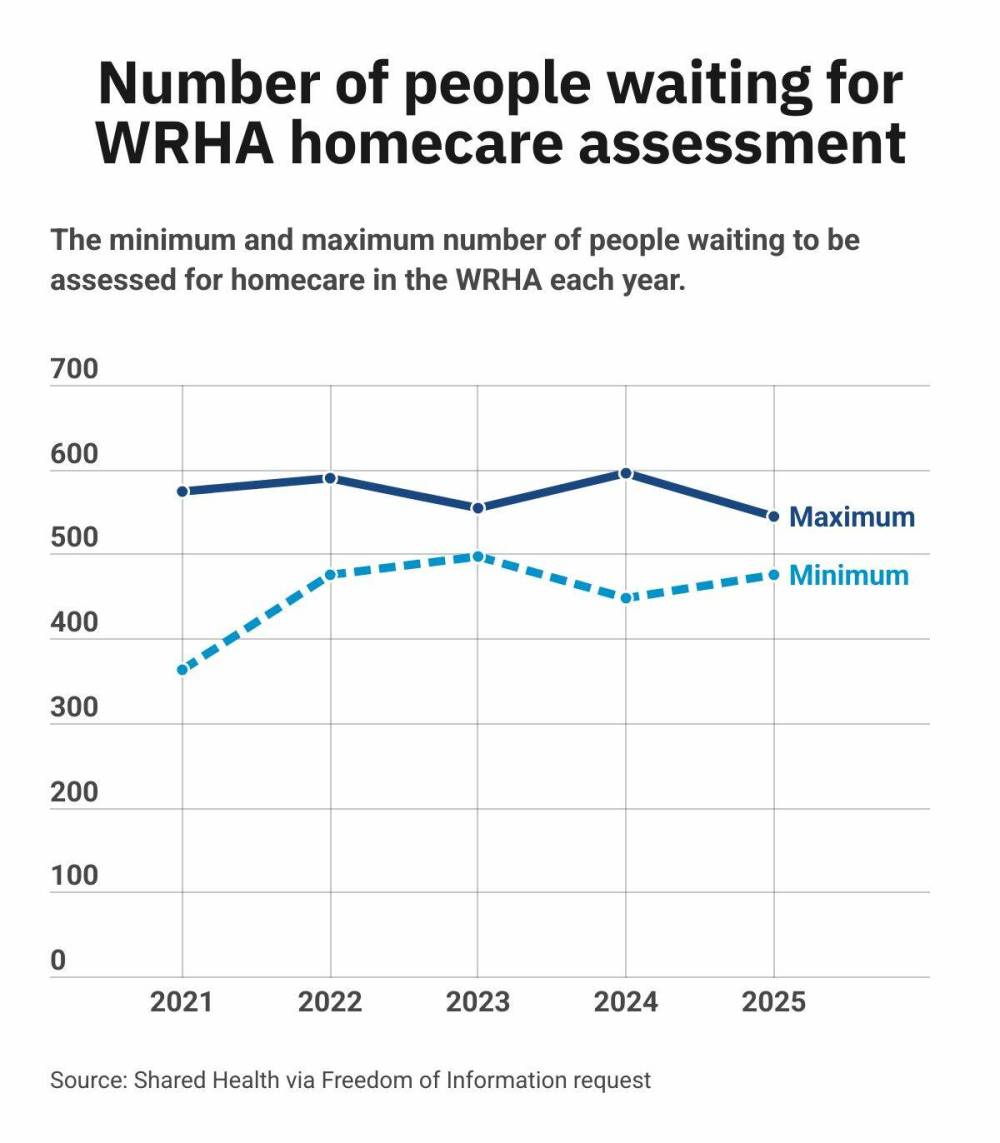
A maximum 545 clients were waiting for a home-care assessment in Winnipeg last year. At minimum, 476 people waited, the regional health authority’s data show.
It’s similar to 2021: between 363 and 574 people waited for an assessment at a given time.
(The maximum peaked in 2024, at 595 clients waiting.)
Laura Funk, a University of Manitoba sociology professor, noted wait times haven’t changed since the COVID-19 pandemic that strained health-care resources.
The World Health Organization declared in 2023 that COVID-19 was no longer a public health emergency.
“You would hope that as things improved, that things would stabilize with case co-ordinator workloads,” said Funk, who researches care for older adults.
“(Then) they could maybe get on top of those referrals for the assessments.”
Case co-ordinators oversee initial home care assessments. The Manitoba Association of Health Care Professionals represents 106 of them — just one more than the 105 who were working 2019, said Jason Linklater, the union’s president.
The Winnipeg Regional Health Authority said it staffs 277 case co-ordinators for home care.
“Workloads and complexity have… increased substantially,” Linklater said. “(The co-ordinators are) amazing people but they certainly can’t do it all, and they need more resources.”
Trainees are told to assess potential home care clients within two weeks, Linklater said. At least half of clients last year waited longer.
Co-ordinators are also tasked with year-later check-ins, to see if Manitobans’ needs have changed. It adds to the workload but is essential for care, Linklater said.
Manitobans often wait for home care services after being assessed. It’s critical that assessments are timely, Funk said.
“Many older adults might be a bit reluctant to accept formal care services,” she said. “By the time they’re asking, there can be some urgency to that request.
“Those family carers might be under considerable strain.”
The Free Press reported on weeks-long waits for initial visits with home care in 2023. People don’t wait as long if home care is deemed clinically necessary, data showed at the time.
Assessment wait times are consistent because the volume of clients waiting has been consistent, said Scott Sime, communications director for the Winnipeg Regional Health Authority.
Wait times vary by community and are influenced by the volume and complexity of cases, Sime wrote in a statement.
“Our approach is focused on intake and strengthening the entire home care system so it can meet growing demand,” Health Minister Uzoma Asagwara said in a statement, highlighting hiring and improving home care scheduling.
The lack of staff affects home care services, said Margaret Schroeder, president of the Canadian Union of Public Employees Local 204. The union represents more than 2,000 home care staff, including aides (but not case co-ordinators).
“They’re always having to head out to the next call,” Schroeder said. “They’re still providing good quality care… but they feel that it’s rushed.”
She said the stagnant assessment wait times are disappointing, but not surprising.
“The population is still aging, and more and more folks are staying at home,” Schroeder said. “We need to be able to keep pace.”
About 17 per cent of Manitoba’s population — 229,050 people — were at least 65 years old in 2021, Statistics Canada found.
The WRHA has a health-care aide vacancy rate of 9.2 per cent. It’s dropped from roughly 13 per cent in October 2025, Sime said.
It seems the provincial government and post-secondary institutions are trying to fill health care labour gaps, noted Christine Kelly, a University of Manitoba community and global health professor.

“There’s an openness to solutions, but it’s just like trying to tread water in a really difficult context,” Kelly said, adding there are vacancies across the health sector.
Ideally, clients would be assessed for home care in a week. While waiting, they might stay in hospital or depend on unpaid caregivers such as family and friends, Kelly said.
Noah Schulz, provincial director of the Manitoba Health Coalition, expects a “waiting game” to build up necessary health-care staff. Manitoba’s 2026-27 budget will help, but change doesn’t happen overnight, he said.
“I think of home care as a real linchpin for the health-care system,” Shultz said, adding it prevents stays in hospitals and personal care homes.
gabrielle.piche@winnipegfreepress.com
Gabrielle Piché reports on business for the Free Press. She interned at the Free Press and worked for its sister outlet, Canstar Community News, before entering the business beat in 2021. Read more about Gabrielle.
Every piece of reporting Gabrielle produces is reviewed by an editing team before it is posted online or published in print — part of the Free Press‘s tradition, since 1872, of producing reliable independent journalism. Read more about Free Press’s history and mandate, and learn how our newsroom operates.
Our newsroom depends on a growing audience of readers to power our journalism. If you are not a paid reader, please consider becoming a subscriber.
Our newsroom depends on its audience of readers to power our journalism. Thank you for your support.
Gabrielle Piché reports on business for the Free Press. She interned at the Free Press and worked for its sister outlet, Canstar Community News, before entering the business beat in 2021. Read more about Gabrielle.
Every piece of reporting Gabrielle produces is reviewed by an editing team before it is posted online or published in print — part of the Free Press‘s tradition, since 1872, of producing reliable independent journalism. Read more about Free Press’s history and mandate, and learn how our newsroom operates.
Our newsroom depends on a growing audience of readers to power our journalism. If you are not a paid reader, please consider becoming a subscriber.
Our newsroom depends on its audience of readers to power our journalism. Thank you for your support.

Advertisement Advertise With Us
Advertisement Advertise With Us