

Khan in hot water over ‘deeply dismissive’ social worker remarks
Regulatory body seeks public apology from Tory leader

Advertisement
Read this article for free:
or
Already have an account? Log in here »
To continue reading, please subscribe:
Digital Subscription
One year of digital access for only $1.44 a week*
- Enjoy unlimited reading on winnipegfreepress.com
- Read the E-Edition, our digital replica newspaper
- Access News Break, our award-winning app
- Play interactive puzzles
*Billed as $5.77 plus GST every four weeks. After 52 weeks, price increases to the regular rate of $19.95 plus GST every four weeks. Offer available to new and qualified returning subscribers only. Cancel any time.
To continue reading, please subscribe:
Add Free Press access to your Brandon Sun subscription for only an additional
$1 for the first 4 weeks*
- Enjoy unlimited reading on winnipegfreepress.com
- Read the E-Edition, our digital replica newspaper
- Access News Break, our award-winning app
- Play interactive puzzles
*Your next Brandon Sun subscription payment will increase by $1.00 and you will be charged $17.95 plus GST for four weeks. After four weeks, your payment will increase to $24.95 plus GST every four weeks.
Read unlimited articles for free today:
or
Already have an account? Log in here »
Hey there, time traveller!
This article was published 01/04/2026 (202 days ago), so information in it may no longer be current.
Manitoba Tory Leader Obby Khan is under pressure to publicly apologize to social workers after saying they aren’t mental health professionals.
The Manitoba College of Social Workers issued an open letter to Khan this week in which it referenced comments made by him in the legislature March 26.
He had taken shots at the government’s plan to create a $13.6-million mental health zone in the Health Sciences Centre.
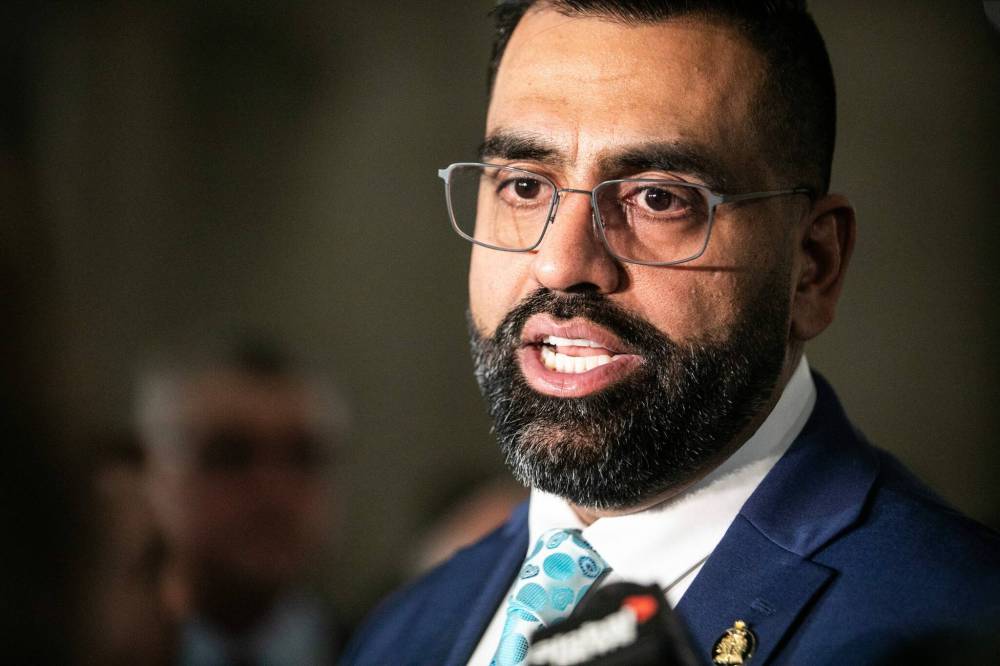
Khan said it would be staffed by social workers, although that detail isn’t confirmed in the 2026-27 budget released last month.
A provincial government spokesperson said the staffing model is being finalized, and various professions are expected to be involved.
The budget includes a promise to place social workers in emergency rooms and urgent care centres 24-7.
“Social workers, yes, do very important work, but they are not mental health professionals,” Khan said on March 26. “Why is this government putting social workers in the way of potential harm? We have mental health professionals.”
“We have a government who believes that the mental-health crisis, Manitobans suffering that, can be dealt with social workers.”
His statements are inaccurate, offensive and “deeply dismissive” of the social work field, the college’s letter reads. The governing body counts roughly 3,000 licensed professionals. Many are employed by hospitals and community health centres.
Social workers can provide psychotherapy and conduct mental health assessments, the Canadian Association of Social Workers notes online.
Khan’s remarks reflect “a fundamental misunderstanding of the mental health system,” Barbara Temmerman, the Manitoba college’s registrar, said in an interview. “(Social workers are) already doing front-line mental health work every day.”
Khan’s words undermine public trust and devalue front-line workers, Temmerman said: “Those comments risk confusing the public about who is safe to turn to in a crisis.”
“We have a government who believes that the mental-health crisis, Manitobans suffering that, can be dealt with social workers.”
She signed the college’s letter, which requests that Khan publicly correct his “inaccurate” statements, issue a sincere apology to the profession and engage with social workers and their professional bodies.
On Wednesday, Khan’s office sent an apology letter to the college, but Temmerman said while it’s a good first step, it doesn’t go far enough: the college wants him to issue a public statement.
Khan’s letter says he was “recently made aware” the Canadian Mental Health Association includes social workers as mental health workers.
“I apologize for this inadvertent error,” his signed letter reads. “Social workers do incredibly important work across Manitoba. They are highly trained professionals, and they are often on the front lines supporting people in difficult moments.
“My comments didn’t reflect that, and I regret that.”
Khan said his focus is on ensuring Manitobans can access a range of mental health supports, and that he “would welcome the opportunity” to meet with college representatives.
He wasn’t made available for an interview on Wednesday.
The Winnipeg Regional Health Authority employs nearly 200 social workers. Licenced social workers also qualify for 25 positions — such as counsellors and trauma workers — in the health authority’s mental health program, a spokesperson said.
“(Social workers are) already doing front-line mental health work every day.”
The Manitoba Association of Health Care Professionals represents roughly 400 social workers. The number is likely higher because some social workers take jobs that are classified differently, including mental health clinicians, said union president Jason Linklater.
Various allied professions, such as occupational therapists, may take mental health positions. Khan’s comments last week reflect a wider, systemic misunderstanding of allied professions’ work, Linklater said.
“If the leader of the Official Opposition does not understand what a social worker does in a mental-health setting, the question must be asked — who else doesn’t know?” Linklater questioned.
It keeps allied health care professionals regularly “excluded from the conversation” at the government level, he said.
“Most of the time, people have this impression of ‘social workers are just there to work with child welfare,’” said Bolaji Akinyele-Akanbi, who’s been a social worker for upwards of 10 years. “Social work was founded based on meeting the needs of people.”
“Maybe there’s a need for more education on what social workers do.”
Akinyele-Akanbi, a University of Manitoba professor, has assisted people with anxiety and depression.
Every social work job touches on mental health because the profession takes a holistic approach, considering various factors in clients’ lives, Akinyele-Akanbi noted.
“Those comments risk confusing the public about who is safe to turn to in a crisis.”

Mary Anne Clarke has practised social work for four decades. Much of her career has been with First Nations services for children in which assessing suicide risk was a regular task, she said.
“We need more trained, capable social workers throughout all areas of social services,” Clarke said. “We’re facing major challenges that are more deadly and more significant than I’ve seen in over 40 years, in terms of addictions and related issues.”
The college of social workers began in 2015. Before that, a voluntary regulatory organization oversaw the profession for nearly 50 years.
Social workers also staff correctional facilities, schools, shelters and private practice clinics, among other spaces.
gabrielle.piche@winnipegfreepress.com
Gabrielle Piché reports on business for the Free Press. She interned at the Free Press and worked for its sister outlet, Canstar Community News, before entering the business beat in 2021. Read more about Gabrielle.
Every piece of reporting Gabrielle produces is reviewed by an editing team before it is posted online or published in print — part of the Free Press‘s tradition, since 1872, of producing reliable independent journalism. Read more about Free Press’s history and mandate, and learn how our newsroom operates.
Our newsroom depends on a growing audience of readers to power our journalism. If you are not a paid reader, please consider becoming a subscriber.
Our newsroom depends on its audience of readers to power our journalism. Thank you for your support.
Gabrielle Piché reports on business for the Free Press. She interned at the Free Press and worked for its sister outlet, Canstar Community News, before entering the business beat in 2021. Read more about Gabrielle.
Every piece of reporting Gabrielle produces is reviewed by an editing team before it is posted online or published in print — part of the Free Press‘s tradition, since 1872, of producing reliable independent journalism. Read more about Free Press’s history and mandate, and learn how our newsroom operates.
Our newsroom depends on a growing audience of readers to power our journalism. If you are not a paid reader, please consider becoming a subscriber.
Our newsroom depends on its audience of readers to power our journalism. Thank you for your support.
Related Articles
Manitoba Tory leader rebuked for comments to non-binary cabinet minister

Advertisement Advertise With Us
Advertisement Advertise With Us
History
Updated on Thursday, April 2, 2026 10:31 AM CDT: Removes duplicate quote