

Manitoba students’ science projects aimed at eye health, wildfire prevention take top marks

Advertisement
Read this article for free:
or
Already have an account? Log in here »
To continue reading, please subscribe:

Digital Subscription
One year of digital access for only $205*
- Enjoy unlimited reading on winnipegfreepress.com
- Read the E-Edition, our digital replica newspaper
- Access News Break, our award-winning app
- Play interactive puzzles
*First annual payment billed as $205.00 + GST for one year. This annual subscription will automatically renew at $233.00 + GST every 52 weeks (10% off the regular annual price of $259.35). Offer available to new and qualified returning subscribers only. Cancel any time.
To continue reading, please subscribe:
Add Free Press access to your Brandon Sun subscription for only an additional
$1 for the first 4 weeks*
- Enjoy unlimited reading on winnipegfreepress.com
- Read the E-Edition, our digital replica newspaper
- Access News Break, our award-winning app
- Play interactive puzzles
*Your next Brandon Sun subscription payment will increase by $1.00 and you will be charged $17.95 plus GST for four weeks. After four weeks, your payment will increase to $24.95 plus GST every four weeks.
Read unlimited articles for free today:
or
Already have an account? Log in here »
An everyday conversation at home inspired twin sisters Miriam and Ruth Turk to design and trial a 3D-printed device aimed at preventing a serious eye condition.
The Grade 9 students and their ophthalmologist father, William Turk, were reflecting on their day at school or work months ago, when the elder Turk discussed seeing patients with scarring of the conjunctiva, a thin membrane that covers the white of the eye and underside of the eyelids.
“When this condition happens, you need a symblepharon ring to prevent the eyelid from adhering to the eye,” Miriam Turk said.
JOHN WOODS / FREE PRESS
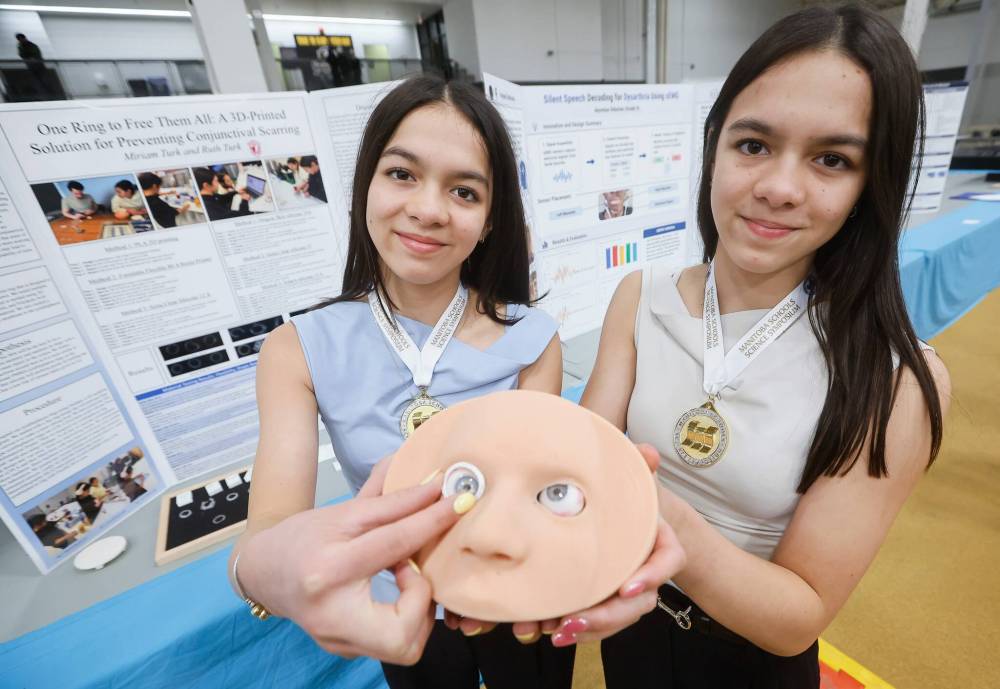
Sisters Miriam and Ruth Turk show off their gold-medal-winning project on developing a 3-D printed solution for preventing conjunctival scarring during the 55th annual Manitoba Schools Science Symposium.
“We asked, ‘What do these rings look like?’ We got to designing and we were intrigued at how these symblepharon rings are shaped, and how currently they’re just little rings and they’re not the ideal shape or the best we can do for the patients.”
The siblings, who attend Mennonite Brethren Collegiate Institute in Winnipeg and are interested in careers in medicine, won a gold medal at the 2026 Manitoba Schools Science Symposium on Sunday.
Ruth Turk said they tested multiple materials while designing a new symblepharon ring — a medical device designed to prevent conjunctival scarring as a result of trauma, infections or other causes — that better fits the curvature of the eye.
Using a model of the human eye, they concluded a ring made of polylactic acid, or PLA, performed best because it offered excellent rigidity and easy placement. Rings currently used by professionals are typically made of a more rigid type of plastic, the siblings said.
“In the future, we could create kits for residents and surgeons for them to practice putting (the rings) inside the model eyes,” Ruth Turk said.
More than 350 students in grades 4 to 12 took part in MSSS, the province’s largest annual science event, at the University of Manitoba. The three-day symposium, which also offered educational activities, concluded with Sunday’s awards ceremony. Some students will advance to the Canada-Wide Science Fair in Edmonton in May.
Grade 9 student Aadhi Chandrasekaran, who won a gold medal, started exploring new ways to predict wildfires using artificial intelligence, after last year’s devastating season forced students from northern Manitoba to miss a science fair that he attended.
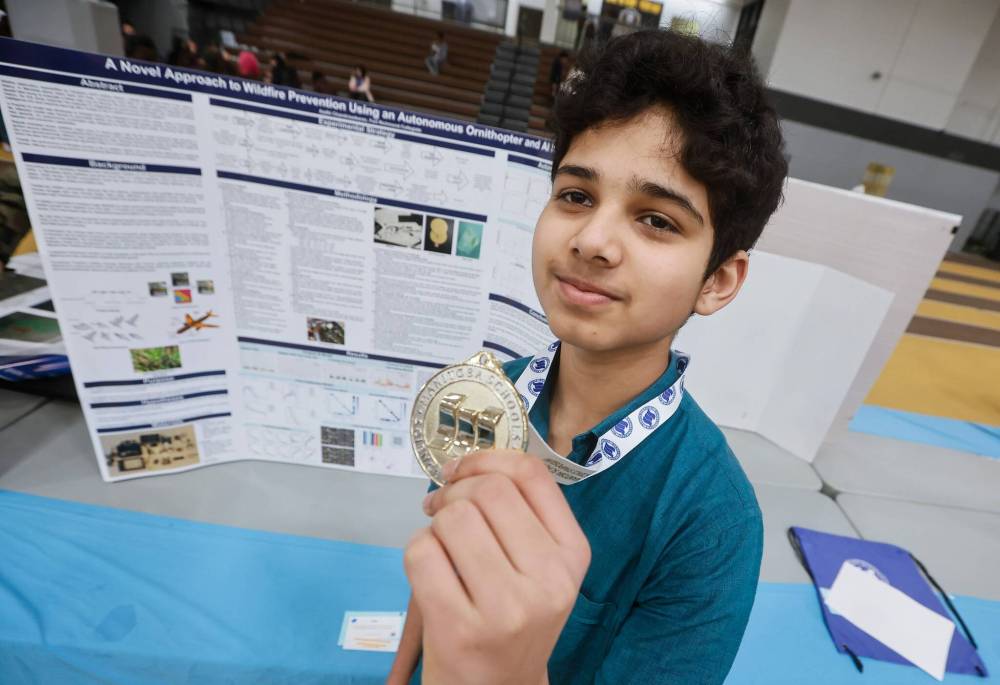
Chandrasekaran, who attends Fort Richmond Collegiate, designed a camera-equipped autonomous ornithopter — a drone with bird-like wings — and two AI models to predict future fire trends and scan aerial images for ignition sources.
“I thought, ‘What are traditional preventive devices doing, and why are they not working?” said Chandrasekaran, 14, who was saddened when 2025’s fires took opportunities away from some of his peers.
JOHN WOODS / FREE PRESS
Aadhi Chandrasekaran shows off his gold-medal-winning project on an approach to wildfire prevention during the 55th annual Manitoba Schools Science Symposium at the University of Manitoba Sunday.
“I wanted to kind of innovate my own new idea so more people can experience science fairs without having to worry about other things they cannot control.”
Chandrasekaran’s aim was to design an ornithopter that is a less expensive and more efficient alternative to traditional drones. The project investigated the ornithopter’s wing mechanism to explore the relationship between wings and aerodynamic efficiency.
Chandrasekaran, who is interested in environmental science, said he hopes to one day manufacture his creation.
“For my conclusion, I determined my autonomous ornithopter can not only be used for wildfire prevention, but also just as an aerial device as its own, and can be used for the ecological monitoring of bird kinematics or any wildlife,” he said.
Alastair Komus, president of MSSS’ board of directors, said projects that incorporate AI are an emerging trend at the symposium.
“AI is so much in the news — all the tools that come out — and the students are learning how to use the tools responsibly,” he said “I think that really sparks a lot of interest in how they can apply that to the topics that interest them.”
Scientists are going through challenging times, particularly in the U.S., while they face research funding cuts, censorship or disinformation campaigns.
“Developing a scientifically literate society is critically important for us, and also engaging in those critical thinking skills as well,” Komus said.
Science and innovation doesn’t have to start in big labs, Chandrasekaran said.
JOHN WOODS / FREE PRESS
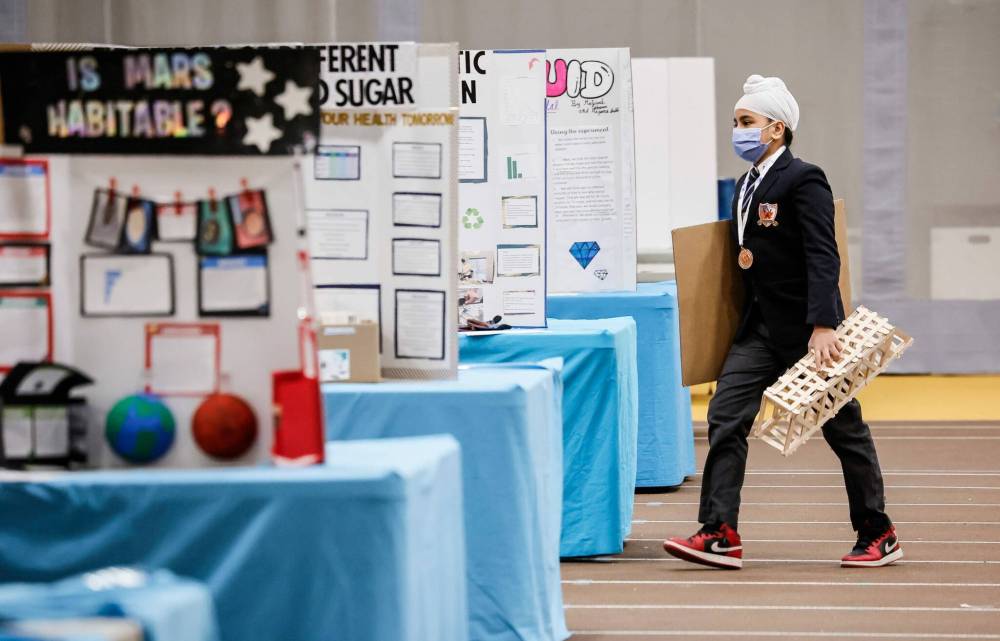
A student walks with his project during the 55th annual Manitoba Schools Science Symposium Sunday

“You can also be a young innovator and slowly start to tackle small problems that you think are important and try to put your own innovative touch,” he said.
“A child might have a different view on something rather than a professor, which is why I think it’s important for everyone to take something new and try innovating, or participate in a science fair.”
Science is a very important component of education systems, Ruth Turk said.
“Even if you don’t go very far in it, it’s very important to try to immerse yourself in it and just learn as much as you can,” she said.
chris.kitching@freepress.mb.ca
Chris Kitching is a general assignment reporter at the Free Press. He began his newspaper career in 2001, with stops in Winnipeg, Toronto and London, England, along the way. After returning to Winnipeg, he joined the Free Press in 2021, and now covers a little bit of everything for the newspaper. Read more about Chris.
Every piece of reporting Chris produces is reviewed by an editing team before it is posted online or published in print — part of the Free Press‘s tradition, since 1872, of producing reliable independent journalism. Read more about Free Press’s history and mandate, and learn how our newsroom operates.
Our newsroom depends on a growing audience of readers to power our journalism. If you are not a paid reader, please consider becoming a subscriber.
Our newsroom depends on its audience of readers to power our journalism. Thank you for your support.
Chris Kitching is a general assignment reporter at the Free Press. He began his newspaper career in 2001, with stops in Winnipeg, Toronto and London, England, along the way. After returning to Winnipeg, he joined the Free Press in 2021, and now covers a little bit of everything for the newspaper. Read more about Chris.
Every piece of reporting Chris produces is reviewed by an editing team before it is posted online or published in print — part of the Free Press‘s tradition, since 1872, of producing reliable independent journalism. Read more about Free Press’s history and mandate, and learn how our newsroom operates.
Our newsroom depends on a growing audience of readers to power our journalism. If you are not a paid reader, please consider becoming a subscriber.
Our newsroom depends on its audience of readers to power our journalism. Thank you for your support.

Advertisement Advertise With Us
Advertisement Advertise With Us