

Indigenous Winnipeggers undercounted, underserved: report

Advertisement
Read this article for free:
or
Already have an account? Log in here »
To continue reading, please subscribe:

Digital Subscription
One year of digital access for only $205*
- Enjoy unlimited reading on winnipegfreepress.com
- Read the E-Edition, our digital replica newspaper
- Access News Break, our award-winning app
- Play interactive puzzles
*First annual payment billed as $205.00 + GST for one year. This annual subscription will automatically renew at $233.00 + GST every 52 weeks (10% off the regular annual price of $259.35). Offer available to new and qualified returning subscribers only. Cancel any time.
To continue reading, please subscribe:
Add Free Press access to your Brandon Sun subscription for only an additional
$1 for the first 4 weeks*
- Enjoy unlimited reading on winnipegfreepress.com
- Read the E-Edition, our digital replica newspaper
- Access News Break, our award-winning app
- Play interactive puzzles
*Your next Brandon Sun subscription payment will increase by $1.00 and you will be charged $17.95 plus GST for four weeks. After four weeks, your payment will increase to $24.95 plus GST every four weeks.
Read unlimited articles for free today:
or
Already have an account? Log in here »
Winnipeg’s First Nations and Métis population may be vastly undercounted, raising questions about how governments fund services for Indigenous communities, a new report says.
The new estimate, contained in the “Our Health Counts First Nations & Métis Winnipeg” report, says the population could be four times larger than what was recorded by the 2021 census. The report pegs the population of First Nations and Métis people in Winnipeg at between 248,000 and 379,000 people based on its survey of 1,090 adults and 306 children, most of whom identified as First Nations or Métis.
In contrast, the 2021 census recorded 90,000 Indigenous people in the city.
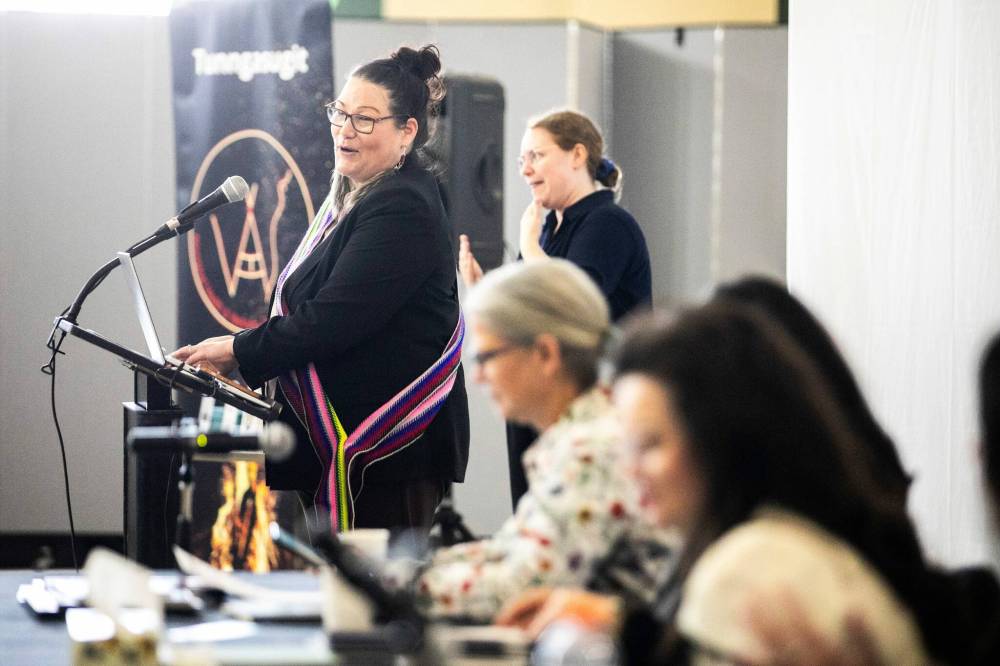
MIKAELA MACKENZIE / FREE PRESS
“We’re coming for change. We’re coming for Indigenous-led health care and social services and justice, education — every sector,” Monica Cyr said Friday.
The study was produced by a partnership of the Aboriginal Health and Wellness Centre of Winnipeg, the Well Living House Action Research Centre, and Indigenous health organizations.
“This is the new benchmark — and if you take a look at the stats, I would almost preface by saying, ‘Brace yourself.’ These stats are intense, and they are disturbing,” said Monica Cyr, CEO of the centre.
“There’s too much invested interest to allow these reports to collect dust,” she said. “We’re coming for change. We’re coming for Indigenous-led health care and social services and justice, education — every sector.”
The study says the census undercounts Indigenous populations in cities because it mainly includes people who live in private households. In contrast, its estimates provide a fuller picture by counting all First Nations and Métis people in Winnipeg, including those in private homes, shelters, collective dwellings, and those who are homeless or in transition.
The findings point to widespread issues of inequity such as poverty, unemployment, racism, child welfare involvement, violence, and barriers to education and health care.
The survey concluded that only 18 per cent of Indigenous adults in Winnipeg had completed the 2021 census, which it attributed it to factors including systemic bias, government mistrust and sampling methods that miss mobile and underhoused populations. Literacy levels also played a role.
The study used a “chain referral” method to reach participants through community networks.
It began with 12 participants, called “seeds,” who completed surveys and then each referred up to three Indigenous friends or famil y members using coupons as an incentive. Those participants repeated the process, which created long referral chains that spread across the community.
In total, about 1,079 referrals were made, with some chains extending up to 26 “waves,” helping the study reach a wide range of people, including those who may be less connected to services or harder to reach through traditional research methods.
Participants received $25 for completing the survey, plus $10 for each family member or friend they successfully recruited to take part.
The research was led by Dr. Janet Smylie, a Canada Research Chair who is probing advancing generative health services for Indigenous populations.
She said the report concludes that a “perfect storm” of poor science, politics and history, as well as underresourcing at Statistics Canada and colonial-related issues, have resulted in the inaccurate estimate of the Indigenous population Winnipeg until now.
“My hypothesis is that we’re closer to the truth than (the federal govenment is),” she said.
Ninety-four per cent of the adult respondents live below the poverty line, compared with eight per cent of Canadians and 11 per cent of Winnipeggers.
Sixty-seven per cent of adults said they were unemployed, far above the city’s seven per cent rate. More than half said they hadn’t completed high school.
Sixty-seven per cent of the respondents said they had experienced racism and 80 per cent said they had witnessed unfair treatment of other Indigenous people.
About half of respondents reported Child and Family Services involvement, while many families said they had been affected by missing persons, homicide, and violence.
Educational attainment is also significantly lower, as 57 per cent said they hadn’t completed high school versus 15 per cent of Winnipeg’s population; only 14 per cent had accessed post-secondary education versus 56 per cent of Winnipeg’s general population.

Eighty-two per cent of parents and caregivers involved in the survey reported that racism is a problem in their children’s schools.
The report calls on all levels of government to work in partnership with Indigenous communities to expand Indigenous-led health, healing, language, victim support, harm reduction, and family reunification services. It calls for reforms to child welfare systems and the implementation of anti-Indigenous racism policies, including in schools, as well as cultural safety training across public services.
The report advocated for urgent action to address housing inequities by expanding access to safe, affordable, and culturally appropriate housing for Indigenous people.
Key recommendations include scaling up Indigenous housing and shelter programs to match population needs, providing transitional housing and wraparound supports for youth who age out of care, and funding holistic, Indigenous-led services to assist individuals and families who move to Winnipeg.
scott.billeck@freepress.mb.ca
Scott Billeck is a general assignment reporter for the Free Press. A Creative Communications graduate from Red River College, Scott has more than a decade’s worth of experience covering hockey, football and global pandemics. He joined the Free Press in 2024. Read more about Scott.
Every piece of reporting Scott produces is reviewed by an editing team before it is posted online or published in print — part of the Free Press‘s tradition, since 1872, of producing reliable independent journalism. Read more about Free Press’s history and mandate, and learn how our newsroom operates.
Our newsroom depends on a growing audience of readers to power our journalism. If you are not a paid reader, please consider becoming a subscriber.
Our newsroom depends on its audience of readers to power our journalism. Thank you for your support.
Method behind the math
A 95 per cent confidence interval is a way of showing how precise a study’s estimate is when it’s based on a sample rather than every person in a population.
Because it isn’t possible to survey every First Nations and Métis person in Winnipeg, the study uses a representative sample to estimate results for the whole population.
The confidence interval provides a range — an upper and lower limit — within which the true population value is likely to fall if the study were repeated.
For example, if 17.9 per cent of adults completed the Canadian Census with a 95 per cent confidence interval of 14.3 per cent to 21.5 per cent, it means the true rate is expected to fall within that range across repeated studies.
— source: Our Health Counts First Nations & Métis Winnipeg
Scott Billeck is a general assignment reporter for the Free Press. A Creative Communications graduate from Red River College, Scott has more than a decade’s worth of experience covering hockey, football and global pandemics. He joined the Free Press in 2024. Read more about Scott.
Every piece of reporting Scott produces is reviewed by an editing team before it is posted online or published in print — part of the Free Press‘s tradition, since 1872, of producing reliable independent journalism. Read more about Free Press’s history and mandate, and learn how our newsroom operates.
Our newsroom depends on a growing audience of readers to power our journalism. If you are not a paid reader, please consider becoming a subscriber.
Our newsroom depends on its audience of readers to power our journalism. Thank you for your support.
Advertisement Advertise With Us
Advertisement Advertise With Us
History
Updated on Friday, April 17, 2026 4:47 PM CDT: Adds comments, details, photo