A forest of faint hope, heartbreaking agony Hundreds of Ukrainian families gather to meet busloads of returning prisoners of war in a real-time lottery that brings joy to a lucky few, refuels ceaseless misery for the rest
Read this article for free:
or
Already have an account? Log in here »
To continue reading, please subscribe:

Digital Subscription
One year of digital access for only $205*
- Enjoy unlimited reading on winnipegfreepress.com
- Read the E-Edition, our digital replica newspaper
- Access News Break, our award-winning app
- Play interactive puzzles
*First annual payment billed as $205.00 + GST for one year. This annual subscription will automatically renew at $233.00 + GST every 52 weeks (10% off the regular annual price of $259.35). Offer available to new and qualified returning subscribers only. Cancel any time.
To continue reading, please subscribe:
Add Free Press access to your Brandon Sun subscription for only an additional
$1 for the first 4 weeks*
- Enjoy unlimited reading on winnipegfreepress.com
- Read the E-Edition, our digital replica newspaper
- Access News Break, our award-winning app
- Play interactive puzzles
*Your next Brandon Sun subscription payment will increase by $1.00 and you will be charged $17.95 plus GST for four weeks. After four weeks, your payment will increase to $24.95 plus GST every four weeks.
Read unlimited articles for free today:
or
Already have an account? Log in here »
CHERNIHIV, Ukraine — Three hours before the buses arrive, the families begin to gather, thronging the gates of a hospital in Chernihiv, a two-hour drive from Ukraine’s capital. The facility is unremarkable: a blunt, white-brick Soviet thing ringed by a low fence, a small muddy courtyard and a few denuded trees.
Soon, this place will become the epicentre of all Ukraine’s hopes and all its grief. Joy and pain. Heartbreak and desperation.
MELISSA MARTIN / FREE PRESS Women tape photos of missing soldiers on the hospital wall.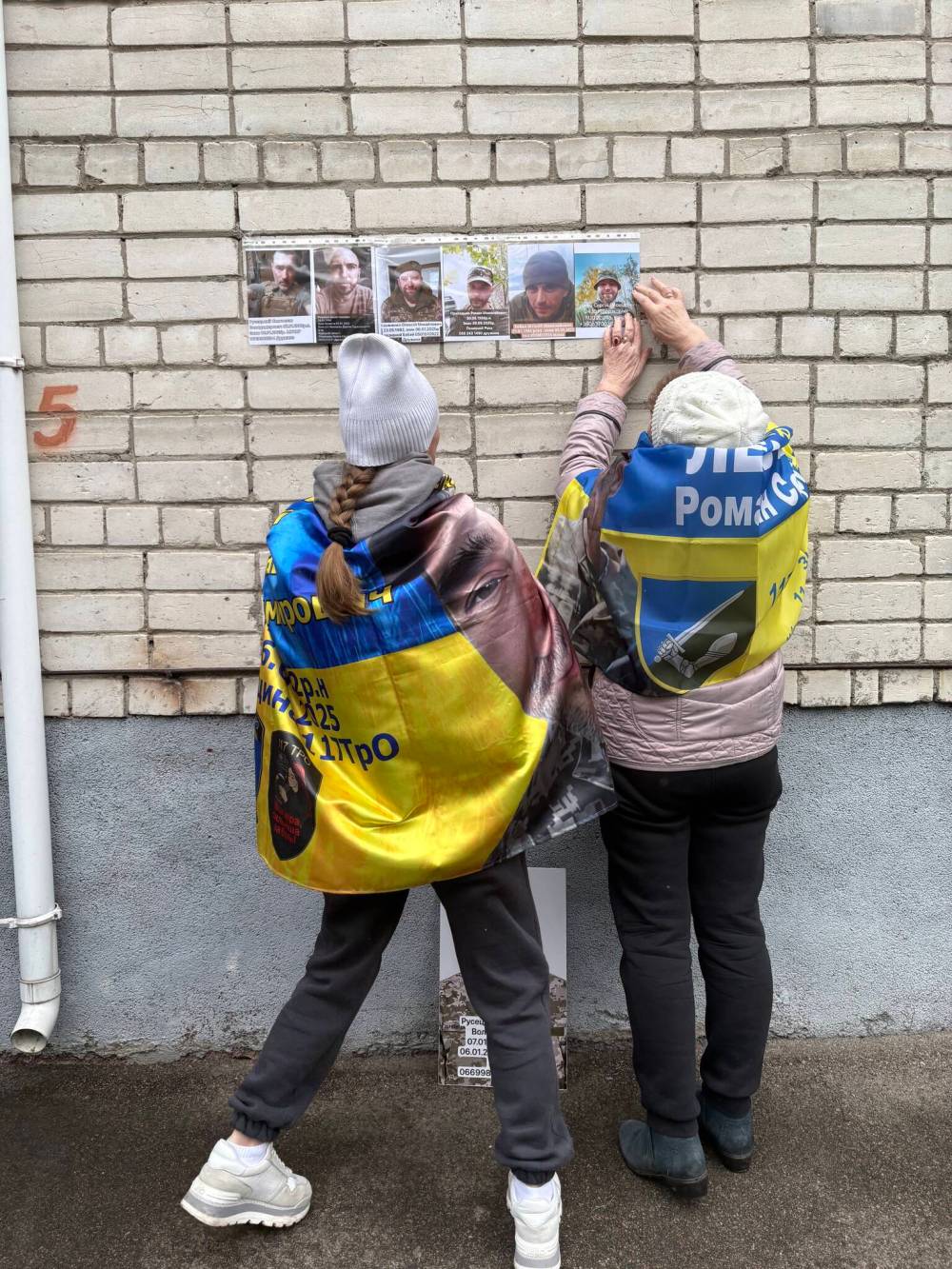
It’s Saturday afternoon, one day before Easter in the Orthodox tradition. Today, 175 Ukrainian soldiers and eight civilians will return from Russian captivity, in exchange for an equal number going the other way. When they arrive, some of their loved ones will be waiting to greet them. But nobody knows yet who that will be.
Prisoner exchanges are delicate. Many things can go wrong. So families are often not informed their soldier is coming home until the last minute; until every Ukrainian is safely on home soil and their identities have been verified, it wouldn’t be right to promise a mother that her son will be back in her arms.
This silence is a bitter kindness. It means that every time an exchange is announced, those aching to be reunited come here just in case, driving to this hospital from all corners of Ukraine. They come in small groups of people from the same family, or the same village or they’re linked by missing men from the same military unit.
They come with no reason to believe it will bring them answers. No reason, except hope.
In their hands, they hold photos of their loved ones pasted on long sticks. Around their shoulders, they drape custom flags emblazoned with oversized images of their soldier and the date they disappeared. One woman spreads out a Ukrainian flag with the image of a bearded young man, and a slogan: “My son — my life.”
Hundreds of relatives are here already. By the time the buses arrive, their numbers will swell to nearly 2,000. They are all searching for a son, a father, a husband. One man, I don’t even have to ask about the relation; they are obviously brothers, the man holding the flag the spitting image of the soldier, Mykola, who is on it.
MELISSA MARTIN / FREE PRESS A mother (middle) of a Ukrainian marine gazes up at the windows of a hospital in Chernihiv, where 175 Ukrainian soldiers and eight civilians were returned on April 11. This mother knows her son was among them; she received a call minutes before the buses arrived. 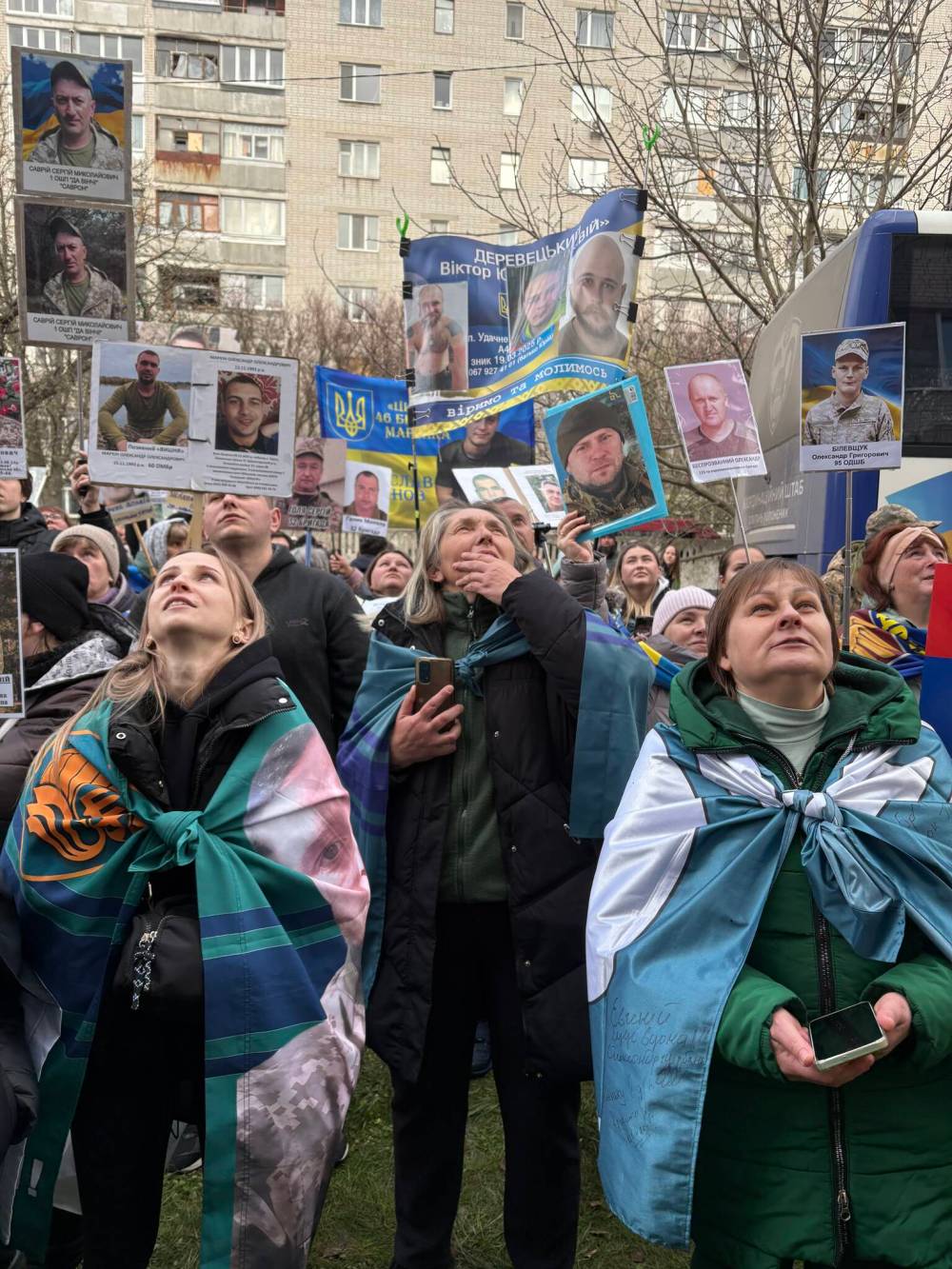
When they notice the presence of journalists with cameras, they begin to coalesce around us, holding their photos and flags. One after another, they step wordlessly in front of the lenses. Some elderly women hide their faces behind their son’s photo, not wanting their grief to show. Others gaze straight at the camera, their eyes ablaze with a sort of defiance.
Then they step away and another silently takes their place, haunting our cameras like living ghosts. In the first hour at the hospital, I photograph more than 150 people this way. We didn’t ask them to do this. All they want is for their loved one to come home; and the only part of that in their control is to make sure their loved one is seen.
Some have more reason to hope than others. A few signs declare a soldier is “v poloni,” in captivity. Far more flags note the soldier is “znyk bezvisti,” missing in action. Or, one could use the literal translation: disappeared without a trace. Vanished over a year ago, or two years, or four. No contact since, and no information.
“We hope he is alive,” says one mother, Svitlana Hordienko, whose 31-year-old son Denys disappeared 263 days ago. “We believe in him. We received a report that he is missing. His brothers-in-arms who were with him said that he was alive. He was left in the position because there was no way to save him. The boys were also wounded.”
She chokes back the grief rising in her throat.
“We hope that God is with us and will bring our son back home.”
“We hope that God is with us and will bring our son back home.”
Most people here have a similar story. Yet they don’t give up hope. After all, miracles have happened: recently, Ukrainian news told the story of a soldier, Nazar Daletskyi, who’d been killed in 2023. His body, which authorities said was verified through DNA, was returned to his family. They held a funeral for him and buried him next to his father.
Daletskyi came back alive from Russian captivity earlier this year.
So, until they know for certain, the families of the missing keep searching. They keep coming to exchanges, crowding around the buses that whisk defenders home, craning their necks to catch a glimpse of every face that emerges. If the living become ghosts in this place, then maybe the ghosts can also become living.
As they arrive they shoulder their way to the hospital doors and hand stacks of photographs to a military chaplain, so that those soldiers who do return today can look them over. Maybe their loved one won’t come back now, or ever. But maybe someone who does will recognize a comrade, and at least be able to tell them what happened.
MELISSA MARTIN / FREE PRESS A military chaplain reaches to collect photos from families of missing Ukrainian soldiers.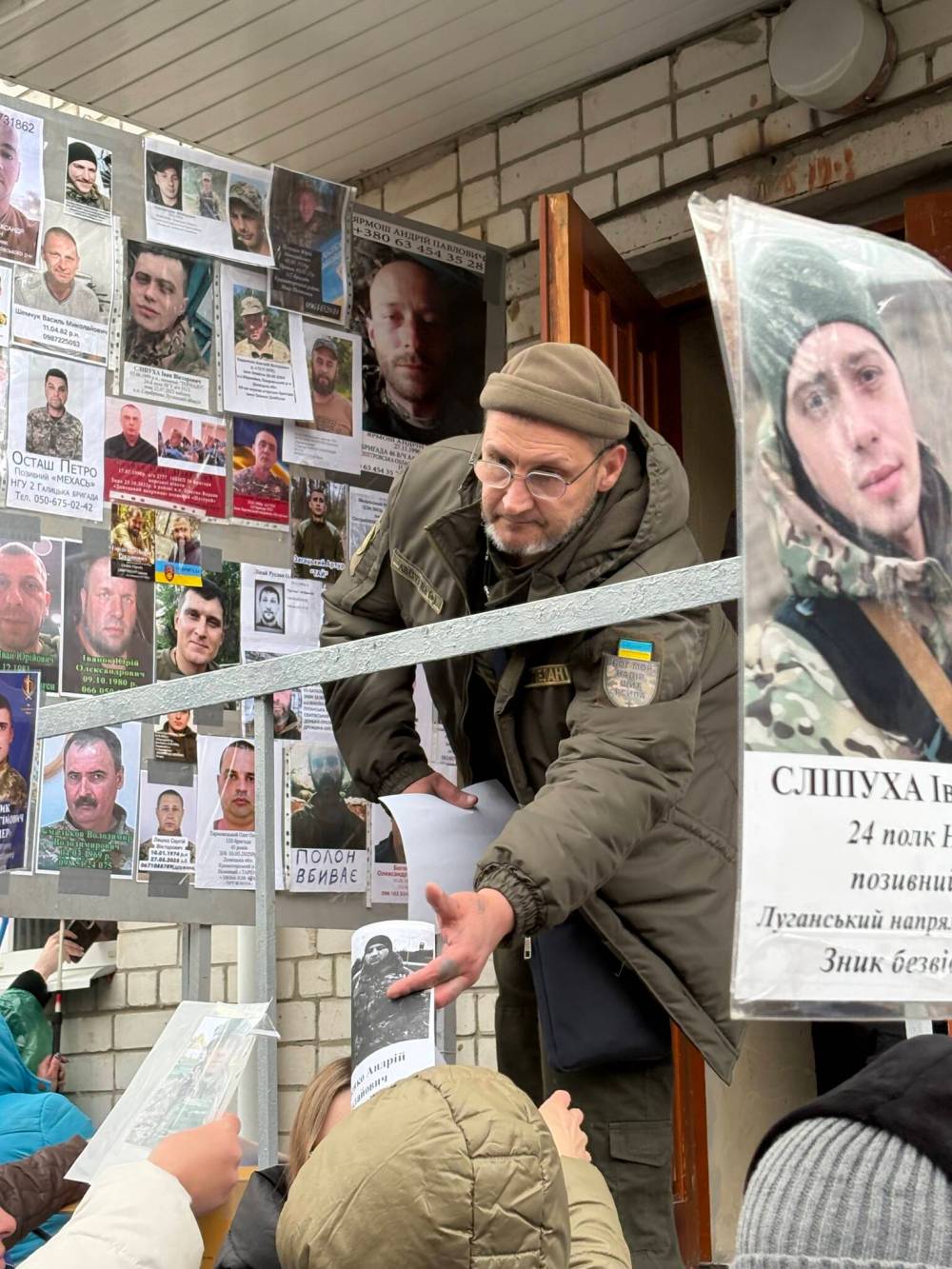
The chaplain drops the photos into a box. Before long, they pile into a mountain. A nurse brings another box from inside the hospital. Soon, that one, too, is overflowing. By now, the families fill the courtyard, lining the paths into each of the hospital’s three entrances, squeezing in to get a position where they can have the best view of the returning defenders.
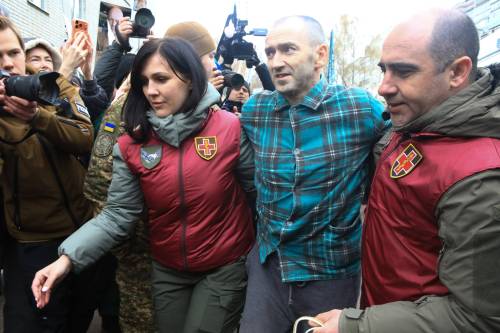
A siren squeals once, to alert the crowd of the first arrivals. Four ambulances pull up first, carrying those too weak or injured to walk. One middle-aged man hops off an ambulance clutching his papers. His right leg is distorted, broken and healed at a strange angle. Yet he refuses a proffered wheelchair and insists on limping through the parted crowd on his own.
“No, it’s fine,” he grunts, waving off the nurses rushing to help. “Let me pass.”
The arrivals are swift. Within seconds, the soldiers are ushered through the narrow space between rows of waiting families, up the steps, and into the hospital. They don’t let the returnees linger outside long, one military medical staffer tells me; for one thing, he explains, the relatives would swarm them, begging for information.
The medical staff can’t let that happen. They worry about overwhelming the returning men. Each freed soldier will stay in hospital for a month to meet with doctors, social workers and psychologists. For the first week they’re not even allowed to see their families in person, though video calls are allowed.
This is another kindness that feels like a small cruelty, but it’s the best practice for reintegration. Most of the soldiers have endured staggering trauma, before and during their captivity. Some have already told nurses about enduring beatings and torture in Russian prisons. They need quiet space to come back to themselves, and relearn what it means to be free.
Building and protecting that space is important work, the medical staffer agrees, although “we would prefer not to have this experience,” he adds drily, “because of course, it is a war.” Still, it can be difficult, “because I’m the one who won’t let them see their families.”
TARASOV / UKRINFORM Volunteers accompany an injured Ukrainian defender, released from Russian captivity. 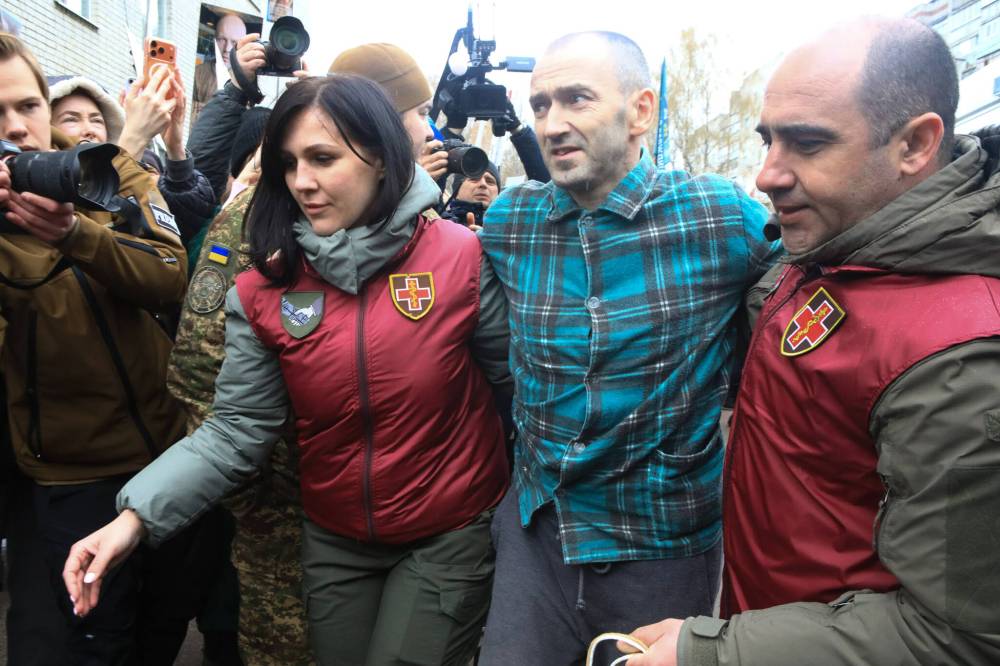
Suddenly, a buzz of excited cries bubbles up from the courtyard. A flurry of people rush to embrace a woman in a pink tuque. Her name is Tamara Adruh, and her son, Serhiy, was a guard at the Chornobyl power plant. He was taken on the first day of the full-scale invasion. She just got the call: today, he is home. She will get to hug him soon, though not for very long.
The buses are arriving now, three big white coaches with dark-tinted windows. The freed men inside press their faces to the glass, gawking at the masses of flag-bearing families filling the courtyard. The buses stop, one at each corner of the building. Their doors open and the defenders emerge, blinking in the grey light of Ukraine’s cold, cloudy spring.
“Vitayemo,” the crowd chants. “We welcome you.”
MELISSA MARTIN / FREE PRESS In his first hours of freedom, a returned Ukrainian service member raises a proud fist to the crowd standing beneath the windows at a hospital in Chernihiv. 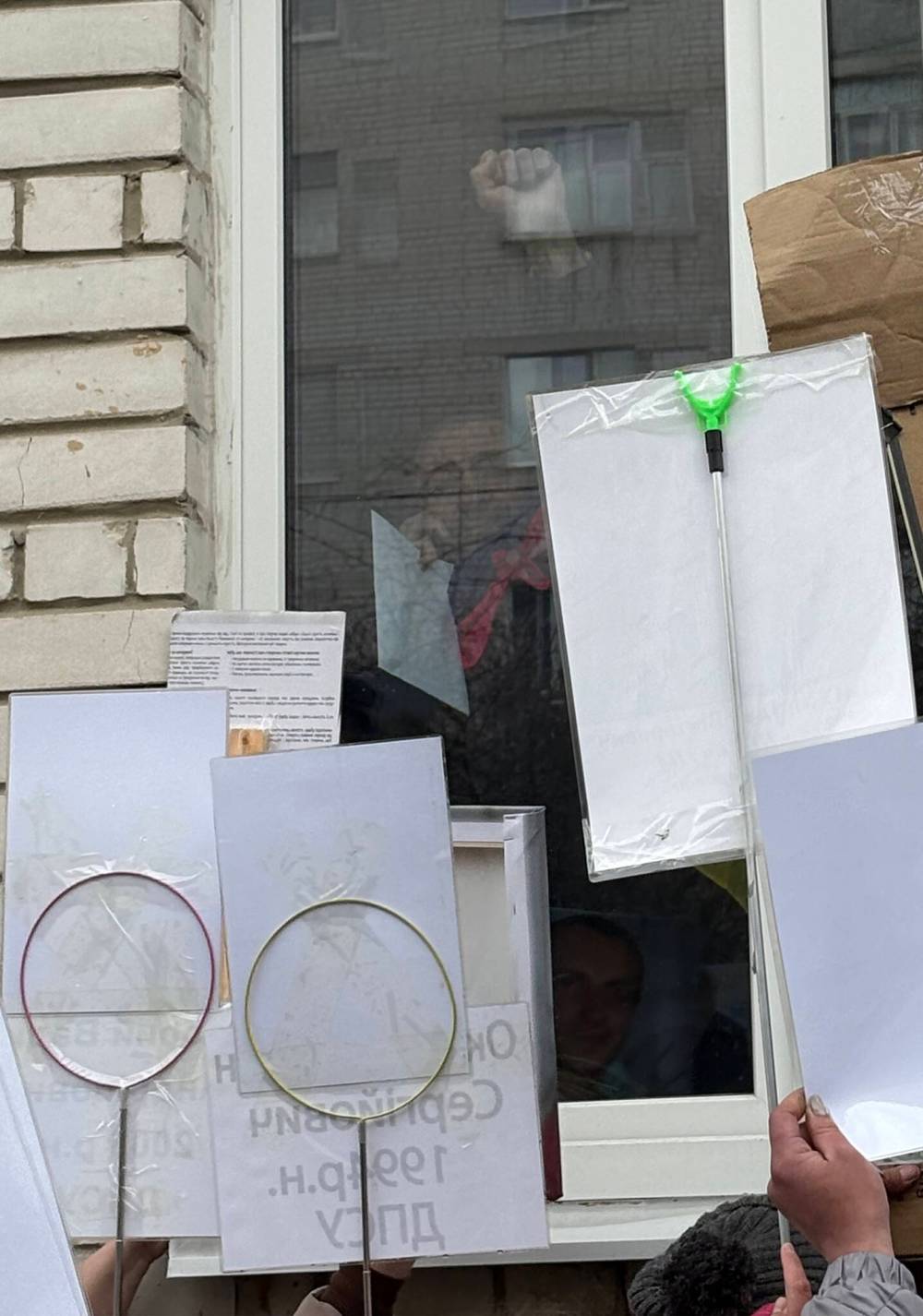
The returnees are a heart-wrenching sight. Most are too pale and far too thin. Their cheekbones cut sharp lines under nearly translucent skin. Some grin and raise their fists in jubilance as they step off the bus; others duck their heads and rush inside without looking up. One man stands shaking in wide-eyed shock and exhales an overwhelmed breath.
The relatives lining the path jostle forward, fighting to get a view of the soldiers. Medical staff link arms to hold them back. They exchange a few frustrated words. They can’t help it; they are not trying to overwhelm the returning men, but they are just desperate. Each person who emerges could be the one they have been longing for years to see.
In front of the bus, a woman with neat steel-grey hair darts back and forth, dancing a little as each defender steps down. She wears the turquoise flag of her son’s marine brigade. He is coming home; she just got the call. I didn’t get her name; she will talk to media after she sees her son, she says. Until then, she can’t think of anything else.
When the last soldier is off, she issues a disappointed laugh. He wasn’t there. He must have been on a different bus.
Now that the buses are empty, the families reassemble, moving away from the doors and turning to face the hospital’s long rows of windows. They raise photos of their loved ones affixed on long sticks, hundreds of images rising together in a forest of grief and hope. Maybe some of the newly returned defenders inside will recognize one of the photos.
At a ground-floor window, a returned national guard serviceman peers through the glass. He waves at the families. He raises his fist. But he does not indicate any recognition of the photographs they are holding.
MELISSA MARTIN / Free Press Relatives hold photos of their missing loved ones.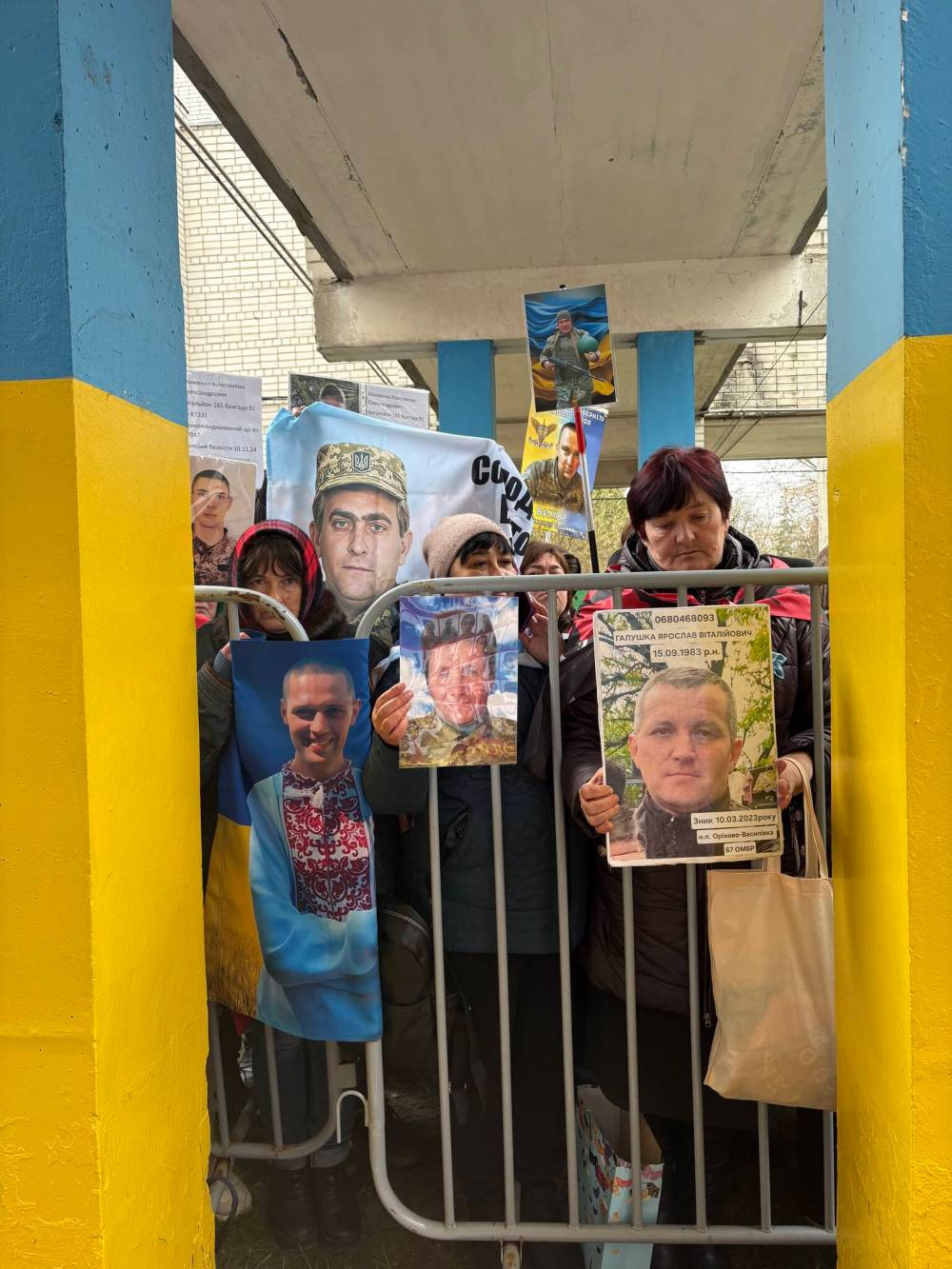
By now, the returned marine’s mother and her relatives are also under the windows, gazing up at the third and fourth floors. “Andriy!” she calls out. The crowd around her joins in, amplifying his name, trying to chant loudly enough so those inside the hospital will hear.
There’s no sign of him at the windows. The mother sighs. Her reunion will have to wait; at least, she knows he is safe.
After the families disperse, I notice an elderly woman in a grey coat. She’s still standing where I’d first seen her, in a prime position near the hospital entrance. Every soldier who entered walked past her; she gazed at them with her chin up and eyes bright, holding her son’s photo proudly.
Fifteen minutes later, she hasn’t moved from that spot. She still raises her son’s photo high. Only now she’s crying, her eyes bloodshot and staring into space, her jaw clenched against the sobs that heave up her chest. I wonder how many times she’s come to an exchange, only to have it end like this.
When Ukraine lands in the news these days, it most often concerns politics. How the negotiations are going. How it affects business, or oil prices or geopolitical machinations. How Europe is triangulating, or not. How the United States plays into things under Trump, or not.
These things do not matter right now to the woman in the grey coat.
Her tears, these families, the forest of photos they raise over every exchange, the missing become ghosts, sometimes — but not often — returned: this is the cost of Ukraine’s independence. The cost charged to a nation that refused to submit to a world where might forgives conquest. Never forget who paid it. Never forget who made them.
melissa.martin@freepress.mb.ca

Melissa Martin
Reporter-at-large
Melissa Martin reports and opines for the Winnipeg Free Press.
Every piece of reporting Melissa produces is reviewed by an editing team before it is posted online or published in print — part of the Free Press‘s tradition, since 1872, of producing reliable independent journalism. Read more about Free Press’s history and mandate, and learn how our newsroom operates.
Our newsroom depends on a growing audience of readers to power our journalism. If you are not a paid reader, please consider becoming a subscriber.
Our newsroom depends on its audience of readers to power our journalism. Thank you for your support.