

Funding to boost early childhood educators’ pay helps some, not others, longtime workers in field lament

Advertisement
Read this article for free:
or
Already have an account? Log in here »
To continue reading, please subscribe:

Digital Subscription
One year of digital access for only $205*
- Enjoy unlimited reading on winnipegfreepress.com
- Read the E-Edition, our digital replica newspaper
- Access News Break, our award-winning app
- Play interactive puzzles
*First annual payment billed as $205.00 + GST for one year. This annual subscription will automatically renew at $233.00 + GST every 52 weeks (10% off the regular annual price of $259.35). Offer available to new and qualified returning subscribers only. Cancel any time.
To continue reading, please subscribe:
Add Free Press access to your Brandon Sun subscription for only an additional
$1 for the first 4 weeks*
- Enjoy unlimited reading on winnipegfreepress.com
- Read the E-Edition, our digital replica newspaper
- Access News Break, our award-winning app
- Play interactive puzzles
*Your next Brandon Sun subscription payment will increase by $1.00 and you will be charged $17.95 plus GST for four weeks. After four weeks, your payment will increase to $24.95 plus GST every four weeks.
Read unlimited articles for free today:
or
Already have an account? Log in here »
Although the federal and provincial governments are boosting early childhood educator wages by more than $14 million this year, some who’ve been working in the field a long time are feeling somewhat overlooked.
The money — $13.2 million from Ottawa and another $860,000 from the province — represents a 2.9 per cent wage increase. Some early childhood educators could see their wages increase by $7 per hour, retroactive to April 2024, when combining this wage hike with one in 2025.
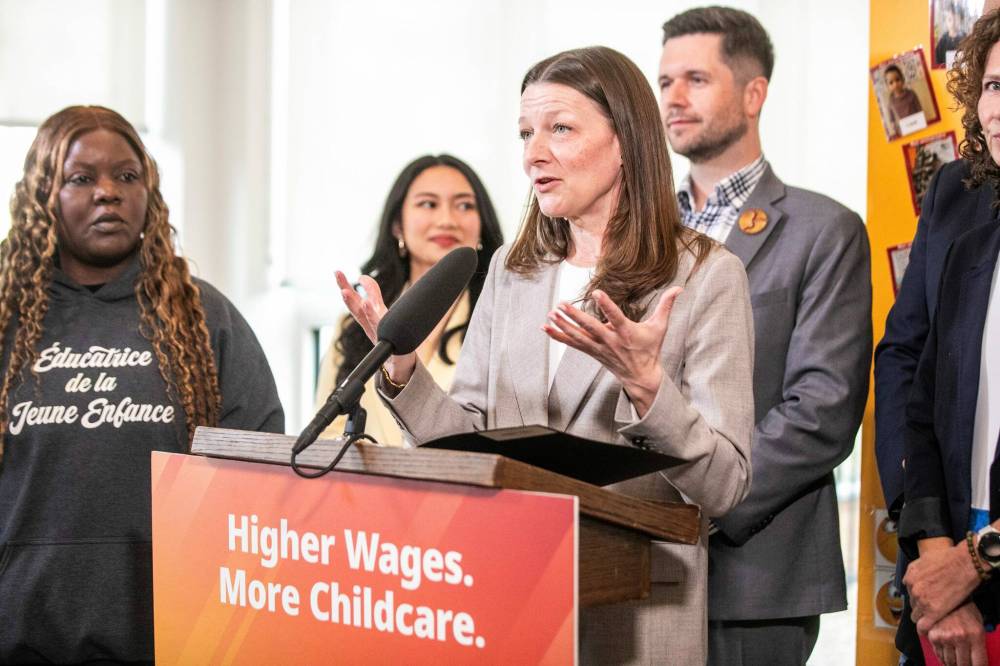
“We’re investing in a strong, well-trained workforce,” Manitoba Early Childhood Learning Minister Tracy Schmidt said Monday.
MIKAELA MACKENZIE / FREE PRESS
Manitoba Early Childhood Learning Minister Tracy Schmidt: “There has never been a better time in Manitoba’s history to be an early childhood educator.”
Schmidt noted that base operating grants for child-care centres will also increase by one per cent this year, by $4.7 million.
The wage increase is good for attracting people to the workforce, said Danielle Dorge-Rempel, who has been general director of Espace pour grandir, a St. Boniface child-care centre, for the past three years.
It does not, however, do much for the people who have been at it for many years, said Dorge-Rempel, who oversees a staff of about 20 who care for approximately 80 children.
The province’s target wage grid is broken down by job type — front-line staff, supervisor, assistant director and director — and by education level. It doesn’t account for years worked.
“I’m doing the budget, trying to figure out — ‘OK, someone that’s been doing this for 15 years is getting the same wage as somebody that’s coming out of school. How?’” Dorge-Rempel said, adding the increase does “nothing” for child-care centre administrators.
She applauded the governments’ funding increase — “(it’s) better than it used to be,” she said — but said it’ll barely change rates at her workplace.
She said she tries to follow the Manitoba Child Care Association’s guidelines for market-competitive salaries. The association breaks down hourly pay by job type, education and experience. More experience can lead to higher pay.
Facilities can pay more than the government’s wage grid, but that can be a challenge when balancing payroll and rent.
“Early childhood educators are paid more today than when we came into government,” Schmidt said in a statement. “There has never been a better time in Manitoba’s history to be an early childhood educator.”
Manitoba Child Care Association’s executive director Jodie Kehl is recommending the province change its pay scale to include levels and more career options for workers with higher education.
Retention in the industry can be tricky, Dorge-Rempel said: “The people that have been in this field for a long time kind of feel like, ‘OK, what about us?’”
Still, career spans have been improving. Workers stay an average 17.2 years, according to a 2025 Probe Research poll the Manitoba Child Care Association commissioned. The average was 14.7 years in 2016.
“We’re talking about a system, a workforce that has been long undervalued, underpaid,” Kehl said. “We’re taking steps in the right direction.”
Manitoba has more than 9,300 people working in early learning and child care, Kehl noted. A majority are child-care assistants.
The provincial government has tracked a 40 per cent increase in the number of certified early childhood educators since March 2023. There were 3,985 as of March 31, a government spokesperson said.
Manitoba teachers are paid on a wage grid that recognizes years of service, with a salary cap at 10 years. It’s something Wayne Ewasko, the Progressive Conservative education critic, said he’d support for early childhood educators.
“It’s good that the minister has continued the path that we have started on,” Ewasko said of the pay raises.
In 2021, the Tories made a deal with Ottawa through the Canada-Manitoba Canada-Wide Early Learning and Child Care Agreement, leading to wage increases.

The province didn’t meet its target of creating 23,000 new non-profit child-care spaces by March 31, 2026. The deadline has moved to March 31, 2031.
Manitoba has opened at least 5,400 of the 23,000 seats. Another 6,100 are committed, the province’s latest budget says.
There are 21 new child-care centres — and 1,235 child-care spaces — slated for completion in fiscal year 2026-27.
The budget includes $14.4 million for 327 post-secondary training seats, for child-care providers, over two years. Spots at the Manitoba Institute of Trades and Technology will be moved to Red River College Polytechnic as MITT closes.
gabrielle.piche@winnipegfreepress.com
Gabrielle Piché reports on business for the Free Press. She interned at the Free Press and worked for its sister outlet, Canstar Community News, before entering the business beat in 2021. Read more about Gabrielle.
Every piece of reporting Gabrielle produces is reviewed by an editing team before it is posted online or published in print — part of the Free Press‘s tradition, since 1872, of producing reliable independent journalism. Read more about Free Press’s history and mandate, and learn how our newsroom operates.
Our newsroom depends on a growing audience of readers to power our journalism. If you are not a paid reader, please consider becoming a subscriber.
Our newsroom depends on its audience of readers to power our journalism. Thank you for your support.
Gabrielle Piché reports on business for the Free Press. She interned at the Free Press and worked for its sister outlet, Canstar Community News, before entering the business beat in 2021. Read more about Gabrielle.
Every piece of reporting Gabrielle produces is reviewed by an editing team before it is posted online or published in print — part of the Free Press‘s tradition, since 1872, of producing reliable independent journalism. Read more about Free Press’s history and mandate, and learn how our newsroom operates.
Our newsroom depends on a growing audience of readers to power our journalism. If you are not a paid reader, please consider becoming a subscriber.
Our newsroom depends on its audience of readers to power our journalism. Thank you for your support.
Related Articles
Payroll reveal: 18 school staff cleared $200K
Advertisement Advertise With Us
Advertisement Advertise With Us