Business council’s new housing alliance, partners complete first ‘deeply affordable’ project
Read this article for free:
or
Already have an account? Log in here »
To continue reading, please subscribe:

Digital Subscription
One year of digital access for only $205*
- Enjoy unlimited reading on winnipegfreepress.com
- Read the E-Edition, our digital replica newspaper
- Access News Break, our award-winning app
- Play interactive puzzles
*First annual payment billed as $205.00 + GST for one year. This annual subscription will automatically renew at $233.00 + GST every 52 weeks (10% off the regular annual price of $259.35). Offer available to new and qualified returning subscribers only. Cancel any time.
To continue reading, please subscribe:
Add Free Press access to your Brandon Sun subscription for only an additional
$1 for the first 4 weeks*
- Enjoy unlimited reading on winnipegfreepress.com
- Read the E-Edition, our digital replica newspaper
- Access News Break, our award-winning app
- Play interactive puzzles
*Your next Brandon Sun subscription payment will increase by $1.00 and you will be charged $17.95 plus GST for four weeks. After four weeks, your payment will increase to $24.95 plus GST every four weeks.
Read unlimited articles for free today:
or
Already have an account? Log in here »
A unique Manitoba business-led enterprise created to invest in affordable housing has completed its first project, helping to launch a 23-unit building in Winnipeg’s inner city.
A $1-million investment from the Collaborative Housing Alliance — created by the Business Council of Manitoba and announced in October 2024 — helped bridge a small budget shortfall to ensure the supportive housing project would open.
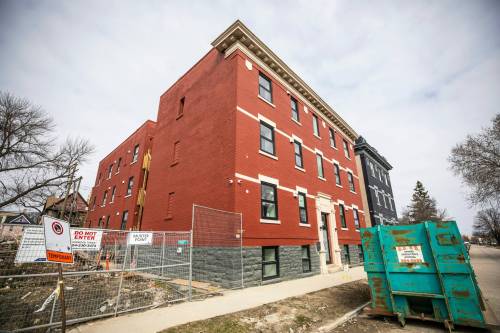
The partnership with Raising the Roof, TD and Main Street Project has built deeply affordable homes (rent-geared-to-income) at 480 Young St., with space for up to 40 residents.
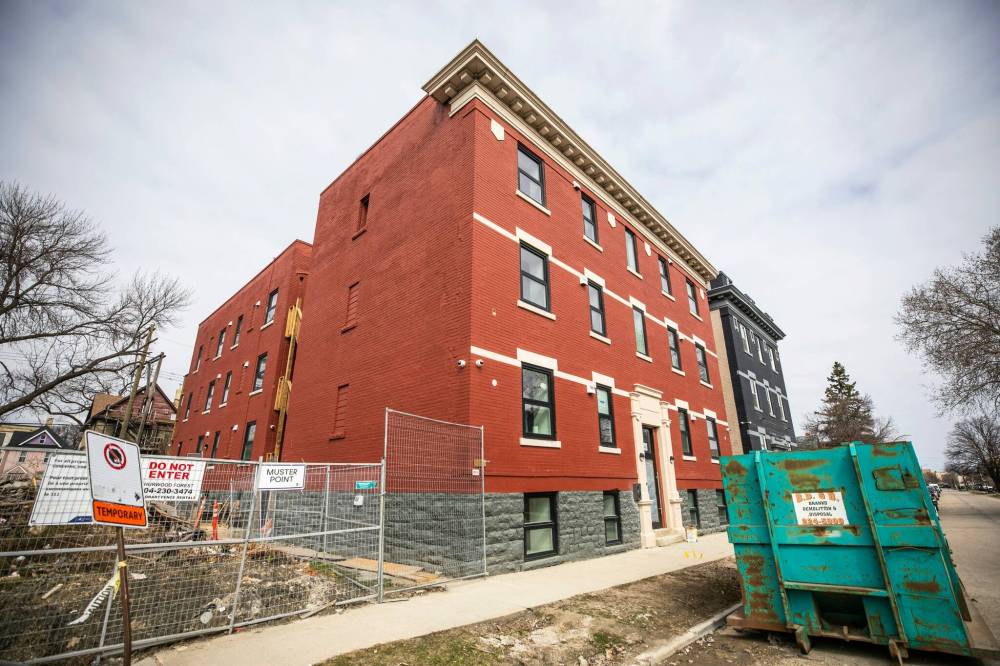
MIKAELA MACKENZIE / FREE PRESS
A new transitional housing complex at 480 Young St. has space for 40 residents.
“We thought it was a perfect fit and a project that we could support,” CHA executive director Tessa Blaikie Whitecloud told the Free Press earlier this week.
“One of our goals is to make sure charitable projects actually come to fruition. It had a small shortfall in capital, and we knew it had trusted partners at the table.”
Raising the Roof — a national charity focused on building, preserving and operating affordable housing — owns the majority of the development. It purchased the property in 2024 with help from TD, which provided a $1 million grant. Demolition began in 2025, and construction is now complete.
“It was a golden opportunity to take a condemned building that no one could live in and transform it.”
The building is ready to welcome tenants, with a formal unveiling set for Friday.
“It was a golden opportunity to take a condemned building that no one could live in and transform it back into a community asset where people could live and feel part of a community,” said Raising the Roof executive director Sheldon Pollett.
Previously, Raising the Roof bought and helped develop Butterfly Lodge, taking an abandoned nail salon on Mountain Avenue and turning it into three affordable housing units, including two large three-bedroom suites for Indigenous families, in 2024.
“That was our starting point (in Winnipeg), and it was such a great experience, a great community and the level of need here fits our mandate in terms of the housing solutions we want to provide to Canadians,” Pollett said.
Main Street Project is overseeing tenant placement and will provide on-site supports, including life-skills programming, to help residents transition to more independent housing. The program is also aimed at helping tenants build a positive rental history, reducing the risk of future homelessness.
MSP executive director Jamil Mahmood said the former derelict building on Young Street is exactly the kind of property that should be converted into social housing.
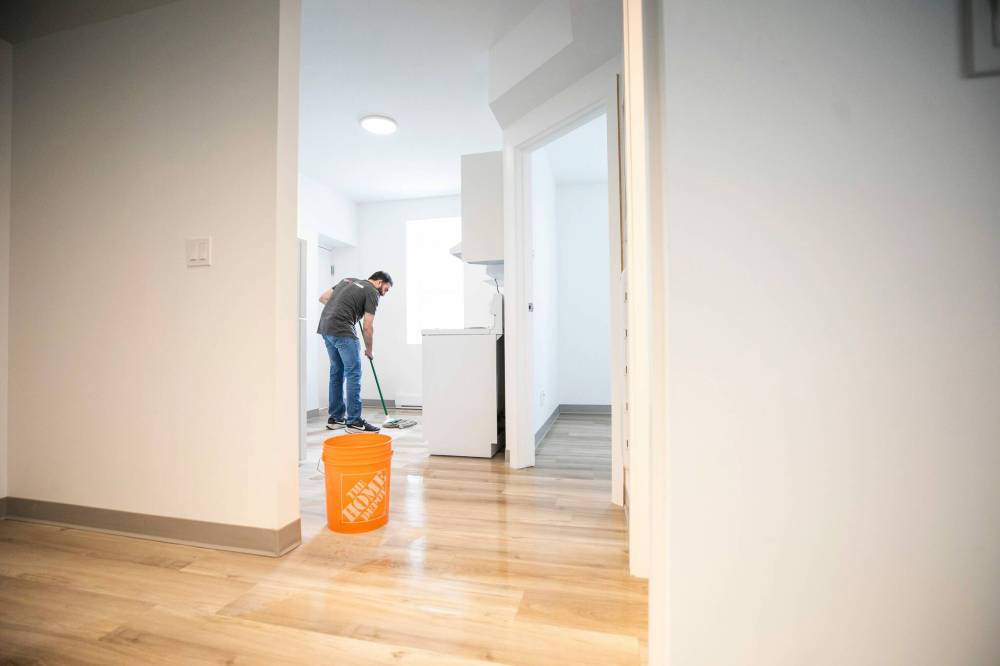
MIKAELA MACKENZIE / FREE PRESS
Volunteer Scott Jodoin mops inside the housing complex. The building is ready to welcome tenants, with a formal unveiling set for Friday.
“We’re excited to have a bit more on the housing spectrum,” he said. “It’s nice to know there’s another option for folks who are stabilizing and need less support so they can move to more independence.
“As people stabilize and they start feeling connected to community, that’s when you start seeing real changes in people’s lives. But you can’t do that if they’re not housed.”
CHA’s investment comes with a 20 per cent equity stake, ensuring the units remain affordable in perpetuity, meaning any changes to the rent-geared-to-income model would have to first be approved by the alliance.
It’s one of the first steps into the “missing middle” housing spectrum the alliance is zeroing in on. Its own analysis estimates that 65,000 housing units are needed right now in the province — a figure it projects will represent the gap in Winnipeg alone by 2030.
The “missing middle” is housing that falls between deeply affordable rent-geared-to-income units and traditional “affordable” housing, typically defined as 80 per cent of median market rent.
The alliance itself was created to partner with the private sector to address shortages in safe, low-cost housing and includes a real estate investment trust to help finance projects such as the one at 480 Young.
One of its future projects, already in the works, will be solely owned by the CHA.
Eventually, Blaikie Whitecloud said, it will become about scalability — taking a successful design and building it multiple times, something that will be key in getting projects up and running faster.
“That leap from transitional and supportive housing to market is gigantic.”
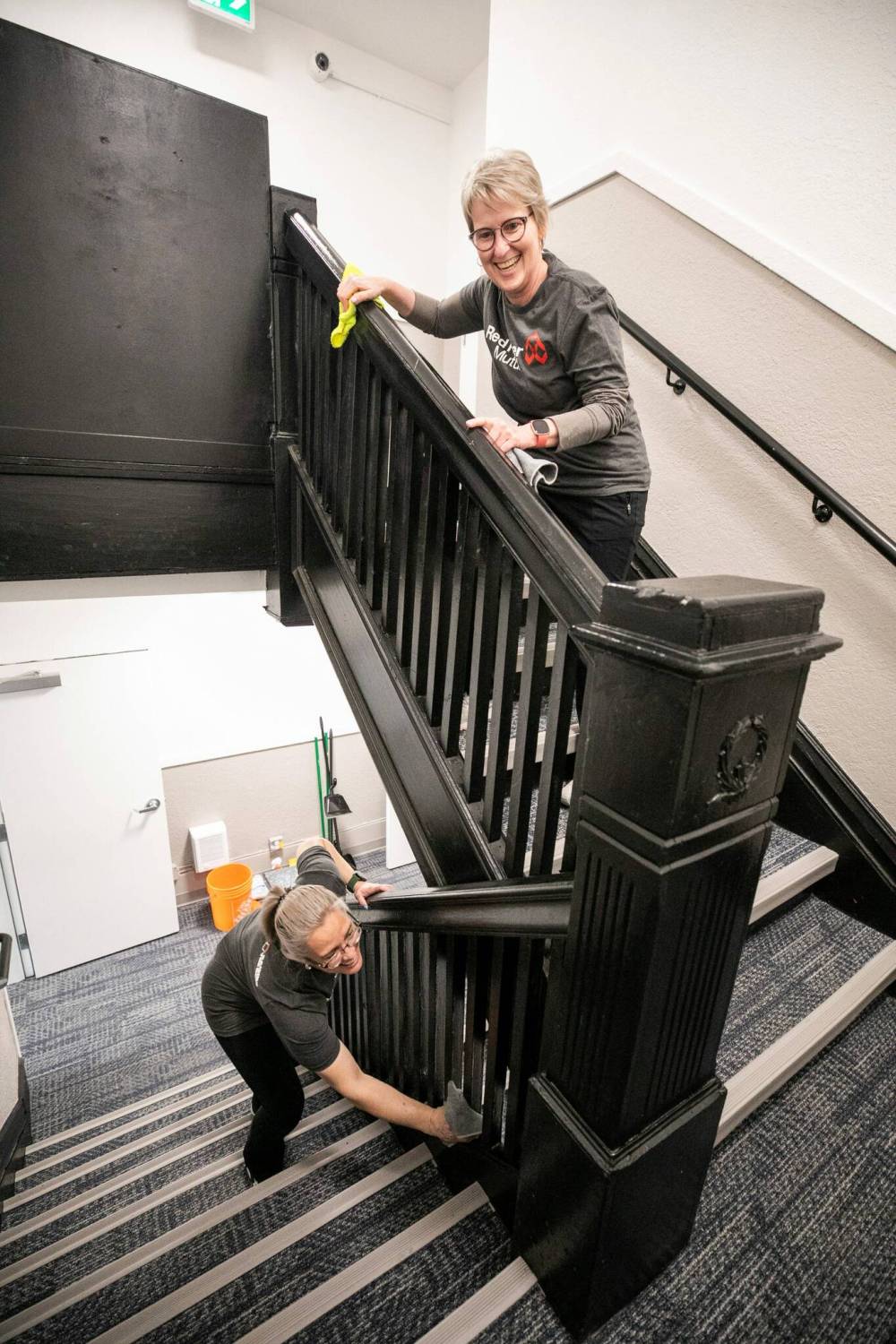
MIKAELA MACKENZIE / FREE PRESS
Volunteers Nicky De Bod (left) and Kim Klassen wipe the handrails in the stairwell of the new transitional housing complex.
The former Siloam Mission CEO and a senior adviser on homelessness to Premier Wab Kinew said people struggling in market housing can end up homeless when all they need is an apartment that is a couple of hundred dollars cheaper.

“That leap from transitional and supportive housing to market is gigantic,” she said. “And in reverse, if you’re struggling in market (housing), you might end up experiencing homelessness.”
She says that, over time, building out the “missing middle” will enable smoother transitions out of deeply affordable housing (both permanent and transitional), help prevent first-time experiences of homelessness among those leaving market housing and ease the broader pressures that both tenants and property owners in Manitoba are facing during the housing crisis.
The general contractor on the Young Street build subcontracted as much of the work as possible to social enterprise partners. The approach creates meaningful, paid, hands-on training opportunities in the trades for Indigenous youth and others facing barriers to employment, helping them build skills, gain experience and establish pathways into long-term construction careers.
The project has offered opportunities to 31 people.
scott.billeck@freepress.mb.ca

Scott Billeck is a general assignment reporter for the Free Press. A Creative Communications graduate from Red River College, Scott has more than a decade’s worth of experience covering hockey, football and global pandemics. He joined the Free Press in 2024. Read more about Scott.
Every piece of reporting Scott produces is reviewed by an editing team before it is posted online or published in print — part of the Free Press‘s tradition, since 1872, of producing reliable independent journalism. Read more about Free Press’s history and mandate, and learn how our newsroom operates.
Our newsroom depends on a growing audience of readers to power our journalism. If you are not a paid reader, please consider becoming a subscriber.
Our newsroom depends on its audience of readers to power our journalism. Thank you for your support.
Related Articles
Province turning former university building downtown into transitional living units for homeless people