

City missing opportunity to help the homeless, save significant amount of money

Advertisement
Read this article for free:
or
Already have an account? Log in here »
To continue reading, please subscribe:

Digital Subscription
One year of digital access for only $205*
- Enjoy unlimited reading on winnipegfreepress.com
- Read the E-Edition, our digital replica newspaper
- Access News Break, our award-winning app
- Play interactive puzzles
*First annual payment billed as $205.00 + GST for one year. This annual subscription will automatically renew at $233.00 + GST every 52 weeks (10% off the regular annual price of $259.35). Offer available to new and qualified returning subscribers only. Cancel any time.
To continue reading, please subscribe:
Add Free Press access to your Brandon Sun subscription for only an additional
$1 for the first 4 weeks*
- Enjoy unlimited reading on winnipegfreepress.com
- Read the E-Edition, our digital replica newspaper
- Access News Break, our award-winning app
- Play interactive puzzles
*Your next Brandon Sun subscription payment will increase by $1.00 and you will be charged $17.95 plus GST for four weeks. After four weeks, your payment will increase to $24.95 plus GST every four weeks.
Read unlimited articles for free today:
or
Already have an account? Log in here »
By all accounts, Winnipeg could face a tsunami of homelessness this summer. And, by many of those same accounts, Winnipeg is woefully unprepared.
Last month, End Homelessness Winnipeg released a new audit of the number of people living on Winnipeg streets and found that it had risen exponentially over the last year. The best, current estimate is that more than 8,200 Winnipeggers were living without adequate housing, and over half that number meeting the definition of chronic homelessness.
Agencies that support the homeless population have warned the city and province that warmer weather usually expands the number of people living rough on the streets. They have pleaded for more immediate help to deal with this impending crisis.
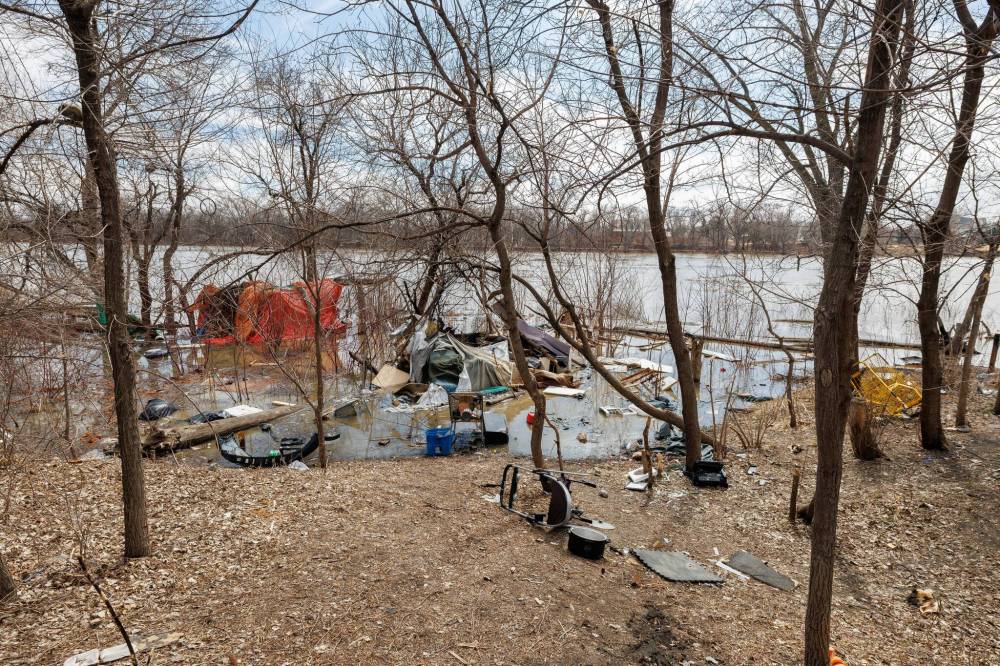
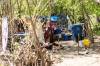
Remains of an encampment on the Red River that runs along Waterfront Drive as seen in April. (Mike Deal / Free Press files)
Government is responding, albeit rather unevenly.
The province is spending tens of millions of dollars on Your Way Home, which is attempting to move homeless people into permanent housing and provide wraparound services to address mental health and addictions and provide access to primary health care.
Although the program is making progress, it is moving at a glacial pace that simply isn’t keeping up with the spike in the homeless population.
At city hall, however, the efforts range from counterintuitive to disinterested.
Last November, the city passed a bylaw banning homeless encampments in public areas located near schools, playgrounds and community centres. From November to March, the city dismantled several large camps and worked with the province and social service agencies to find alternate shelter.
At the same time, however, there was some acknowledgement that just dismantling the camps wasn’t going to make the situation better. In December, council asked staff to study the idea of a semi-permanent homeless community managed by the city and social service agencies.
The idea for a managed homeless site was absolutely the right thing to do. While longer-term solutions are being sought by the province through Your Way Home, and the city is dismantling unsafe tent camps, another housing option is needed to bridge the gap between living on a riverbank and living in social housing.
Unfortunately, city staff completely botched their assignment. The report delivered April 21 on the feasibility of establishing a managed encampment was a lazy and incomplete effort. So much so that it very strongly suggests a bias within the city’s administration against the idea of sanctioned homeless communities.
Sanctioned homeless encampments — whether temporary tent cities or more permanent “tiny home” communities — are springing up all over Canada. In some instances, the sanctioned sites provide a bridge to longer-term housing; in others, they are a housing solution in and of themselves, a longer-term alternative to apartment blocks.
Although the Winnipeg staff report acknowledged the growing popularity of this approach, the authors completely missed the practical and financial value it can bring.
Homelessness is a complex social problem that consumes enormous quantities of health and social services: fire and paramedic responses to overdoses and fires in temporary encampments, police responses for alleged criminal acts and an enormous strain on hospital emergency rooms.
Although the administration report calculated the costs of operating a sanctioned community, it did not even mention the runaway costs the city is already facing.
For example, the municipal government spent nearly a quarter of a million dollars to clear homeless encampments since last November. That’s roughly $50,000 per month in direct costs. And even that number drastically underestimates the total financial burden that homelessness puts on the city.
Staff recommended against proceeding with the proposal for a semi- or permanent homeless community, which essentially traps the idea in bureaucratic limbo. That is a disheartening development, given that as mentioned earlier, the homeless population is expected to explode in the summer.
As badly as staff performed on this file, it’s not hard to be at least a little sympathetic about the city’s dilemma.
The province and, to a lesser extent, the federal government, are supposed to be taking the lead on combating homelessness. Any good ideas the city has for addressing the problem absolutely need financial support from senior levels of government.
Unfortunately, the report notes the province is not interested in any semi-permanent housing solutions, preferring to forge ahead with Your Way Home. This is a huge mistake by the NDP government, which has already shown that it cannot produce enough social housing quickly enough to meet the demand from homeless people.

Seasonal, possibly even permanent, sanctioned homeless communities are not just stopgaps. In some instances, homeless people find the sense of community and overall environment of a sanctioned tent or tiny homes community preferable to conventional apartment-block living.
The challenges of establishing a sanctioned community are significant. Finding the right location is certainly at the top of that list, and there is the issue of cost. However, the experience in other cities that have established these sites shows that the challenges — including location — are easily overcome with thoughtful planning and effective communication.
It is negligent for the city and province to ignore a proven model of social housing for the homeless while we’re bearing down on a crisis.
One can only hope that bias and inertia can be replaced with action and accountability before the weather improves. Otherwise, we’re in for a very bad summer indeed.
dan.lett@freepress.mb.ca
Dan Lett is a columnist for the Free Press, providing opinion and commentary on politics in Winnipeg and beyond. Born and raised in Toronto, Dan joined the Free Press in 1986. Read more about Dan.
Dan’s columns are built on facts and reactions, but offer his personal views through arguments and analysis. The Free Press’ editing team reviews Dan’s columns before they are posted online or published in print — part of the our tradition, since 1872, of producing reliable independent journalism. Read more about Free Press’s history and mandate, and learn how our newsroom operates.
Our newsroom depends on a growing audience of readers to power our journalism. If you are not a paid reader, please consider becoming a subscriber.
Our newsroom depends on its audience of readers to power our journalism. Thank you for your support.
Dan Lett is a columnist for the Free Press, providing opinion and commentary on politics in Winnipeg and beyond. Born and raised in Toronto, Dan joined the Free Press in 1986. Read more about Dan.
Dan’s columns are built on facts and reactions, but offer his personal views through arguments and analysis. The Free Press’ editing team reviews Dan’s columns before they are posted online or published in print — part of the our tradition, since 1872, of producing reliable independent journalism. Read more about Free Press’s history and mandate, and learn how our newsroom operates.
Our newsroom depends on a growing audience of readers to power our journalism. If you are not a paid reader, please consider becoming a subscriber.
Our newsroom depends on its audience of readers to power our journalism. Thank you for your support.
Related Articles
City councillor frustrated by sluggish pace of encampment enforcement







Advertisement Advertise With Us
Advertisement Advertise With Us