

Second of two transitional housing facilities for women and children will open doors before end of month

Advertisement
Read this article for free:
or
Already have an account? Log in here »
To continue reading, please subscribe:

Digital Subscription
One year of digital access for only $205*
- Enjoy unlimited reading on winnipegfreepress.com
- Read the E-Edition, our digital replica newspaper
- Access News Break, our award-winning app
- Play interactive puzzles
*First annual payment billed as $205.00 + GST for one year. This annual subscription will automatically renew at $233.00 + GST every 52 weeks (10% off the regular annual price of $259.35). Offer available to new and qualified returning subscribers only. Cancel any time.
To continue reading, please subscribe:
Add Free Press access to your Brandon Sun subscription for only an additional
$1 for the first 4 weeks*
- Enjoy unlimited reading on winnipegfreepress.com
- Read the E-Edition, our digital replica newspaper
- Access News Break, our award-winning app
- Play interactive puzzles
*Your next Brandon Sun subscription payment will increase by $1.00 and you will be charged $17.95 plus GST for four weeks. After four weeks, your payment will increase to $24.95 plus GST every four weeks.
Read unlimited articles for free today:
or
Already have an account? Log in here »
The paint is drying on new transitional housing for women and children fleeing gender-based violence.
Two Winnipeg facilities — a total of 26 units — are nearly ready for Manitoba women struggling to find shelter space in order to leave abusive relationships.
“Every woman deserves to live free from violence,” Housing Minister Bernadette Smith said Monday, inside one of the sites.
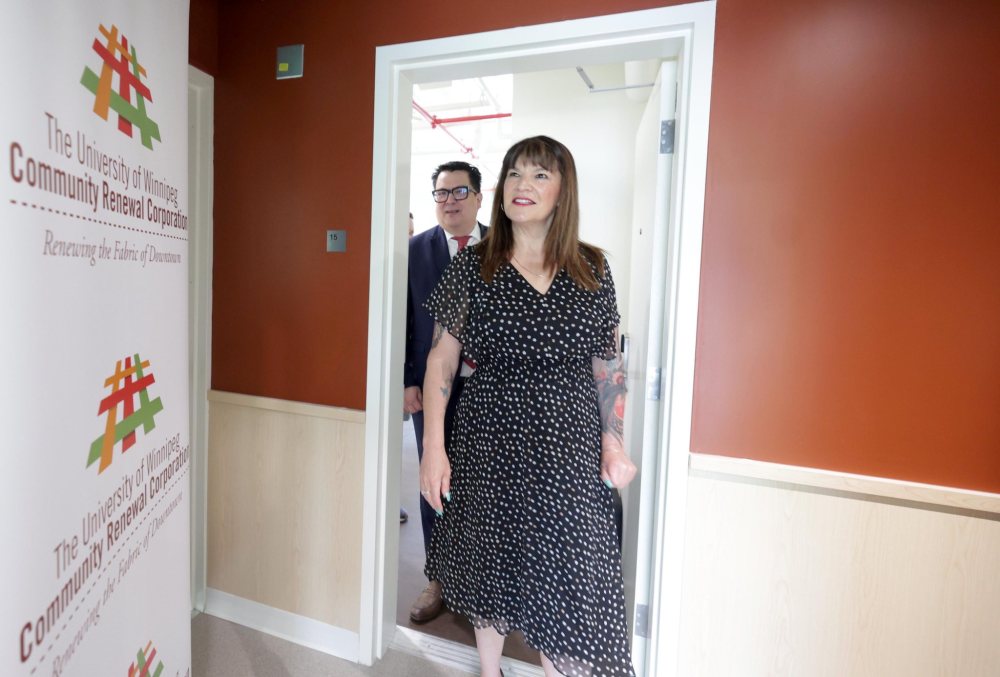
Ruth Bonneville / Free Press
Housing, Addictions and Homelessness Minister Bernadette Smith looks at some studio suites in new transitional housing, Monday.
The 15-unit West Broadway block is expected to be finished by the end of the month. Smith said she expects all units to be occupied shortly after.
The other housing project began accepting residents to its 11 units earlier this year. The downtown Winnipeg apartment was finished in January.
Tenants can stay as long as two years. They’ll pay rent based on their income — about 30 per cent — and will receive services such as counselling and peer support groups.
Social service agencies Family Dynamics, Ikwe Widdjiitiwin and New Journey Housing are providing the services.
“This (housing) allows us — when women and children are stable and ready — to transition from a shelter,” said Kimberly Fontaine, executive director of Ikwe Widdjiitiwin, an Indigenous crisis shelter for survivors of gender-based violence.
“It allows us to make more beds available, to keep doing that life-saving work.”
The need is great, noted Cynthia Drebot, executive director of the North End Women’s Centre.
The Selkirk Avenue facility sees between 120 and 150 people daily. Of those, a “good couple of dozen” women are homeless and may be seeking a spot in a shelter.
“We have so many challenges when finding housing, in general, in Winnipeg right now, with a lack of deeply affordable and social housing,” Drebot said. “People aren’t able to move out of the shelters sometimes.
“Or if they do move out of the shelter, it’s very difficult for them to find a place to stay or continue to stay.”
Women often don’t feel comfortable going to Winnipeg’s largest homeless shelters. They may have experienced violence from men, or they’ve felt fearful during their stays, Drebot said.
A 2025 City of Winnipeg housing needs report noted women are more likely to experience “hidden homelessness,” where they couch-surf or stay in unsafe living conditions.
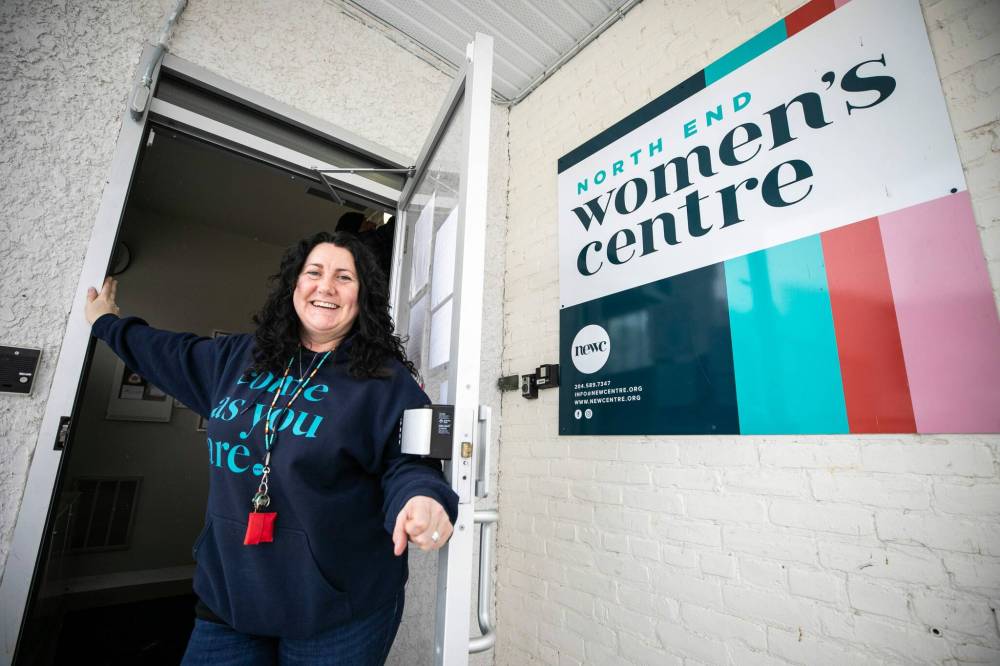
MIKAELA MACKENZIE / FREE PRESS FILES
Cynthia Drebot, executive director of the North End Women’s Centre.
Homeless mothers often have children apprehended by Child and Family Services, Drebot said. It’s a trend she’s seen at the North End Women’s Centre.
“We’re in this vicious cycle right now because we don’t have enough… gender-based violence shelters for women to go to with their children to keep themselves and their kids safe,” she said.
“Then, in some format or another, they end up having their kids removed… because they’re judged for the fact that they haven’t been able to get their kids to a place of safety.”
She called more transitional housing “super, super important.”
Winnipeg’s 2025 housing needs assessment also called for more safe and culturally responsive transitional housing for women.
Those without a space to go may stay at home and experience more abuse, Smith said.
Tenants entering the two housing facilities will meet with an intake co-ordinator, who will determine what supports are needed.
Both buildings have counselling offices. The downtown site, called Standing Eagle, has a two-metre-high fence around its perimeter. Both spaces require key fob access, have double doors at exits and are equipped with security cameras.
There’ll be on-site security, said Sahla Mitchell, director of real estate development advancement for The University of Winnipeg Community Renewal Corp.
The UWCRC owns both buildings. Its portfolio is typically made up of mixed-use residences and is currently constructing the largest women’s shelter in Manitoba, Mitchell said. She declined to share further details Monday.
“I think government recognized that this is an issue — that gender-based violence is not going anywhere,” she said.
“This is going to be a continuous issue, so we do need to make sure there’s placements.”
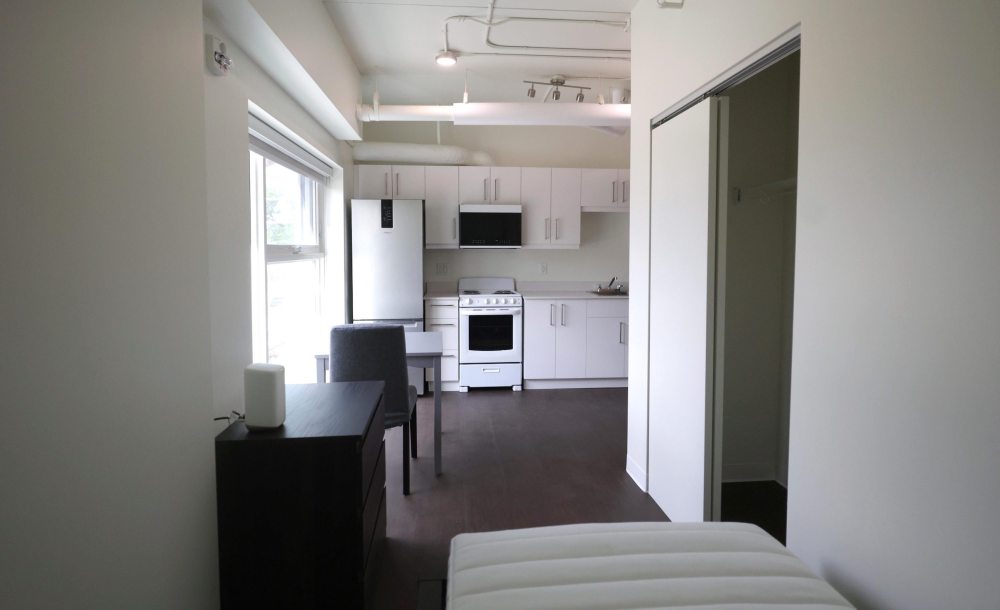
Ruth Bonneville / Free Press
One of the new transitional housing units that has recently been completed.
All three levels of government advanced money for the two residences. Roughly $3.4 million came from Ottawa; the province contributed about $4 million.
The West Broadway apartment, called Morning Light, is four storeys and had a construction budget of $9.5 million. The Manitoba Housing and Renewal Corp. contributed $2.25 million, the most from a single entity, though all levels of government participated.
Standing Eagle is five storeys, with a $10.2-million construction budget. Of that, $6.5 million was covered through Winnipeg’s portion of Ottawa’s Rapid Housing Initiative fund. Grants and government money largely pay the rest.
Manitoba Housing will spend $114,000 annually on rent supplements. It’s committed up to $2.25 million in capital funding and has conditionally approved annual operating supports, including rent supplements and support service funding, Smith said.

Both projects target Indigenous and newcomer women.
Approximately 61 per cent of Indigenous women face intimate partner violence, compared to 44 per cent of non-Indigenous women, Statistics Canada found in 2018.
Morning Light is all electric, and Standard Eagle was designed to be energy efficient. Suites range from studios to three-bedrooms.
Women housed in Morning Light and Standing Eagle won’t be counted in the provincial government’s Your Way Home strategy, which sets a goal of ending chronic homelessness by 2031, a spokesperson said.
gabrielle.piche@winnipegfreepress.com
Gabrielle Piché reports on business for the Free Press. She interned at the Free Press and worked for its sister outlet, Canstar Community News, before entering the business beat in 2021. Read more about Gabrielle.
Every piece of reporting Gabrielle produces is reviewed by an editing team before it is posted online or published in print — part of the Free Press‘s tradition, since 1872, of producing reliable independent journalism. Read more about Free Press’s history and mandate, and learn how our newsroom operates.
Our newsroom depends on a growing audience of readers to power our journalism. If you are not a paid reader, please consider becoming a subscriber.
Our newsroom depends on its audience of readers to power our journalism. Thank you for your support.
Gabrielle Piché reports on business for the Free Press. She interned at the Free Press and worked for its sister outlet, Canstar Community News, before entering the business beat in 2021. Read more about Gabrielle.
Every piece of reporting Gabrielle produces is reviewed by an editing team before it is posted online or published in print — part of the Free Press‘s tradition, since 1872, of producing reliable independent journalism. Read more about Free Press’s history and mandate, and learn how our newsroom operates.
Our newsroom depends on a growing audience of readers to power our journalism. If you are not a paid reader, please consider becoming a subscriber.
Our newsroom depends on its audience of readers to power our journalism. Thank you for your support.
Related Articles
Almost 250 people moved from city encampments under provincial strategy

Advertisement Advertise With Us
Advertisement Advertise With Us
History
Updated on Monday, June 15, 2026 9:30 PM CDT: Adds photos