

RCMP vacancy rate in Manitoba drops below 10 per cent after years of staff shortages
Rookies right out of Regina depot training bolster ranks across province

Advertisement
Read this article for free:
or
Already have an account? Log in here »
To continue reading, please subscribe:

Digital Subscription
One year of digital access for only $205*
- Enjoy unlimited reading on winnipegfreepress.com
- Read the E-Edition, our digital replica newspaper
- Access News Break, our award-winning app
- Play interactive puzzles
*First annual payment billed as $205.00 + GST for one year. This annual subscription will automatically renew at $233.00 + GST every 52 weeks (10% off the regular annual price of $259.35). Offer available to new and qualified returning subscribers only. Cancel any time.
To continue reading, please subscribe:
Add Free Press access to your Brandon Sun subscription for only an additional
$1 for the first 4 weeks*
- Enjoy unlimited reading on winnipegfreepress.com
- Read the E-Edition, our digital replica newspaper
- Access News Break, our award-winning app
- Play interactive puzzles
*Your next Brandon Sun subscription payment will increase by $1.00 and you will be charged $17.95 plus GST for four weeks. After four weeks, your payment will increase to $24.95 plus GST every four weeks.
Read unlimited articles for free today:
or
Already have an account? Log in here »
The RCMP has managed to tamp down a nagging vacancy rate across Manitoba that frustrated municipal leaders and rural residents who were tired of years of staffing shortages and the effect on safety.
The rate of vacant RCMP positions funded under contract with the provincial government, which pays for the majority of Mounties in Manitoba, has declined to 9.69 per cent in 2026, from just under 15 per cent in October 2025. It had reached a staggering 21.99 per cent in October 2023, which resulted in a shortage of Mounties in many detachments across the province.
Although the shortage was nationwide, the vacancy rate in Manitoba was at one point the worst outside of the territories.
“This is fantastic,” said Bobby Baker, the prairie region director for the National Police Federation, the union that represents RCMP officers. “The numbers are amazing.”
“The numbers are amazing.”
The Manitoba government said the addition of 110 officers to provincial ranks in the 2025-26 fiscal year alleviated the problem.
Around 100 of them arrived right out of training at the Regina depot, from late October until the end of March, said Baker.
“That’s not stopping,” said Baker, who has been an officer for nearly 30 years. He commended the force for making recruitment a priority amid advocacy from the union and others.
“Nearly every week a troop is graduating with five, sometimes up to nine, new members coming to Manitoba.”
The vacancy rate reduction is of great benefit to officers in the field, whose jobs become easier when their ranks are bolstered, said Baker.
“It also impacts their wellness, it impacts their safety, it impacts them in terms of burnout and work-life balance,” said the union leader. “They can show up to work fresh, they can show up to work safe.”
The NDP government has increased its annual funding to the RCMP under the provincial police service agreement, to more than $206 million in this year’s budget from just under $170 million in 2023, Justice Minister Matt Wiebe has said, adding beefing up the ranks of the RCMP will improve safety in Manitoba communities.
MIKE DEAL / FREE PRESS
Assistant Commissioner Scott McMurchy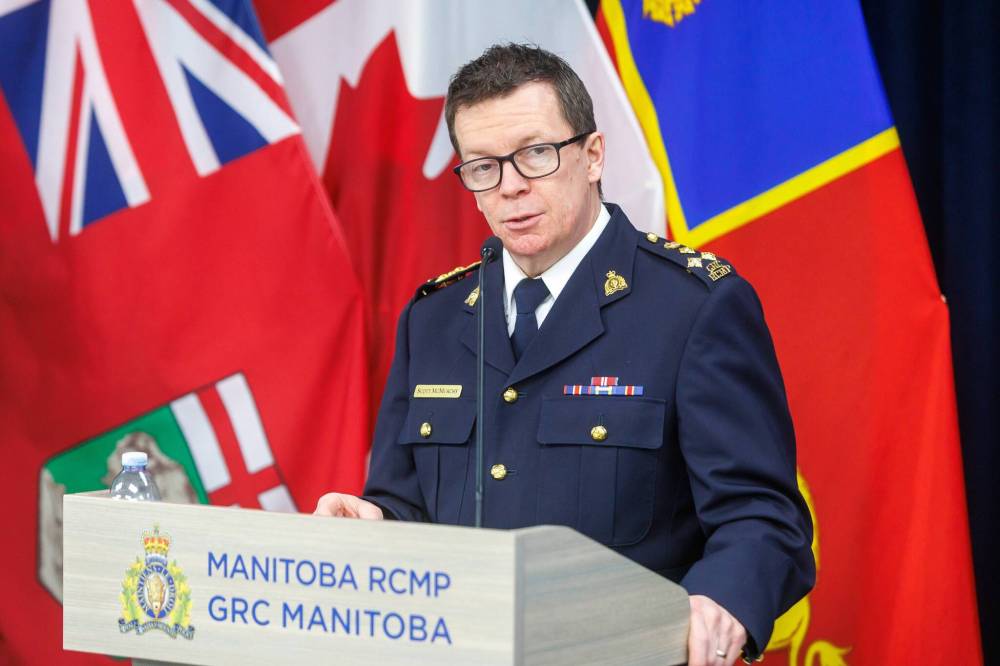
Assistant Commissioner Scott McMurchy, commanding officer of the Manitoba RCMP, said last week the provincial funding increase has been integral to the force’s recruitment campaign and improving public safety in communities policed by Mounties.
The federal auditor general, in an audit released in March, found RCMP staff shortages got worse after the force set targets that did not meet its needs, then failed to recruit as many officers as planned, after receiving many applications but not processing them efficiently.
The audit, which said the shortage got worse in the last two years, found the RCMP was short about 3,400 front-line officers as of the fall of 2025.
The audit also found the policy that allowed recruits to choose where they would be posted, introduced in 2023 and intended to beef up recruitment, resulted in uneven levels of staff across the country and worsened shortages in the territories, the Prairies and some of the Atlantic provinces. That policy has since been amended. Recruits can still select their preferred posting, but RCMP officials will send rookies to priority areas as needed.
Kathy Valentino, the president of the Association of Manitoba Municipalities, said the modification to the flexible posting policy has played a role in improving the vacancy rate.
“We’re seeing the vacancy rate drop, which is a good thing, but there’s still work to be done, to continue working on that number,” said Valentino, who is a city councillor in Thompson.
“The high vacancy rate is clearly keeping municipalities not as safe as they should be. We’re seeing rural crime at a very high rate, we see violent repeat offenders continually getting out and being on the streets.”
“There’s still work to be done, to continue working on that number.”
The recent passage of the federal Liberal government’s bail reform law should free up the officers in communities across the province, she said.
In January 2025, with the shortage of Mounties particularly dire, officers from other provinces were asked to temporarily fill gaps by working in Manitoba for two-week stints, mainly in the northern region. Officers were similarly asked to take temporary work in Saskatchewan.
Baker said when the shortages were most significant, officers “took so much on their back” to keep the public safe, leading to many suffering from burnout.
“Our members went above and beyond and ensured that public safety didn’t falter,” he said.
erik.pindera@freepress.mb.ca
Erik Pindera is a reporter for the Free Press, mostly focusing on crime and justice. The born-and-bred Winnipegger attended Red River College Polytechnic, wrote for the community newspaper in Kenora, Ont. and reported on television and radio in Winnipeg before joining the Free Press in 2020. Read more about Erik.
Every piece of reporting Erik produces is reviewed by an editing team before it is posted online or published in print — part of the Free Press‘s tradition, since 1872, of producing reliable independent journalism. Read more about Free Press’s history and mandate, and learn how our newsroom operates.
Our newsroom depends on a growing audience of readers to power our journalism. If you are not a paid reader, please consider becoming a subscriber.
Our newsroom depends on its audience of readers to power our journalism. Thank you for your support.
Erik Pindera is a reporter for the Free Press, mostly focusing on crime and justice. The born-and-bred Winnipegger attended Red River College Polytechnic, wrote for the community newspaper in Kenora, Ont. and reported on television and radio in Winnipeg before joining the Free Press in 2020. Read more about Erik.
Every piece of reporting Erik produces is reviewed by an editing team before it is posted online or published in print — part of the Free Press‘s tradition, since 1872, of producing reliable independent journalism. Read more about Free Press’s history and mandate, and learn how our newsroom operates.
Our newsroom depends on a growing audience of readers to power our journalism. If you are not a paid reader, please consider becoming a subscriber.
Our newsroom depends on its audience of readers to power our journalism. Thank you for your support.
Related Articles
Auditor general says RCMP's staff shortage got worse in recent years



Advertisement Advertise With Us
Advertisement Advertise With Us