Tunnel vision Few Winnipeggers knew a remote-controlled robot was digging a passage under the Red River; the $26.5-M project is a big deal for the city, excited engineers say
Read this article for free:
or
Already have an account? Log in here »
To continue reading, please subscribe:

Digital Subscription
One year of digital access for only $205*
- Enjoy unlimited reading on winnipegfreepress.com
- Read the E-Edition, our digital replica newspaper
- Access News Break, our award-winning app
- Play interactive puzzles
*First annual payment billed as $205.00 + GST for one year. This annual subscription will automatically renew at $233.00 + GST every 52 weeks (10% off the regular annual price of $259.35). Offer available to new and qualified returning subscribers only. Cancel any time.
To continue reading, please subscribe:
Add Free Press access to your Brandon Sun subscription for only an additional
$1 for the first 4 weeks*
- Enjoy unlimited reading on winnipegfreepress.com
- Read the E-Edition, our digital replica newspaper
- Access News Break, our award-winning app
- Play interactive puzzles
*Your next Brandon Sun subscription payment will increase by $1.00 and you will be charged $17.95 plus GST for four weeks. After four weeks, your payment will increase to $24.95 plus GST every four weeks.
Read unlimited articles for free today:
or
Already have an account? Log in here »
For almost two months, a robotic creature lurked below the bed of the Red River, its massive mechanical teeth gnawing through silt, clay and bedrock.
Taking its first bite on March 28 and its last on May 19, the creature — specifically a Herrenknecht micro-tunnel boring machine — dug a 2.4-metre-wide shaft connecting the east and west riverbanks alongside the Fort Garry bridges on Abinojii Mikanah.
Working 17 metres below street level and moving at a speed of roughly 1.25 metres an hour, the machine — which was operated remotely from above ground — left a 350-metre-long tunnel in its wake.
It’s a pace that would drive the most mild-mannered commuters on the bridge above mad. For engineers watching it unfold below, it was a thing of marvel.
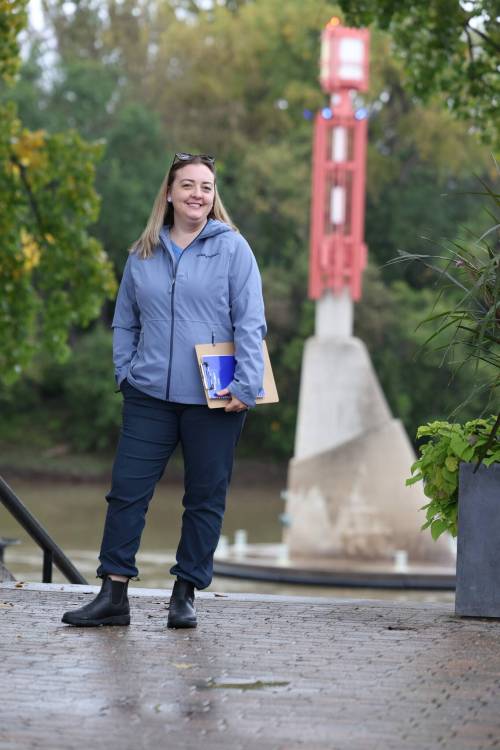
“In 20 or 30 years from now, hopefully, when I’m driving over that bridge, I can say to my grandchildren: ‘I was part of that,’ and to me, that’s very exciting,” said Susan Lambert, a field service operations engineer and the branch head of wastewater collection for the city.
MIKE DEAL / FREE PRESS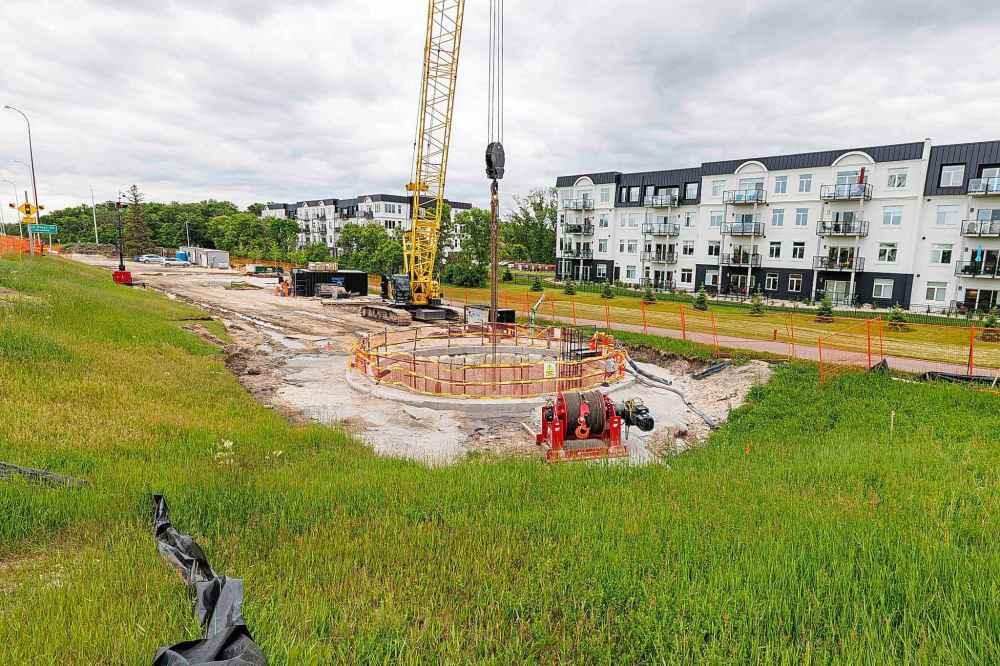
Other than cranes, a construction shack and a small crew, there were few signs that a $26.5-million city infrastructure project was underway. Unlike building a bridge, all the heavy lifting occurred underground, out of sight of neighbourhood residents and motorists.
Yet for engineers, wastewater infrastructure experts and an assortment of contractors, that tunnel, nearly four football fields in length, plots a course for a better environmental future in Winnipeg.
In February 2024, 228 million litres of raw sewage spilled into the Red River after the aging pipes failed at that location.
It was the largest sewage spill in recent city history and has triggered a $4-billion lawsuit, launched by several downstream First Nations against the city, province and federal government.
It’s anticipated the micro-tunnelling project will protect Manitoba waterways for decades to come.
Over the past 10 or so years, micro-tunnelling has become a more common way to install large sewer pipes over long distance, as it allows the work to be carried out without disrupting existing infrastructure.
It’s highly specialized and complex work that only a handful of contractors in North America can do.
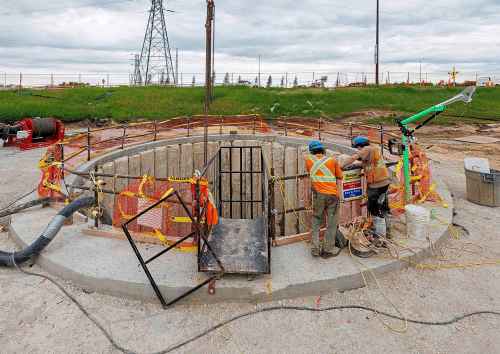
To begin, the machine is lowered underground via custom-made silos on each side of the river. In addition to grinding through soil and rock, which was reduced to a slurry and piped out, the machine also threaded a massive casing pipe through the borehole.
SUPPLIED Stacy Cournoyer, head of the city’s design and construction branch’s waste and water engineering division, said while the starting point for the tunneling effort was deep — 17 metres below the surface — the machine itself would be going deeper.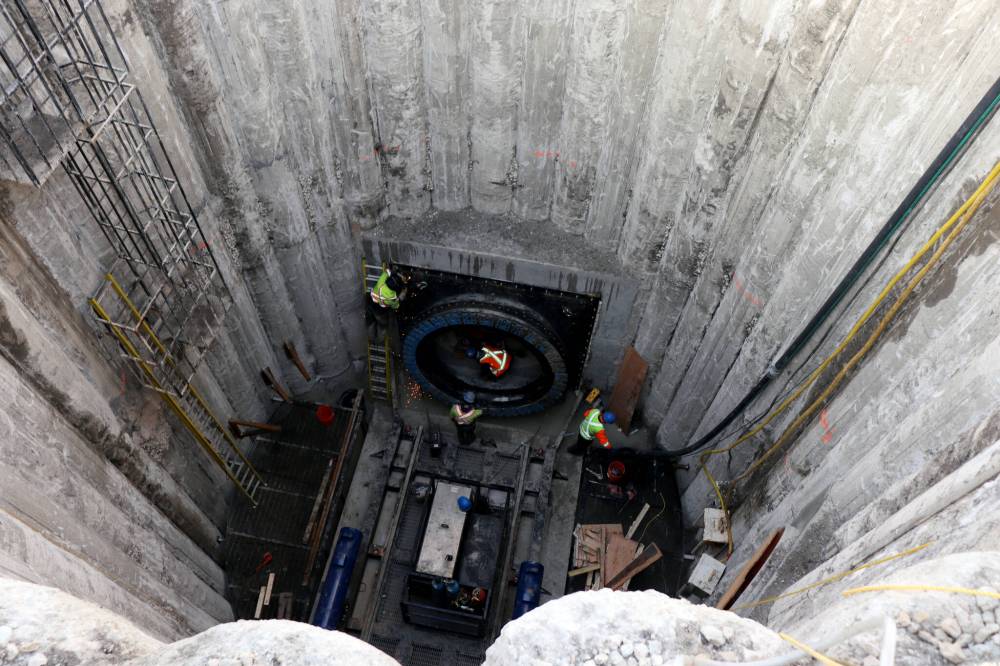
Two sewage lines will then be pulled into the casing pipe. Once connected, the temporary bypass system that currently runs atop the bridge will be removed and wastewater will flow under the Red again. That’s expected to begin later this summer.
Stacy Cournoyer, head of the city’s design and construction branch’s waste and water engineering division, said other options were considered but micro-tunnelling was the least disruptive.
“You’re working near an active bridge and highway, you’re near buildings — all while trying to maintain access to active transportation routes — so this ended up being the best solution,” he said. “It’s very precise.”
The tunnelling went smoothly, Cournoyer said, as crews had to go underground just once to work on the machine’s drill face — a rotating cutting head — but the pressure to carry out the work was immense.
“You’re starting at a deep elevation in those shafts, but then you’re going even deeper,” he said.
SUPPLIED Manufactured by Herrenknecht, this micro-tunnel boring machine just chewed through material ranging from silt to bedrock as it remotely dug a 350 metre tunnel under the Red River to replace a pair of sewer lines, including one that dumped millions of raw sewage into the waterway.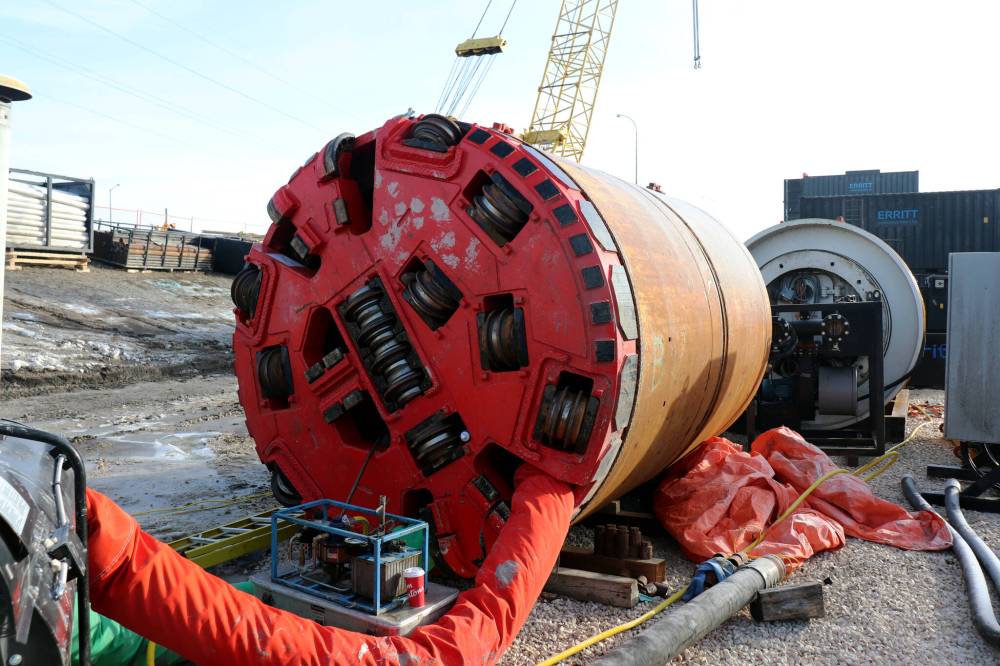
In addition to protecting the Red River and the province’s waterway network that eventually flows into Hudson Bay, Cournoyer said the work will also prevent basement flooding.
He said it’s been exciting being part of a project so focused on public service to the city and its residents.
“There’s challenges with every project,” he said. “Every single one is different, works out differently. Things that you think will go right, you get surprised, sometimes.”
CITY OF WINNIPEG A technical drawing of the tunnel connecting the east and west riverbanks alongside the Fort Garry bridges on Abinojii Mikanah. 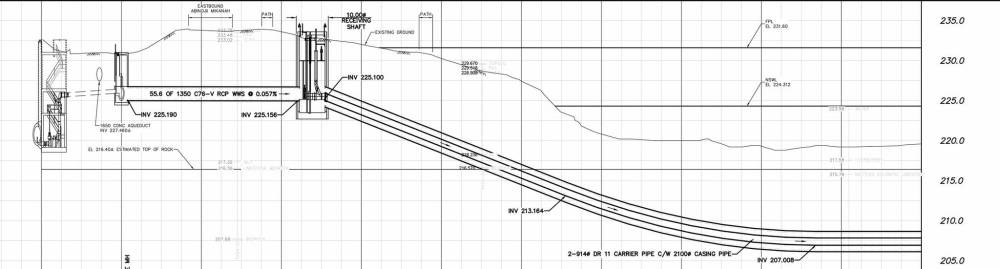
The completion of the underground tunnel was a milestone; the finished project — servicing Winnipeg to its western city limits and east to the Red River, south to the St. Norbert area and north to the rail line that runs along Wilkes Avenue — will be a turning point in Winnipeg’s infrastructure future, Lambert said.
“It’s a huge step forward,” she said.
When operational, the sewer lines will have capacity to handle more than 1,110 litres per second during stormy weather, with flows ranging between zero to 350 litres per second during normal conditions.
While flow rates are designed to be “operationally and hydraulically equivalent to the lines it replaced,” the new system offers a new level of stability and reliability.
Ongoing maintenance is expected to be minimal; the bedrock tunnel serves as a strong, natural barrier for the infrastructure it holds. Sewage leaks are expected to be a thing of the past.
“We’re not going to see pipe materials degrade, or we’re not going to see pipes break,” Lambert said.
“This is a very, very solid system. Very, very reliable.”
MIKE DEAL / FREE PRESS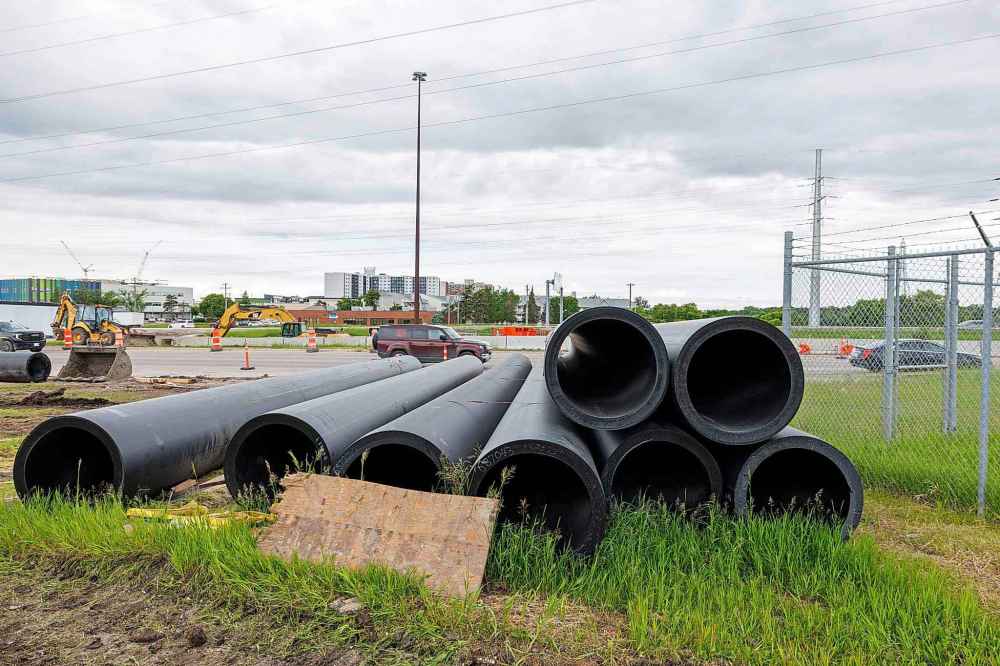
Unless there’s a major sewage spill or residential basement flooding, Winnipeggers may not give waste and water infrastructure systems much thought.
So, when the city — which monitors the underground system around the clock — gave its experts a chance to explain how things work, they jumped at the chance.
“We’re continuously trying to improve how it’s operating,” Lambert said.
“Technologies are always changing and getting better and better. To be part of this whole process, and to see it now, compared to 20 years ago, it’s quite remarkable.”
SUPPLIED A portion of the micro-tunnel boring machine stands tall beside workers on site in this photo from the City of Winnipeg. The tunnel machine spent approximately 45 days digging through material underneath the Red River.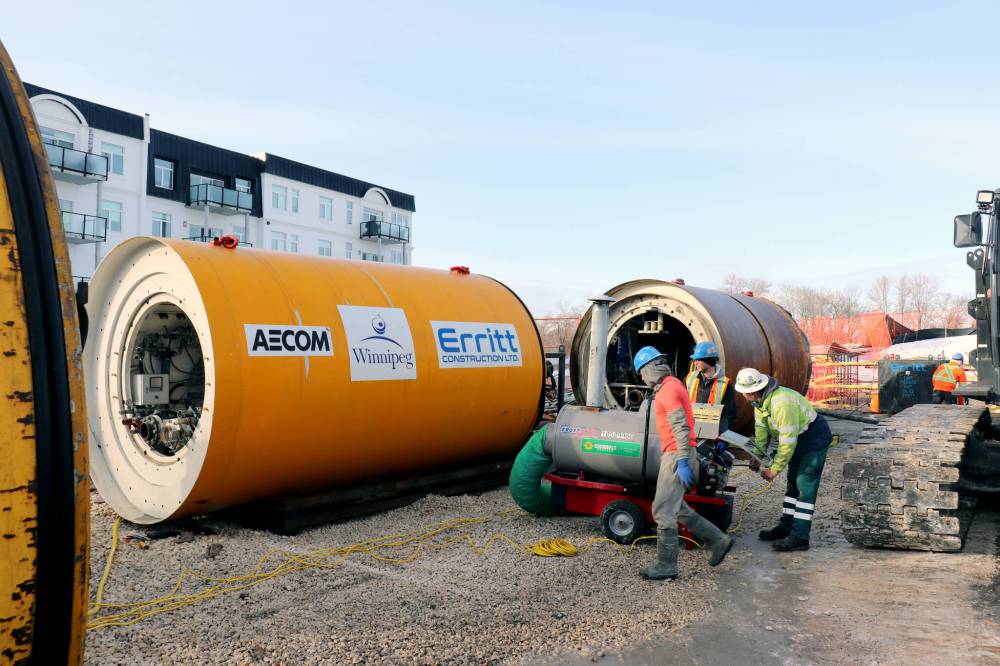
Despite the project’s large scope, the tunnelling went quickly, Lambert said. The main objective, in addition to safeguarding Winnipeggers and the environment, was to provide a high degree of infrastructure stability and reliability.
She hopes future civic leaders will appreciate the effort.
“I hope they would look at it and realize, to the best of our ability, we used the most advanced technology to put something in place that was as safe — and robust — as we could.”
Manitoba Historical Society head researcher Gordon Goldsborough said infrastructure construction, particularly involving wastewater, may not be “sexy” enough to attract the attention of historians, let alone the public, but the projects often serve as critical markers in a city’s growth.
“I’ve long argued that infrastructure is one of the very least-reported aspects of Manitoba history,” said Goldsborough. “Nobody ever tends to know much about infrastructure until it doesn’t work.”
He said this project is a marvel, much like the building of the Shoal Lake Aqueduct that began supplying Winnipeg’s drinking water in 1919, or the major upgrades made to the city’s wastewater system in the 1930s.
MIKE DEAL / FREE PRESS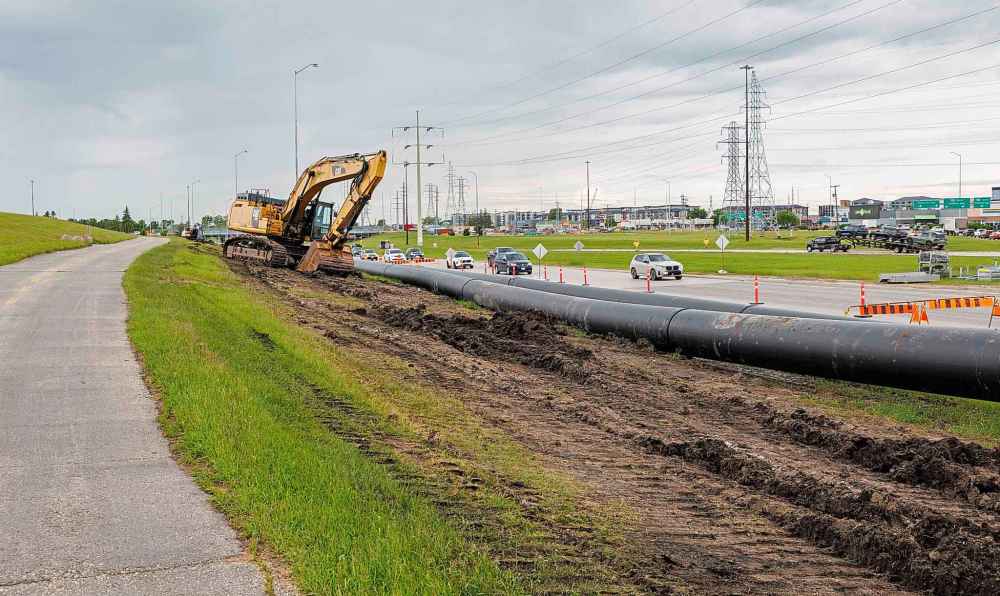
Today’s technology, however, would be unimaginable for labourers who toiled in “atrocious” working conditions more than a century ago, he said, adding that it wouldn’t hurt for residents to pay closer attention to such projects that are vital in making our lives — from turning on a tap to flushing a toilet — safer and more convenient.
“Infrastructure is fundamental to our daily lives, and we tend to forget that,” he said. “We don’t think about all the various pieces that have to work properly for us to have all the things that happen on a daily basis.”
No corks were popped when the micro-tunnelling was completed last month. Just a few high-fives celebrating the completion of the most difficult part of the project.
It’s not sexy, and it’s out of sight, but this project will soon take its place in municipal history.
MIKE DEAL / FREE PRESS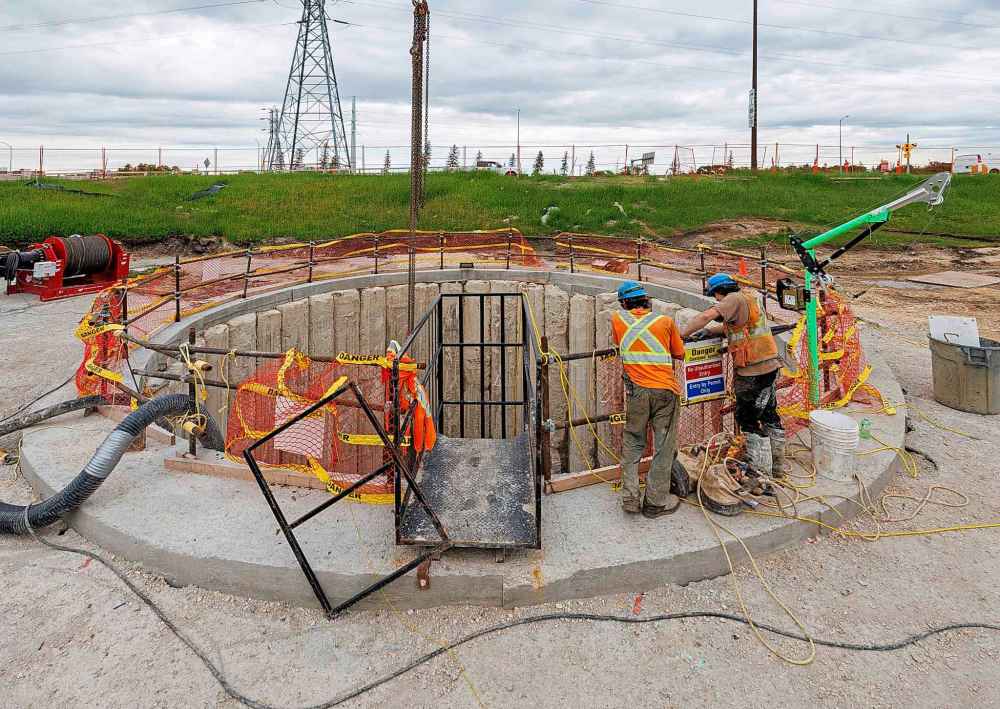
morgan.modjeski@freepress.mb.ca

Morgan Modjeski
Reporter
Signal
Morgan Modjeski is a news reporter and multimedia producer for the Free Press. Read more about Morgan.
Every piece of reporting Morgan produces is reviewed by an editing team before it is posted online or published in print — part of the Free Press‘s tradition, since 1872, of producing reliable independent journalism. Read more about Free Press’s history and mandate, and learn how our newsroom operates.
Our newsroom depends on a growing audience of readers to power our journalism. If you are not a paid reader, please consider becoming a subscriber.
Our newsroom depends on its audience of readers to power our journalism. Thank you for your support.