

City’s greenhouse emissions rise, councillor says net-zero still within reach

Advertisement
Read this article for free:
or
Already have an account? Log in here »
To continue reading, please subscribe:
Digital Subscription
One year of digital access for only $1.44 a week*
- Enjoy unlimited reading on winnipegfreepress.com
- Read the E-Edition, our digital replica newspaper
- Access News Break, our award-winning app
- Play interactive puzzles
*Billed as $5.77 plus GST every four weeks. After 52 weeks, price increases to the regular rate of $19.95 plus GST every four weeks. Offer available to new and qualified returning subscribers only. Cancel any time.
To continue reading, please subscribe:
Add Free Press access to your Brandon Sun subscription for only an additional
$1 for the first 4 weeks*
- Enjoy unlimited reading on winnipegfreepress.com
- Read the E-Edition, our digital replica newspaper
- Access News Break, our award-winning app
- Play interactive puzzles
*Your next Brandon Sun subscription payment will increase by $1.00 and you will be charged $17.95 plus GST for four weeks. After four weeks, your payment will increase to $24.95 plus GST every four weeks.
Read unlimited articles for free today:
or
Already have an account? Log in here »
City of Winnipeg operations created more greenhouse gases in 2025 than they did one year earlier, despite its target to hit net-zero emissions by 2050.
Last year, city operations caused 324,638 tonnes of greenhouse gas emissions — 1.6 per cent or 5,159 tonnes, more than what was emitted in 2024.
Vehicles, buildings and waste from landfills were the highest emitters, says an annual report on Winnipeg’s climate action plan that’s set to be presented to council’s water, waste and environment committee next week.
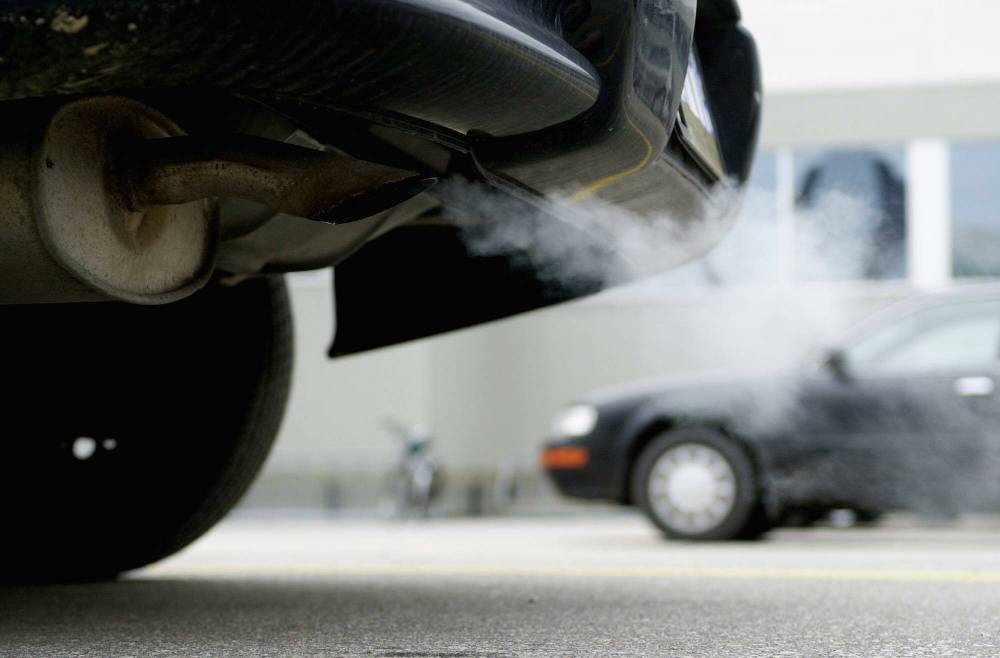
Tibor Kolley / The Canadian Press Files
Vehicle emissions along with buildings and waste from landfills were the highest emitters of greenhouse gases for City of Winnipeg operations in 2025.
“While the city continues to advance actions across governance, policy, transportation, waste, and resilience, corporate (greenhouse gas) levels will need to decline faster to meet the city’s targets,” writes Becky Raddatz, manager of the city’s office of sustainability, in the report.
Regardless, the goal of net-zero emissions by 2050 is still within reach, said water and waste committee chairman Coun. Ross Eadie.
He pointed to the approval in April of the city’s building emissions reduction strategy, which recommends millions be invested in retrofits to reduce emissions, and the long-awaited curbside composting program set for 2030.
“There’s a lot of things that are still coming along that will contribute to our ability to meet those goals by 2050,” Eadie (Mynarski) said.
“There’s nothing in that report that’s saying that at the rate we’re going, we won’t achieve it, we have some big things coming.”
The municipality should “set the tone” for green initiatives in Winnipeg, said James Wilt, policy development manager at Climate Action Manitoba.
“This is the product of choices that are being made by city hall, and, really, inaction when it comes to the things that we know we need to be doing to reduce emissions,” he said.

He noted that while 2050 is decades away, the climate action plan, launched in 2018, also committed to a 20 per cent reduction in city emissions relative to 2011 levels by 2030.
Proven solutions, including electrification of Winnipeg’s vehicle fleet, improving Winnipeg Transit conditions, and installing better insulation in buildings are available, but the city needs to prioritize their implementation through its budget, said Wilt.
“This is really the product of short-term thinking, and also a refusal to grapple with the urgency of the climate crisis,” he said.
Meanwhile, there was a small decrease in the amount of waste generated in 2025. The number of visits to 4R Winnipeg Depots decreased 1.5 per cent and residential waste generation decreased by 1.6 per cent.
malak.abas@freepress.mb.ca
Malak Abas is a city reporter at the Free Press. Born and raised in Winnipeg’s North End, she led the campus paper at the University of Manitoba before joining the Free Press in 2020. Read more about Malak.
Every piece of reporting Malak produces is reviewed by an editing team before it is posted online or published in print — part of the Free Press‘s tradition, since 1872, of producing reliable independent journalism. Read more about Free Press’s history and mandate, and learn how our newsroom operates.
Our newsroom depends on a growing audience of readers to power our journalism. If you are not a paid reader, please consider becoming a subscriber.
Our newsroom depends on its audience of readers to power our journalism. Thank you for your support.
Malak Abas is a city reporter at the Free Press. Born and raised in Winnipeg’s North End, she led the campus paper at the University of Manitoba before joining the Free Press in 2020. Read more about Malak.
Every piece of reporting Malak produces is reviewed by an editing team before it is posted online or published in print — part of the Free Press‘s tradition, since 1872, of producing reliable independent journalism. Read more about Free Press’s history and mandate, and learn how our newsroom operates.
Our newsroom depends on a growing audience of readers to power our journalism. If you are not a paid reader, please consider becoming a subscriber.
Our newsroom depends on its audience of readers to power our journalism. Thank you for your support.
Advertisement Advertise With Us
Advertisement Advertise With Us