

Mosquito surge expected after heavy rainfall
Advertisement
Read this article for free:
or
Already have an account? Log in here »
To continue reading, please subscribe:

Digital Subscription
One year of digital access for only $205*
- Enjoy unlimited reading on winnipegfreepress.com
- Read the E-Edition, our digital replica newspaper
- Access News Break, our award-winning app
- Play interactive puzzles
*First annual payment billed as $205.00 + GST for one year. This annual subscription will automatically renew at $233.00 + GST every 52 weeks (10% off the regular annual price of $259.35). Offer available to new and qualified returning subscribers only. Cancel any time.
To continue reading, please subscribe:
Add Free Press access to your Brandon Sun subscription for only an additional
$1 for the first 4 weeks*
- Enjoy unlimited reading on winnipegfreepress.com
- Read the E-Edition, our digital replica newspaper
- Access News Break, our award-winning app
- Play interactive puzzles
*Your next Brandon Sun subscription payment will increase by $1.00 and you will be charged $17.95 plus GST for four weeks. After four weeks, your payment will increase to $24.95 plus GST every four weeks.
Read unlimited articles for free today:
or
Already have an account? Log in here »
Winnipeggers may want to keep the bug spray close at hand.
Intense rainfall in recent weeks has created ideal conditions for mosquitoes to breed across Winnipeg, including in backyards where standing water can quickly become a source of larvae.
“With all the rain we’ve received, I fully expect to see an increase,” entomologist Taz Stuart said.
Just over two weeks ago, Winnipeg was pummelled with more than 122 millimetres of rain.
The city has a network of 24 traps in Winnipeg and nine outside city limits to track adult mosquito populations and guide control efforts. That data feeds into an “adulticiding factor analysis,” which determines whether conditions meet strict thresholds for a fogging program. Fogging is considered when the AFA is high.
“We’re sitting at a medium AFA right now,” said David Wade, the City of Winnipeg’s superintendent of insect control.. “I think we’ll be moving into a high AFA, but we have to wait and see what the trap counts show.”
Wade said larvae from that event have since developed into adult mosquitoes.
“Every year, especially after a major rainfall event, we go around the city and eight kilometres outside city limits and check sites that we know hold standing water and produce mosquito larvae,” he said “If they have larvae, we treat them with larvicides to prevent them from becoming adult mosquitoes.”
Once thresholds are met, the city can deploy adult mosquito control measures using products such as DeltaGard 20EW, which contains deltamethrin and targets the insects’ nervous systems.
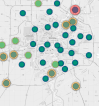
The Free Press has an interactive mosquito monitor map at wfp.to/mosquitomap that shows trap locations and day-to-day counts.
Cankerworms at low phase
While mosquitoes could become more noticeable in the coming weeks, Winnipeg’s other notorious summer pest is following a different trend.
Cankerworms, little green inchworms that dangle from tree branches and coat sidewalks, remain at relatively low levels across the city.
The pests are in the low phase of their natural population cycle, said Wade.
Targeted control efforts by the city in recent years have helped suppress the population, while the late spring likely affected the ability of the insects to survive the winter.
“We have seen less cankerworms and true pest caterpillars in general, and it’s just more so a natural cycle in their populations,” Wade said.
Stuart said cankerworm populations typically rise and fall during a four- to seven-year cycle, with outbreaks occurring when the insects reproduce in large numbers before naturally declining in the following years.
Stuart, the city’s former entomologist who owns Taz Pest Control, said that even after peak years, cankerworms persist in the environment through eggs laid by adult moths, which overwinter and hatch the following season. From there, year-to-year population levels depend largely on how many larvae survive to maturity.
Rebecca Tiessen remembers a bad summer six years ago.
“I was on Corydon (Avenue), and there were crazy amounts of worms all over the place,” she said. “They were plastering the walls; they were at eye level on every single residential street.”
“I’ve always now since been scared of them and just wanted to see if there’s any sort of patterns across the city (in) neighbourhoods.”
Years later, that memory became the basis for Winnipeg Worm Watch, an anonymous community tool created by Tiessen that tracks cankerworm density across the city. The app and website launched this spring.
While lower cankerworm numbers this season have meant it hasn’t seen heavy use, Tiessen hopes it will grow into a tool people look forward to using each year.
Users can open Winnipeg Worm Watch on their phone or computer and submit a report by selecting a pin on a map. A pop-up then asks them to rate cankerworm activity on a scale from one to five — from just a few sightings to heavy infestations. Users can also note whether there are small green cankerworms or larger brown forest tent caterpillars. Their submitted report is added to the map along with the time it was posted so others can track the worm activity.
“It’s a very neutral way for us to be aware of the ecosystem around us and make choices depending on the data,” Tiessen said.
zoe.pierce@freepress.mb.ca
Related Articles
Larviciding takes a bite out of emerging mosquito population
Advertisement Advertise With Us
Advertisement Advertise With Us