

Inquest judge recommends Winnipeg police improve training, dog handling, policies
Man with metal bar shot dead by officer six years ago

Advertisement
Read this article for free:
or
Already have an account? Log in here »
To continue reading, please subscribe:

Digital Subscription
One year of digital access for only $205*
- Enjoy unlimited reading on winnipegfreepress.com
- Read the E-Edition, our digital replica newspaper
- Access News Break, our award-winning app
- Play interactive puzzles
*First annual payment billed as $205.00 + GST for one year. This annual subscription will automatically renew at $233.00 + GST every 52 weeks (10% off the regular annual price of $259.35). Offer available to new and qualified returning subscribers only. Cancel any time.
To continue reading, please subscribe:
Add Free Press access to your Brandon Sun subscription for only an additional
$1 for the first 4 weeks*
- Enjoy unlimited reading on winnipegfreepress.com
- Read the E-Edition, our digital replica newspaper
- Access News Break, our award-winning app
- Play interactive puzzles
*Your next Brandon Sun subscription payment will increase by $1.00 and you will be charged $17.95 plus GST for four weeks. After four weeks, your payment will increase to $24.95 plus GST every four weeks.
Read unlimited articles for free today:
or
Already have an account? Log in here »
A Manitoba inquest judge has made 14 recommendations stemming from the fatal shooting by police of a 22-year-old man in the Maples six years ago.
Provincial court Judge Anne Krahn concluded the officer was justified when he fired at Winnipeg resident Stewart Andrews, a member of God’s Lake First Nation, on April 18, 2020.
The Winnipeg Police Service constable shot Andrews as he swung a metal bar at the officer’s head. The constable, his partner and a police dog were trying to detain Andrews in the lane behind Pipeline Road, after an armed robbery.
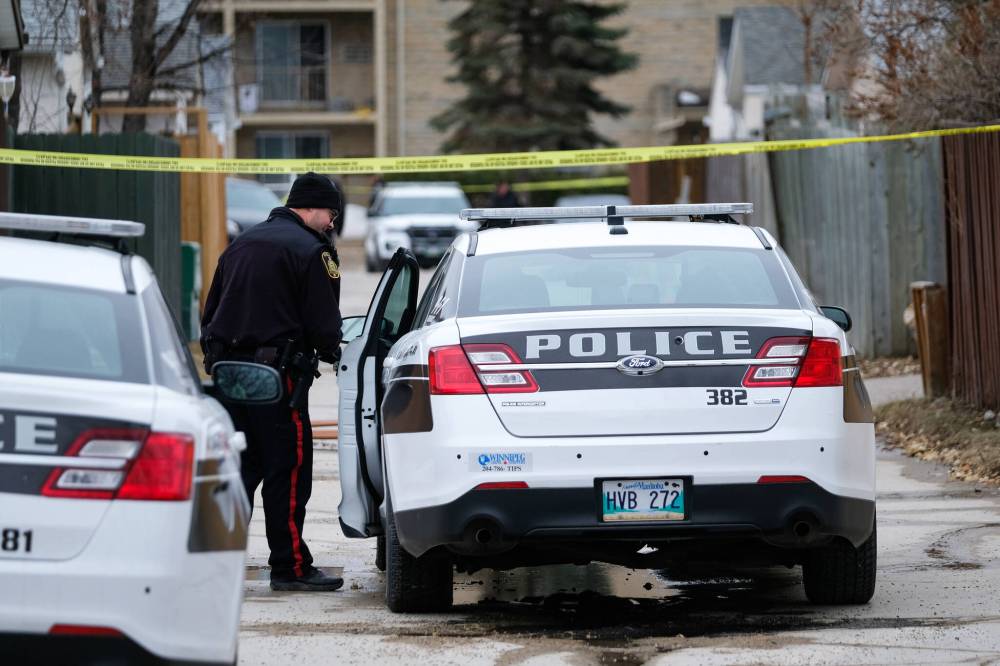
DANIEL CRUMP/ FREE PRESS FILES
Winnipeg Police at the scene of Stewart Andrews shooting on April 18, 2020.
The 14 recommendations largely focus on improving Winnipeg police training, policies and education, and making the inquest process easier for the families of those whose deaths are under review.
“The loss of Mr. Andrews in this scenario is undeniably tragic and traumatic for his family and community,” wrote Krahn.
“My hope is that some of the recommendations in this report are improvements and small steps to re-build the loss of trust that results from the circumstances in this death.”
The incident began when a resident, who was taking out the garbage on Adsum Drive around 4 a.m., was confronted by two males who demanding cash, said Krahn.
One of the men had what appeared to be a firearm and the other had a shovel. The resident got away and called police, but not before he was hit with the shovel. A short time later, a woman in a nearby apartment called 911 after her windows were smashed.
Officers found Andrews and a teenage boy walking in the lane and believed they were the suspects.
One of the officers had a leashed police dog and a flashlight, while the other had his gun out. The officer with the dog shouted for the suspects to stop, but the teenager ran off.
Andrews stayed and raised the three-foot metal pole as if it were a baseball bat as police approached and told him to drop the bar, Krahn said.
The dog handler tried to send the dog to apprehend Andrews, but pulled the dog back after Andrews swung the bar at the dog’s head, said Krahn.
He told the inquest he pulled the dog back to stop it from biting Andrews, so they could take him into custody with the least amount of force.
Andrews then turned his attention to the other officer, with the bar “raised over his head in a baseball style swing,” Krahn found.
The officer shot Andrews five times.
Krahn found the forensic and autopsy evidence was consistent with the officers’ accounts of what happened.
Lawyers for the Andrews family argued the police shot him to protect the dog, but Krahn concluded that scenario was inconsistent with the evidence.
The judge recommended the police service improve training and policies in relation to police dogs, update its use-of-force policy in several areas, evaluate its use of de-escalation, and work with Manitoba Keewatinowi Okimakanak to examine its use-of-force training with an Indigenous lens. MKO, which represents many northern Manitoba First Nations including God’s Lake, participated in the inquest.
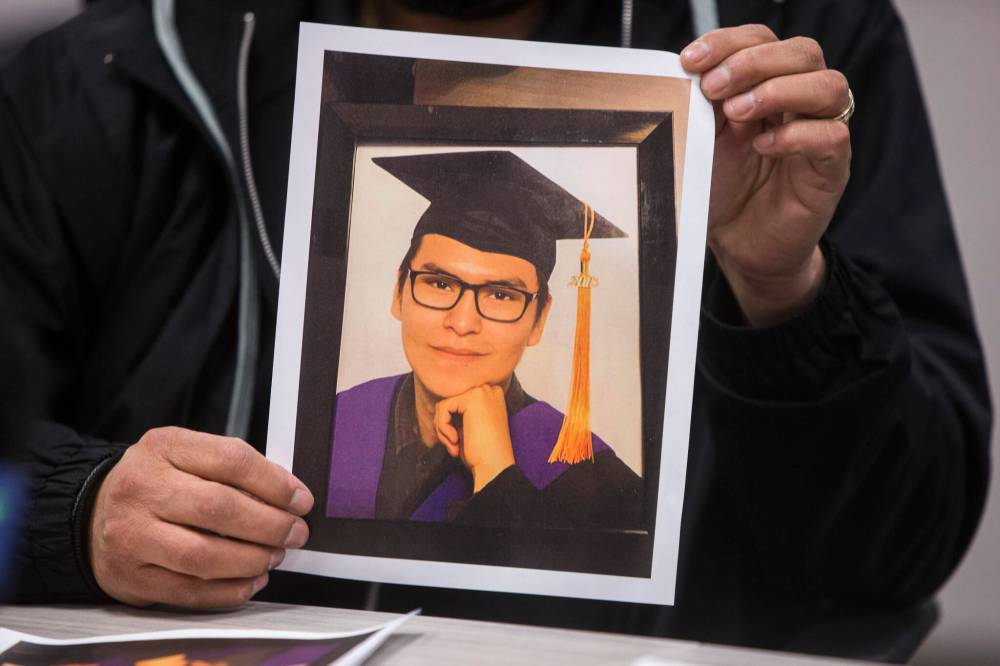
MIKAELA MACKENZIE / FREE PRESS FILES
God’s Lake chief Hubert Watt holds a photo of Stewart Andrews during a press conference reacting to the IIU report in Winnipeg.
She recommended Winnipeg police continue to implement body-worn cameras for officers and work with Indigenous leaders, potentially MKO, to offer an education program for young Indigenous people who may interact with police.
Andrews was one of three Indigenous people shot by Winnipeg police officers in a 10-day period, a context that “feeds a well-documented lack of trust between Indigenous peoples and police,” noted Krahn.
She recommended families be given support and resources during the inquest process, including potential funding from the province for immediate family members who must travel to attend the proceedings, and that the chief provincial judge contact the family of the deceased and share inquest reports with them before the document is made public.
Krahn also said the Manitoba government should work with the chief provincial judge to reduce the significant delay in holding inquests, and that the courts ought to make information about the status of inquests more publicly accessible online.
Martin Pollock, a lawyer for the Andrews family at the inquest and in the ongoing lawsuit over the shooting, said the family does not agree with the judge’s findings and is disappointed.
Speaking with the Free Press, Pollock argued, as he did at the inquest, that a fearful Andrews was defending himself from the dog at the time he was shot, rather than moving to attack the officer.

“There was nothing given to the perspective of the young man during that period of time, of being confronted by that dog,” said Pollock of the judge’s findings.
“(The family doesn’t) believe that he would have turned and weaponized against a police officer.”
He said many questions remain unanswered after the inquest. But, Pollock said, he thinks Krahn made diligently considered and “very positive” recommendations.
Inquests, which are mandated when a death involves police, are meant to offer recommendations that could prevent similar deaths.
erik.pindera@freepress.mb.ca
Erik Pindera is a reporter for the Free Press, mostly focusing on crime and justice. The born-and-bred Winnipegger attended Red River College Polytechnic, wrote for the community newspaper in Kenora, Ont. and reported on television and radio in Winnipeg before joining the Free Press in 2020. Read more about Erik.
Every piece of reporting Erik produces is reviewed by an editing team before it is posted online or published in print — part of the Free Press‘s tradition, since 1872, of producing reliable independent journalism. Read more about Free Press’s history and mandate, and learn how our newsroom operates.
Our newsroom depends on a growing audience of readers to power our journalism. If you are not a paid reader, please consider becoming a subscriber.
Our newsroom depends on its audience of readers to power our journalism. Thank you for your support.
Judge’s recommendations
Provincial court Judge Anne Krahn made the below 14 recommendations after overseeing an inquest into the death of Stewart Andrews, 22, who was shot by a Winnipeg Police Service officer while armed with a metal bar.
The judge’s recommendations have been edited for style.
– I recommend the Winnipeg Police Service should develop written documentation of course training standards and supportive plans for training of police service dogs, canine handlers, and the canine team. The course training standards would identify the content that must be taught, and supportive plans would detail training plans for the delivery of course content.
– I recommend the WPS should develop written training documents for teaching the concept of the police service dog as a use-of-force tool, to be delivered to canine officers and as part of these officers’ use of force training.
– I recommend the WPS should evaluate whether sufficient time is dedicated to tactical communication, including de-escalation and whether it is feasible to increase the time dedicated to this subject.
– I recommend the WPS use-of-force policy should include an explicit statement that human life including the life of the subject takes priority over the life of the police service dog.
– I recommend the WPS yse-of-force policy should include an explicit statement that the priorities of life in a potential use of force situation are, in order, the public, the peace officer, the subject.
– I recommend the WPS, in collaboration with Manitoba Keewatinowi Okimakanak, explore if and how use of force training could incorporate a.) the unique experience of Indigenous individuals and how those experiences might inform risk assessments and tactical considerations when police are interacting with Indigenous individuals in a potential use of force situation and b.) how unconscious or implicit bias related to race may influence officer risk assessments. This should include an assessment of the feasibility of countering unconscious bias or implicit biases through reality-based training.
– I recommend the WPS use-of-force policy and model should be reviewed and revised to include expanded explanations of tactical considerations with respect to de-escalation and tactical repositioning.
– I recommend the Manitoba government, in consultation with the chief provincial court judge, develop a plan, which may well require the allocation of additional resources, to reduce the significant delay in Inquests.
– I recommend the chief provincial court judge contact the family of the deceased or counsel for the family, if counsel is in place, and if desired by the family, arrange a meeting to share the inquest report, in advance of its release to the public, on the understanding this is a confidential process, with adequate cultural and emotional supports in place.
– I recommend Manitoba courts should update the “Inquests” webpage of the Manitoba provincial courts to display information regarding the status of an inquest, along with press releases and general information on inquest proceedings to allow for the public to access information on these important proceedings.
– I recommend inquest counsel should be involved in ensuring the family of the deceased has access to victim services and other resources to ensure they are as supported as possible during challenging times, even if they are not represented by counsel. This should include: a.) ensuring family members are aware of the details of the hearing; b.) securing a quiet space/family room for the family to gather in; and c.) coordinating a space to smudge that is easily accessible before all hearing days, allowing for a seamless and positive experience for all involved.
– I recommend the WPS continue to advocate for the implementation of body worn cameras for its officers in the field.
– I recommend the WPS with Indigenous collaboration (perhaps MKO) formulate a program in Winnipeg offering education and insight of urban policing including on the matter of young Indigenous residents potentially intersecting with police, understanding the array of variables governing discharge of duties and how to respond. A cross-cultural expert, as well as other individuals of professional, academic and field expertise, and elders or community members, should be utilized in delivering this program of education with police representatives.
Erik Pindera is a reporter for the Free Press, mostly focusing on crime and justice. The born-and-bred Winnipegger attended Red River College Polytechnic, wrote for the community newspaper in Kenora, Ont. and reported on television and radio in Winnipeg before joining the Free Press in 2020. Read more about Erik.
Every piece of reporting Erik produces is reviewed by an editing team before it is posted online or published in print — part of the Free Press‘s tradition, since 1872, of producing reliable independent journalism. Read more about Free Press’s history and mandate, and learn how our newsroom operates.
Our newsroom depends on a growing audience of readers to power our journalism. If you are not a paid reader, please consider becoming a subscriber.
Our newsroom depends on its audience of readers to power our journalism. Thank you for your support.
Advertisement Advertise With Us
Advertisement Advertise With Us